The idol makers…

Three years ago, while working in Tamil Nadu, I came across a story that I determined to return to and photograph.

_____________

“What we do here is the work of God and that work is spread through our blood” says Radhakrishna Stapathy.

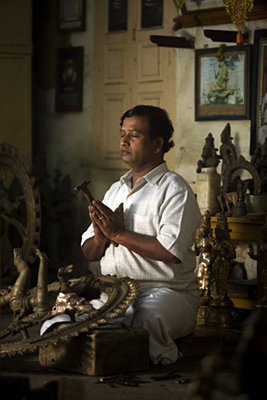
It is just after dawn and Stapathy squats cross-legged on a wooden block, a small hammer between his palms drawn to his forehead in prayer. In front of him, a large statue, freshly cast to which he will bring life by smoothing its metal through long hours of patient work.

Stapathy is an idol maker, a caster of statues, a master craftsman and one whose lineage can be traced backwards twenty three generations to the time that the great Chola Empire that ruled South India more than seven hundred years ago.

Swamimalai is a sleepy temple town deep in Tamil Nadu. Five hours drive from the bustling noisy city of Chennai (formerly Madras); it has a rhythm of a time that has been. Peasants winnow grain under the wheels of passing trucks and bend low in fields ankle deep in rich soil and bullock pull carts along dirt tracks.

This is the heartland of Tamil Dravidian culture and the landscape is linked organically to its religion with every field, every village, paying homage to a deity. A sacred geography links its towns where great palaces of temples provide, in the eyes of the faithful, a real home for the Gods.

The Stapathy studio, fronted by two (relatively) modern offices, is a dark and cavernous space that ironically resembles a temple itself. Men sit of the floors dressed in stained dhotis, deep in concentration, chipping and finishing statues and icons in the warm air filled with incense and the smell of the damp, cool earth under bare feet.

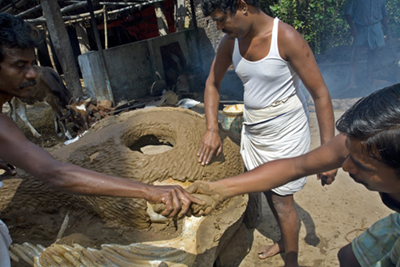
In the courtyard outside, three men mould clay around perfectly carved wax images that will melt on the introduction of molten metal. This ‘lost wax’ process was described by August Rodin as “the most perfect representation of rhythmic movement in art.”

The art of bronze casting can trace its origins from the Indus Valley civilization reaching its zenith during the Chola period in the Thanjavur delta during the 9th-11th centuries A.D.

At the end of the reign of Rajaraja, the greatest Chola king a magnificent temple was built in his capital, Tanjore. On its completion in 1010, the Cholas had donated 500 tons of gold, jewels and silver as well as sixty bronze images of deities to the new structure.

The temples at Tanjore, Chidambaram and Gangaikondacholisvaram are still dark, mysterious places alive with pilgrims prostrating themselves in cavernous halls before oiled black-stone images of gods and demons eerily lit by camphor lamps. They worship before the most famous incarnation of Shiva – Nataraja who elegantly dances the world into destruction and re-birth.

The Stapathy family were originally stonemasons but were called to Tanjore to learn the new art. It was discovered that that the fine silt from the nearby Kauvery River suited the moulding of the bronzes and the process has not changed since.

“Here is our culture,” says Stapathy and rows of half finished pieces peer from the shadows. All around, wax figures sit cool in great bowls of water: arms, legs, and heads like a battle hospital for Gods. Moulds of countless beings are stacked on dusty shelves around the walls. Later, at his house, across the street, Radakhrishna, now joined by his brother Srikanda, perform a puja at their family shrine honouring their ancestors. “It’s like this,” says Srikanda. “We need no training, a fish doesn’t need lessons of how to live in water: we are born for this work. And the work is good… orders are there and money is there”. Indeed, work is brisk and the brothers’ skills are in demand all across the Indian diaspora. Temples in London, California and Canada want idols crafted in the tradition of their fathers and pay handsomely for the privilege. There are other families that make idols “but” says Radhakhrishna, “none know the Sanskrit, none can make the prayers… we only are keeping the Chola king’s tradition.”

As the afternoon draws on, sweating men carefully pour molten metal into a mould held tight in the earth. Later, in a flurry of steam and almost divine heat, a statue will emerge beneath their hammers onto the workshop floor and, if the prayers have been performed properly, the process will produce an idol. Depending on its size it may take weeks to prepare for its ‘birth’ when its eyes are sculpted and its ‘Jeevan’ or life force will be breathed into it, it will, for a set time (depending on where it ‘lives’ and how faithfully it’s worshipped) become in a real sense, a God.

Dawn again, with the streets quiet, Radhakrishna pulls his skirt around him and steadies himself on his wooden seat. Still for a moment, he takes his chisel and checks his cutting line. He makes an incantation and the room is gently filled with the tap-tapping of a hammer. A noise that echoes across the room, across his family and across generations.

©Stuart Freedman 2010

In his recent book, the historian William Dalrymple devotes a chapter to the idol makers.

India - Tamil Nadu - Master craftsmen Radhakhrishna Stpathy (r) and his brorther, Srikanda mould an icon in wax in their workshop in Swamimalai, India..The current Stpathy family is the twenty third generation of bronze casters dating back to the founding of the Chola Empire. The Stapathys had been sculptors of stone idols at the time of Rajaraja 1 (AD985-1014) but were called to Tanjore to learn bronze casting. Their methods using the 'lost wax' process remains unchanged to this day..
India - Tamil Nadu - Workers sealing and covering a wax mould of an icon with clay ready to be fired in the pit at the workshop in Swamimalai, India.The current Stpathy family is the twenty third generation of bronze casters dating back to the founding of the Chola Empire. The Stapathys had been sculptors of stone idols at the time of Rajaraja 1 (AD985-1014) but were called to Tanjore to learn bronze casting. Their methods using the 'lost wax' process remains unchanged to this day..
India - Tamil Nadu - Workers sealing and covering a wax mould of an icon with clay ready to be fired in the pit at the workshop in Swamimalai, India.
India - Tamil Nadu - Master craftsman Pranava Stapathy instructs another craftsman whilst working on a large statue of Hanuman, the monkey God at the workshop of S. Devasenapathy Stapathy and Sons.
India - Tamil Nadu - A craftsman pours wax into a mould from which a statue will be cast from bronze.
India - Tamil Nadu - A worker carves a wax mould of an icon in the studio of the Stpathy family of idol makers, Swamimalai, India.
India - Tamil Nadu - Workers cast an icon in the pit at the workshop of the Stpathy family, Swamimalai
India - Tamil Nadu - Radakrishna Stpathy directs the breaking open of a icon mould at his workshop in Swamimalai
India - Tamil Nadu - A finished icon of the God Shiva shown here in the form of the dancing Nataraja.
India - Tamil Nadu - A priest by a shrine at the Murugan temple stands in front of a shrine containing a ritual idol
India - Tamil Nadu - Devotees light oil lamps in the Murugan temple
India - Tamil Nadu - Master craftsman Radhakhrishna Stpathy, works on the final touches to a statue of the dancing Nataraja at dawn in his workshop

Waiting for the volcano…

I’m sitting at home waiting anxiously to see whether an assignment in Israel will actually happen on Thursday as planned or whether the Icelandic volcano, Eyjafjallajökull, will have the last laugh.
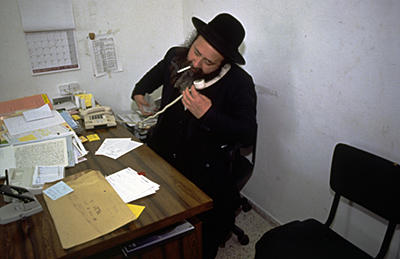
Looking through my archive, I found that the last time I was there, I had an assignment to photograph a Rabbi detective. Very interesting chap – a sort of Yiddish Philip Marlowe. Anyway, here’s a few pictures from that trip when airline travel was easier…

Israel - Jerusalem - Yehuda Gordon, a Jerusalem based Rabbi that is charged by the Rabbinical courts to trace errant husbands that refuse to divorce their wives and so deny them access to the their rights under Jewish law.
Israel - Jerusalem - Israeli soldiers pray at the 'Wailing' or Western Wall in Jerusalem
Israel - Jerusalem - an Orthodox Jewish boy

Fight Clause 43

In February I wrote about the threat to visual journalism in the UK.  Here’s a concise and detailed breakdown from the excellent stop43.org.uk that explains the situation perfectly (and I quote verbatim):


CLAUSE 43:
• destroys the concept that a property owner has control over his property
• In so doing it destroys any guarantee of exclusive use, and
• It breaks the contractual ties between models, their agencies, property rights holders, photographers and clients, because
• images will be used in ways that rights holders would have forbidden, had they known beforehand
• It says that images can be declared orphan after a “diligent search” for the owner without recognising the practical impossibility of such a search
• It proposes that images should be licensed at “the market rate” while ignoring the impossibility of determining such a rate for any specific image
• It breaches UK commitments under international copyright and trade laws
• It entirely fails to recognise that the owners of “orphan” works may not be UK-based, but based in places such as the USA which have a strongly litigious culture, and therefore
• It exposes licensees of works declared as orphans in the UK to litigation from their foreign owners
• It contains no mechanism to irrevocably establish copyright in a work via mandatory attribution; or to prevent deliberate orphaning, and no effective sanctions against those who so do
• It could have a strong chilling effect on the UK ad industry as multinationals shun UK agencies, photographers and shoots because we will no longer be able to guarantee exclusivity (our work can be orphaned and used by others beyond our control) and those multinationals seek to avoid their campaign assets becoming orphaned.

http://www.stop43.org.uk/

Here’s what to do

Intolerance

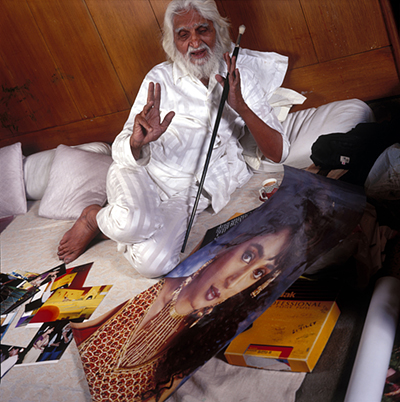
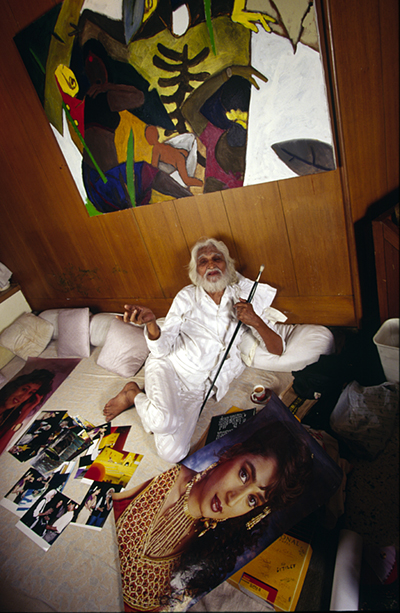
It appears that the great Indian artist, MF Husain has accepted citizenship from Qatar after having to live in exile in London and Dubai since 2006. It may well close one of the saddest episodes in secular India: Husain, now 95, has been the target of Hindu fundamentalists after his depiction of naked Hindu goddesses. The Indian government has been unable to protect either his property or his personal safety and so one of India’s most famous sons is now unlikely ever to return to his home. I photographed him in Mumbai (then Bombay) about a dozen years ago for the Independent on Sunday Magazine. He was as charming as he was extraordinarily talented.

India - Mumbai - MF Husain
India - Mumbai - MF Husain with an image of his muse, Maduri Dixit


India - Mumbai - MF Husain with an image of his muse, Maduri Dixit

Photoshopping Herodotus

Last week I read that a new biography of Ryszard Kapuscinski, the great Polish Foreign correspondent, had accused him of inventing a good deal of his work. The biographer, Artur Domoslavski, observes that Kapuscinski “consciously built on his status as a legend” and “extended the boundaries of reportage far into the realm of literature”. I read this in Delhi online and, somehow the process of reading these allegations on a computer screen made me smile with irony. It made me think just how far we think we’ve come in journalism and reporting but perhaps just how little we’ve progressed. Let me explain.

I have few heroes in photography, but I held people like Kapuscinski, like Chatwin and Lewis et al as great writers that I could read as much for pleasure as literal accuracy. I don’t read Polish and so the details of Domoslavski’s allegations are a little hard to substantiate but they are not new. There has been a great deal written about Kapuscinski in the last decade: how he was a spy, how he was a womaniser. Much of it to me smacks of a jealousy and a pettiness and the disturbing tendency in modern life to have an icon to smash. We live in a celebrity culture controlled by big business and advertisers that have a financial stake in selling things – people – as commodities. That requires constant banality and revision. This week, ‘failed celebrity actress recovers from drugs’. Next week, ‘failed celebrity actress caught having an affair’. Orwell called it Prolefeed. What all the commentators have failed to mention is that Kapuscinski, when not filing tight wire reports for the Polish news service, was working within the tradition of his own hero, Herodotus, whose books he kept close by for all of his career. Herodotus drew upon an earlier oral tradition of story-telling and interpreting the world from his travels. Sometimes, he wasn’t strictly accurate (‘dog headed men, gold digging ants and flying snakes’ spring to mind) but that wasn’t necessarily the point. The Histories are as much about him as they are the events that he describes: he was interpreting the world politically through the prism of the mid fifth century BC. Kapuscinski was writing during the Cold War and cleverly subverting his masters when he was able to by speaking directly of the warmth and humanity of those people that he met. We are all constructs of our position on time. Plutarch‘s description of Herodotus’ work is vicious:

“He’s a dangerous Barbarian lover (a great heresy at the time) who praises foreigners and denigrates the most ‘solemn and holy truths of Greek religion with Egyptian humbug and fairytale”.

and of course misses the point entirely. Kapuscinski, like Herodotus was evidently no saint – it may be that he polished quotes, ‘tidied’ sentences but I wonder if that mattered: he was writing what he called ‘literary reportage’. It’s a way of understanding the world – to be able to breathe others’ air – you’re meant to believe what you are being told, but not in every literal detail. What we know for certain is that the world has lost a great reporter and a great writer: a man that suffered terrible hardship and was a conduit for the story of the later half of the twentieth century through his travels.

Which brings me back to the title of this post. Last week a photographer, Stepan Rudik was disqualified from the World Press Photo competition for altering an image. Rudik photoshopped out an offending foot from a frame but he also savagely cropped the picture and converted it to black and white. To be fair,  it isn’t a million miles away from what Eugene Smith did with his Haiti pictures – except perhaps in intention. Smith was working in not a disimilar way to Kapuscinski – attempting to change the world by showing itself to itself (albeit with some literary license). Rudak was trying to win a prize which has somehow (and very sadly) become the defining element of a successful photojournalistic career. My contention here is not that Rudik was wrong or right (and I honestly feel rather sad for him) but that as photography and journalism stumbles further into the abyss of uncertainty and change, the move by the World Press jury looks a little like closing the stable door after the horse has bolted. As photography is neutered by loss of magazines, funding and status, the industry relies increasingly on young freelancers with digital cameras to cover the world. Cheaply. Perhaps it’s my age but I see an erosion of professional standards, ethics and training. As a young photographer I aspired to those in Magnum, Network, Rapho, Gamma etc: the business was difficult to break into and there were identifiable mentors. No longer. It’s a free for all. We’re all journalists now and as far as I can see, there’s an ocean of visual mediocrity masquerading as the best of photojournalism – heavy post-production, a snapshot aesthetic. Easy frames – boring frames. There’s an army of young photographers treating the Developing world as an extended gap year in which to launch their careers into a media that they have no understanding of. Wars in Iraq and Afghanistan have meant a generation covering war by treating ’embedding’ as the norm.

Of course we get the industry that we deserve in a way. If we clamour for the pap of celebrity then we shouldn’t be surprised if journalistic standards fall. That’s why this is a defence of Kapuscinski. As a master storyteller he was entirely aware of what he was doing but had the intellectual rigour to understand the context that he was working within. It’s a lesson that photographers more than ever need to learn.

Orphan Works and the death of visual journalism

I write this during a rather frenetic period in Delhi where I seem to be working on several things at once. I thought I should mention, ironically from the land of bureaucracy, some developments in the UK –  the home of liberty. Allegedly.

As some of you may be aware, the British government is determined to push through a devastatingly stupid piece of legislation – primarily aimed to give the ailing publishing industry free content: photographers images. Despite the failure of Orphan Works Legislation in the USA last year, HMG will seea similar bill into UK law by March 2010.

I am too tired, too saddened and angry to discuss this fully here but it means essentially that any image on the web, uncredited, is fair game for anyone to use. Since there is little way of proving ownership apart from visibly watermarking one’s name across every visible image, it means that anyone can come and use my work however they please without payment. In one masterstroke the UK government has effectively killed the concept of copyright for visual creators (that has stood for 150 years) and overturned the idea of moral rights. So – if you have images on Flickr, Facebook, Google or whatever – you might have the privilege of seeing someone use them commercially at your expense and there will be little you can do about it. And before anybody thinks that their work is protected on these or any other sites, the onus will be on you to prove that your work has been taken. You can of course register your work. For a fee. Good luck with that.

More Kafka-esque and more worrying is the UK Government’s attempts to effectively ban photography in public places in the name of data protection. Essentially The Information Commissioner’s Office (ICO) has decided that professional photographers (amateurs with mobile phones will be exempt – for now) must now gain consent from anyone who might object to being photographed in public. This means the end to any kind of visual journalism/documentary/news work on the streets. Ironically, as this proposal is about protecting individual’s rights online and does not as I understand it specifically mention photography per se, I would venture that film cameras and images recorded as analogue would be exempted. Except of course they couldn’t be published electronically. For those inclined, you can read the consultation document here.

A fuller, more comprehensive survey of all this can be found at the excellent Copyright Action site to whom I am indebted for tireless service in highlighting these atrocious pieces of absurdity.

I would urge all to draft a letter to their MP’s (sorry if anyone heard a weary note in my voice there…) using this template. It’s not much, but short of me condoning more, ahem, forthright action against those seek that speak in our name I would suggest that this might be the only course…

http://copyrightaction.com/digital-economy-bill-mp-letter-template

Overexposed (?)

As I sit packing in Delhi waiting to go to the South on a story, a good friend, Martin Beddall emails me about a programme (‘Overexposed’) he was interviewed for on BBC Radio a while ago. Martin was a postgraduate student on the photojournalism course at the (then) London College of Printing nearly twenty years ago. Another former student, Miles Warde has retraced the fate of some former classmates. As the BBC has it:

“Miles Warde presents the story of a group of photojournalists who set out to witness world events. They went to Yugoslavia, Angola, Chechnya, Gaza and Iraq. Two of them were shot dead. A compelling portrait of youthful ambition and the power of photography to change the world”.

The programme, originally broadcast on Monday 25 Jan 2010 is available on BBC iPlayer for another week.

Listen here:

Although I wasn’t a student on the course, I was around the same time finding my feet and as I’ve written previously, was friends with and worked alongside two photographers, Paul Jenks and James Miller who were both subsequently killed.

An odd feeling listening: my friend Gary Calton is featured as well and his and Martin’s comments ring very true. As a generation we seemed to have wanted to change the world. Was it because we had come through the politics-stained 1970’s that were in turn coloured by the 1960’s? I don’t know but I sense something now has changed. The myth of the great days of the magazine photographer has been exposed. There are no great magazines left to run work: TV, video and now the internet has won. We live in a more cynical age and we are all a little older, if not a little wiser.Many of us are struggling to find a way to say the things that still need saying. Perhaps it will not be through photography.

And the world needs changing more than ever…

Perfect Pathshala

It’s rare these days that a jaded old photographer like me finds something positive about the industry but that is exactly what has happened in the last week in Chittagong in Bangladesh.
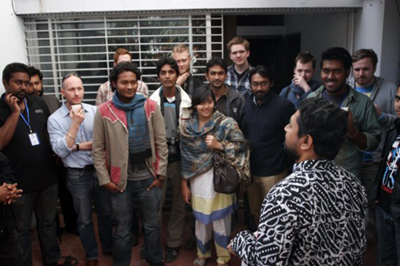
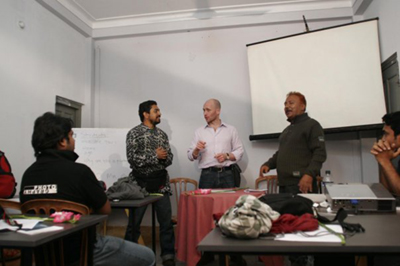
As you may remember, I was asked to lead a workshop for aspiring photojournalism students from Norway and Bangladesh on behalf of the Pathshala Institute
headed by the prolific Shahidul Alam. It was a rather daunting challenge. The only workshop that I’d ever attended was as a young photographer myself at the World Press Masterclass in 1998. I’ve had no formal photographic education and, despite giving a dozen or so lectures and talks over the years, I wasn’t confident that I could add much to these students education. I need not have worried. Ably assisted by the extraordinary Abir Abdullah, an exceptional educator in his own right, I think – I hope – that I managed to pass on something of the little I know to the students.

I must say that the Norwegians were for their age, exceptional visual journalists and it was a lesson for me to see them produce their assignments with an energy and proficiency that would put many established UK professionals to shame. I think to a person their level of visual literacy was far higher than I was expecting. The Bangladeshi’s, some a product of the Pathshala Institute and some having just completed a basic photography course struggled a little with the idea of storytelling – the theme of the workshop. That said, their determination and enthusiasm was a pleasure to witness. I felt by the end that the concept of a photo-essay was firmly entrenched. As a matter of fact, despite some rather cliched ideas of what a documentary project could look like, it was a two Bangladeshi students – both women I should add – that produced ideas for their course projects that impressed me most. Both decided to work on the personal sphere. In an industry dominated by men and seemingly endless stories of poverty and darkness it was a welcome change.

It was also my first visit to Bangladesh – a pleasant journey from the cold English winter and Chittagong and it’s people in particular I have to thank for being so welcoming and open. I’m now due to come back in the summer to shoot a story. I’m looking forward to it already.

Delhi waits for me now – a flight from Dhaka and then almost a month in India. I have a corporate assignment there and then two stories that I need to work on.

As usual I shall be on:

0091 9810941435

It just remains for me to say thank you in particular to Abir, Shoeb and his wife (what a lovely meal), Joseph Rozario (a marvel), Ashraf (for all his patience with me), Shadab (for his kindness) and to the students – firstly for their beautiful and unexpected gifts (you know who you are…) and secondly for their patience and unwavering attention even when I’m sure I was talking rubbish… you all touched me deeply. I hope we stay in touch. Thank you.

For now I leave you with some images from the workshop and one of a couple of frames that I had time to make myself in Chittagong.

Bangladesh - Chittagong - Abir Abdullah talking to students (and myself) during the workshop
Bangladesh - Chittagong - Stuart Freedman works with Maria on her project ©Adnan Wahid
Bangladesh - Chittagong - Abir, Stuart and Shoeb address the class ©Adnam Wahid
Bangladesh - Chittagong - Stuart Freedman addresses the class ©Marius Knutsen
Bangladesh - Chittagong - A man dismantles a boat with a blow torch and hammer on the banks of the Karnaphuli River beneath the Kalurghat Bridge, Chittagong, Bangladesh