 Umbra Sumus
As an increasingly nervous flyer, imagine my delight when I was commissioned last year to work as the still photographer for National Geographic TV’s film about the miraculous emergency landing on the Hudson river by US Airways Flight 1549…
I used to work a great deal for Channel 4 as a stills photographer in the ‘Nineties and early 2000s and there is a specific skill set that you need. You have to be quiet, you have to be quick and on this occasion, you had to be fine with paddling around inside (and outside) a plane submerged in a 3.5 million litre water tank in the middle of a field in the English countryside.
The truth is, on a set like this, you are suddenly the least important figure but you have to make sure that you shout loud enough to get the time and space for what your client needs. In that regard, Simon George the director was utterly charming and was generous with both time and crew. It also isn’t really about pictures that one personally likes because you are trying to make engaging images that will inform the viewer but here are a couple that I liked…

Special thanks to picture editor Nicole Cappello for being so lovely on the assignment organisation.
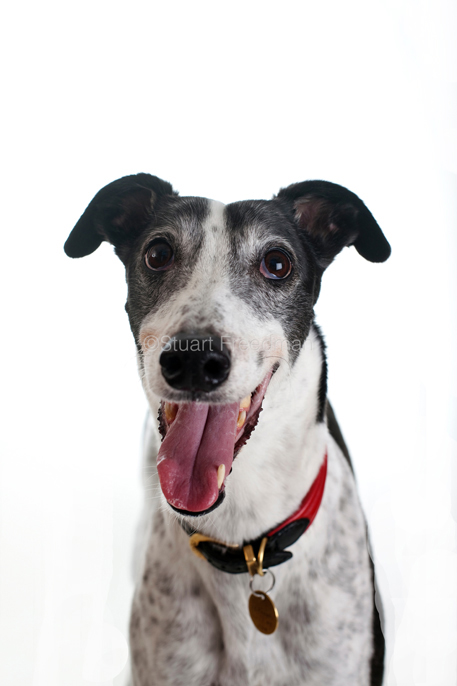
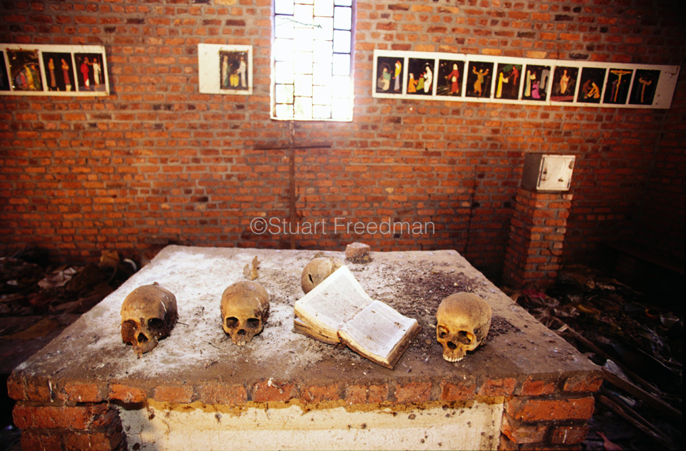
There are more images here but I leave you with an image far scarier than any plane crash…

I’m delighted that one of my images is featured in a new travel magazine called Renegade. It’s small, beautiful and full of interesting stuff. Here’s my double page – an image The Tree of Life in Iraq.

According to a report in the Observer newspaper, Britain is again falling for the charms of the jellied eel. Apparently Tesco sales of the stuff have grown by “35% since the supermarket giant took a gamble and started selling them outside London”. The increase in consumption is being “attributed to a new, more austere environment”.
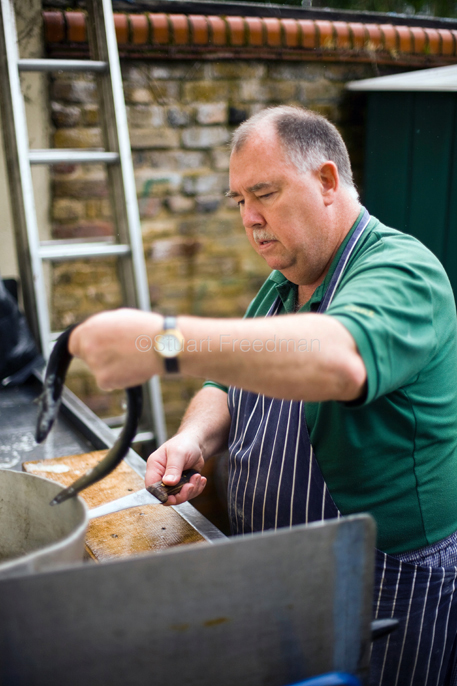
I’ve written and photographed jellied eels and the Pie and Mash shops of the East End a fair few times for different magazines over the last couple of years and I have to say reports that I have heard from there tell a completely different story. Very, very few people ask for eels in pie shops these days and those that do seem to fall into two categories. Firstly, older people that have always eaten them and remember their hayday pre-1950/60’s and secondly, young middle class emigres to the trendier spots of Hackney, that do so once for a bet.
What I suspect we might be seeing are the novelty buying habits of communities that still identify with the traditional accoutrement of a rosy, cosy fug of a dying white working class culture. These are to be found primarily in the post-war new towns of Hertfordshire and Essex. That would certainly explain the supermarket connection and why at least most pie and mash shops stopped killing and jellying their own eels years ago. Jellied eels are totemic of a simpler and now unrecognisable East End Victoriana but eels have long been a staple part of London food and were synonymous with the city and its people. In King Lear, Shakespeare’s Fool in his ramblings to the King, witters – “Cry to it, nuncle, as the Cockney did to the eels when she put ’em i’ the paste alive; she knapped ’em o’ the coxcombs with a stick, and cried ‘Down, wantons, down!’”
In a city dominated and bisected by the River Thames the eel’s popularity was that it was plentiful, cheap and when most meat or fish had to be preserved in salt, eel could be kept alive in puddles of water. The Victorian curate Reverend David Badham reports in his ‘Prose Halieutics; Or Ancient and modern fish tattle’ published in 1854 that –
“London steams and teems with eels alive and stewed. For one halfpenny a man of the million may fill his stomach with six or seven long pieces and wash them down with a sip of the glutinous liquid they are stewed in.”
Such was the demand that eels were brought over from The Netherlands in great quantities by Dutch eel schuyts and these were commended for helping feed London during the Great Fire in 1666. Although they were seen as inferior to domestic eels, the British government rewarded the Dutch for their charity by Act of Parliament in 1699 granting them exclusive rights to sell eels from their barges on the Thames. During the nineteenth century however, the Thames became increasingly polluted so that it could no longer sustain significant eel populations and the Dutch ships had to stop further upstream to prevent their cargo being spoiled.
The rise of the pie shops were a direct result of the adulteration of eels and pies sold on the streets. The shops were indicators of aspiration for sections of the urban working class and their physical rootedness. Their decoration and their hygiene were ways to ape ‘social betters’. The idea in the Observer article that jellied eels are traditionally austerity food is wrong. They were seen, certainly in the pie shops, as a treat. In wider society however, eating jellied eels and pies has a comedic value (but then the British always either laughed at or scorned its poor – except when it sent them off to die in the mud or Flanders or elsewhere) and a resonance with the ‘jolly’ Pearly Kings and Queens. Nowadays seen as quaint costumed charity workers, they were originally leading and respected costermongers that would settle often violent street disputes between gangs. A cartoon representation of poverty and tradition. The undoubted death of the pie mash and eel shops on the High Street is symptomatic of what the New Economics Foundation calls ‘clone town Britain’ where every High Street has the same shops. As Jane Jacobs argued in the Death and Life of Great American Cities (1960) communities are “created by myriad small daily encounters… the sum of such casual, public contact at local level is a feeling for the public identity… a web of public respect and trust”. It was that trust that made people flock to eel and pie shops in the late Nineteenth century because they knew that the food was ‘clean’ and somehow honest. It is what drives a more allegedly ‘sophisticated’ palate away today.
It’s what drives people to shop at Tesco. Even those whose families would describe themselves as ‘working-class East Enders’ whilst living in more affluent suburbs.
When I interviewed Graham Poole, one of three brothers that run the authentic, remaining Manze pie and mash shops, he seemed to bear this out.
“We get emails at all times of night – after people have had a few drinks… old East Enders that have moved out, reminisce – they want their eels and pies”.
They want their memories.
Some memories are dangerous however. As much as I personally enjoy eating them, eels are endangered. In 2010 eel populations in the Thames had fallen by 98% in five years. Across the country there are similar issues. Nobody really understands why elvers aren’t spawning – but then nobody actually knows the precise mechanism for and the location of, the migration to the Sargasso Sea.
Catholic priest Father Oliver Kennedy, 80, has for forty years run one of the only remaining commercially viable wild eel fisheries in Europe (Lough Neagh in Northern Ireland). “Things are very bad (for the eel) in Germany, Holland and France… we on the other hand are relatively safe – we buy elvers out of the Severn (River in the UK) and they take between twelve and twenty years to mature so our crisis might be delayed”.
It is clear however that unless we find a way to farm eels like salmon or clear migratory paths, the European eel may not see the end of the century.


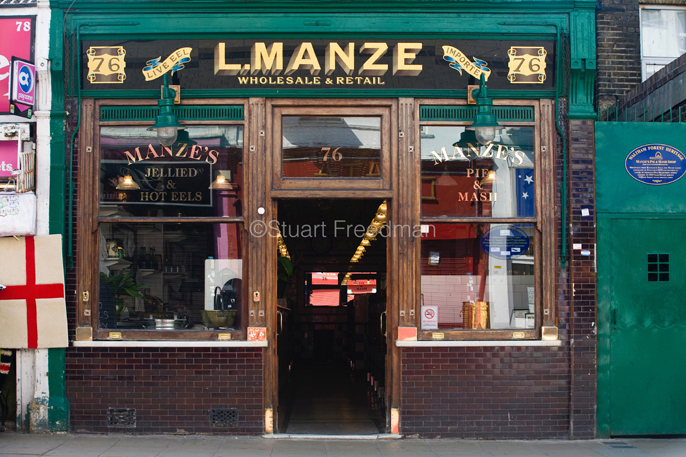
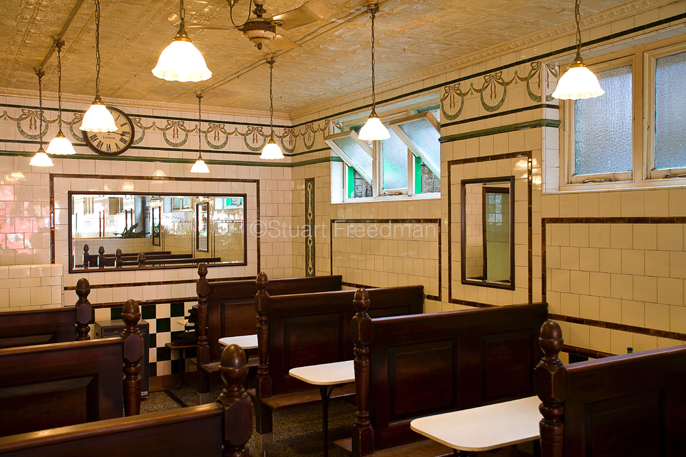
I’m delighted that one of the traditional Pie and Mash shops that I was privileged to photograph a couple of years ago has been given Grade II Listed status.
According to the citation, “The building, which was first opened to the public in 1929, has been given the accolade for its ‘beautifully preserved interiors’, which have never been replaced or modernised”
I wrote and photographed at length about London’s dying Pie and Mash shops (and jellied eels) on this blog last year. See here.
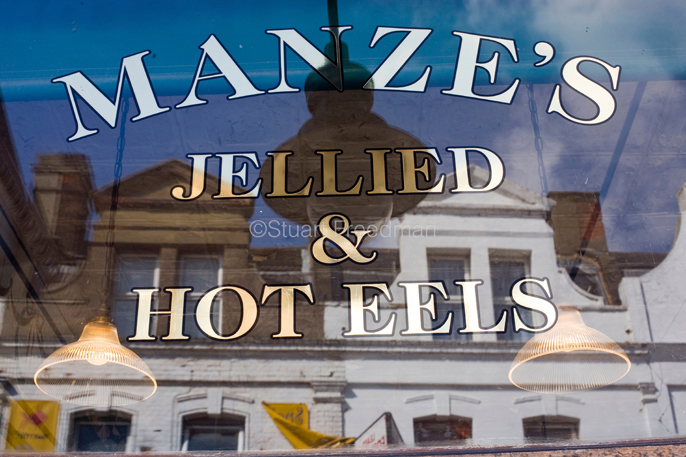
Here’s a small selection of images from Manzes in Walthamstow Market.


I feel the weather turning. The mornings are colder. I hate it. I need cheering up. Here’s a picture with a big lump of red in it to do that.

Why did I choose this image? Just chatting to Michael Regnier at Panos. Sparked a thought about a lyric – John Foxx’s Hiroshima mon amour. Wonderful… “Features fused like shattered glass, the sun’s so low/Turns our silhouettes to gold/Hiroshima mon amour”
No relation to Delhi of course, but that image of light… I can feel the warmth of the late afternoon sun in the big lump of red…
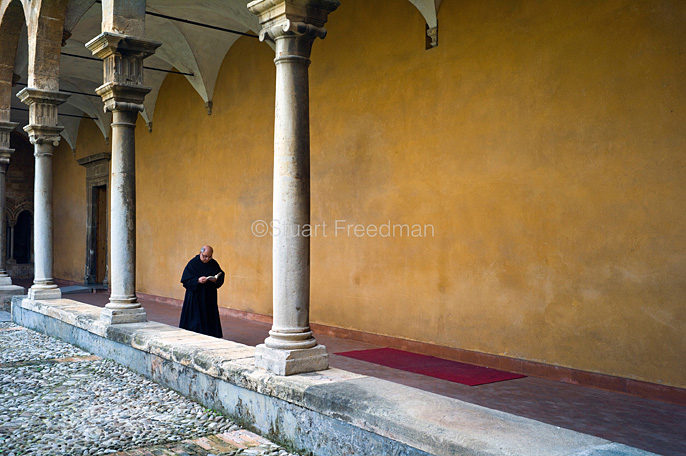
In a blog post yesterday, I showed a very quiet image of a priest reading and walking around a cloister. Below is perhaps a more typical image of Palermo and (southern) Italy in general. It’s said that Italians can only speak with their hands and the New York Times has a recent, rather prosaic piece here on that very subject.
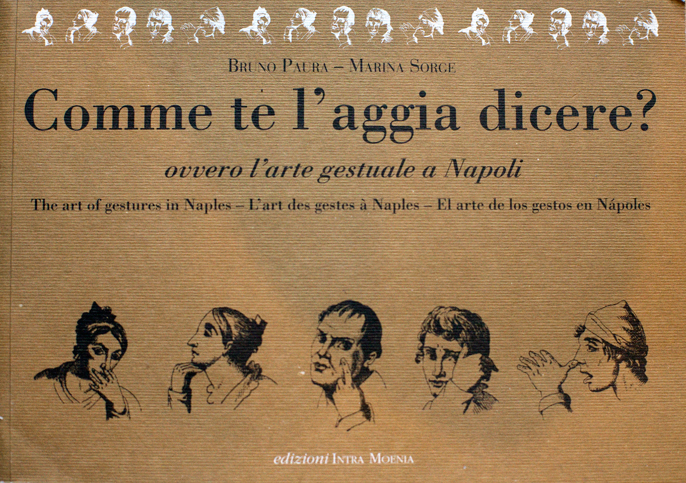
The consensus seems to be that somehow, in such crowded places people needed a further way to make themselves heard. Perhaps. Some years ago I stayed at a rather expensive hotel in Naples and they gave me as a gift, a lovely book (see below) about the secret meanings of Italian hand gestures. There are hundreds: some pleasant, some decidedly unpleasant. It occurred to me that in one sense it was a code, a language of the initiated in the way that rhyming slang was to the Victorian Cockney. A very real way to subvert authority (and of course the law) and build an identity that was separate and uncontrollable. Naples like Palermo are exquisite places full of art and beauty but are also brutal and fearful. Norman Lewis in his highly entertaining Naples ’44 recounting his time in the Intelligence Corp in that city remembers constantly being offered women by their families in order to eat. Peter Robb in his exquisite Midnight in Sicily (and later in his Street Fight in Naples) shows a labyrinthine society with bestial corruption at it’s very heart and violence meted out by mafiosi at every level. A society moved by an unofficial nod of the head, parallel governments. Secrets. Robb lived in Southern Italy, the Mezzogiorno for years. He immersed himself in the language and the culture and his writing shows the depth and commitment of that effort.
A photographer wandering the streets is usually a little different. He walks and sees a moment developing in the chaos of colour and movement and steps towards it. He takes two pictures and the image changes. He might have recorded something significant, something trivial but he has little hope of understanding anything on a deeper level than the symbol in the image – a gesture between two (or in this case three) people. The words he hears don’t mean anything – the gestures might be theatre. He might be ignored, or as in this case, sworn at and threatened. The language he is trying to communicate is equally symbolic as the hands of an Italian yet inevitably painted with a thicker, less subtle brush. He just sees the signs the hands make, not necessarily the subtlety of the meaning. He might interpret those signs as meaning something completely different – something as part of a visual culture that he has absorbed. Photography is as valuable but blunter than words. A more democratic code. Perhaps.
By the way, the title of this post comes from yet another language. Another collected word from another country. Palava(r). A word that I used to hear in West Africa all the time. Apparently it is Portuguese in origin. I didn’t know. Non capisco. So many words, so many countries. A mixture, an argument, a conversation. A beautiful mess. Just like Palermo.