Delhi’s Classic Cafe

It’s with great sadness that I read yesterday in The Times of India that the cafe on Baba Karak Singh Marg is going to close. The Delhi Walla blog has the full story with pictures here.

A strange little place, it was always a haven of quiet away from the tourist throngs of Connaught Place and was never, despite being in a couple of guidebooks a place where many travellers went because thankfully, they couldn’t find it. I was introduced to it maybe a decade or more ago and always made a point of hanging around there between assignments or when I felt the need to come into central Delhi. Tucked away on the roof of a rather downbeat shopping complex it was the kind of place that you had to know was there. The roof ‘garden’ was of course covered in dust and smog but it but it had lovely views if rather awful coffee. The regular clientelle was composed of distinguished older Indian gentleman who’d gather to read the papers and argue about the topic of the day. When I turned up I was usually ignored as it was assumed I was lost and my appalling Hindi seemed only to confirm the fact that I was an idiot. It didn’t matter and I loved it. The staff, unfailingly polite, would always deliver a very ‘masala’ masala dosa which required a second cup of coffee to soothe the heat of the chillies. I unfortunately never tried the ‘humbergers’ nor the milk shakes but I am sure that whatever their culinary achievement I would have enjoyed them.

The coffee shop for me was Delhi – a Delhi that for better and worse is disappearing fast. The place evoked a gentler, simpler time and a city where people read large newspapers, where motor cars (…any car so long as it’s a white Ambassador) were a rarity and the bicycle was what people rode to work. I’ve written before about not romanticising India but there seemed something about the place that actually spoke to me of a bygone London: the (then) chic shopping area, the red velour interiors of Connaught Place’s United Coffee House (now revamped) and the Embassy. A time where you could cross the road in Delhi without being killed.

The whole saga reminds me of the slow death of one of my favourite places in London, The New Piccadilly. I could write a whole piece about the ‘Cathedral of Cafes’ as Adrian Maddox would have it but suffice to say, despite all best efforts, the developers got their way and it closed. I can only recommend the Classic Cafes website and its book as a homage to past glories. Suffice to say there are few places now in London where you can drink a cup of tea and just think without listening to ‘muzak‘ and enduring overpriced coffees sold in incomprehensible sizes as ‘grande’ or ‘tall’. Coincidently, I read today in the Daily Telegraph about a Californian software engineer on a mission to visit every Starbucks in the World. Well good luck with that: I’m still holding out for a world that isn’t based on a greedy corporate propoganda that sucks the individuality and taste (both literal and metaphorical) out of every attempt at difference in order to leverage the last drop of profit.

Tea stains, cigarettes, chipped cups, formica, worn seats, warmth on a cold day, company, a sense of history, courtesy, civility, conversation, ideas. But I digress…

Back in Delhi, the The Times reports Head Waiter Gopal Singh as saying, “If this place closes, our families will land on the streets. If it’s true that rent has not been paid for years, we are willing to pay 50% of our salaries if that will help”. Delhi is a brutal city and I don’t doubt for a second that that would happen.

I never photographed the Coffee House in Delhi, it somehow always seemed like a little bit of home and a liberty to start taking pictures. I retired there sometimes after photographing at the Flower Market on Baba Karak Singh for my project on Delhi. It’s an image from that set that I leave you with.

I wish all those at the Coffee House my best and my sincere gratitude (I was that heavily sweating firangi with the cameras…). Shukriya.
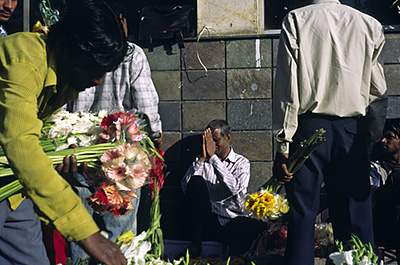
India - New Delhi - A man greets another  buying flowers with a gesture of Namaste at the Flower Market, Baba Kharak Singh Margh
India - New Delhi - A man greets another buying flowers with a gesture of Namaste at the Flower Market, Baba Kharak Singh Margh

A very old photo of me on the roof of the cafe

Ps… if you want to find rather wonderful places to eat in Delhi you could do worse that seek out Hemanshu Kumar and his fantastic blog, Eating out in Delhi

Vedanta – India’s shame

I read today with disappointment and resignation that Vedanta Industries have won their fight on appeal to establish a bauxite mine in the Niyamgiri Hills in India.

I wrote a piece for the Indian magazine Tehelka about this story in 2007 and it can be seen here.

Vedanta Resources, a UK-registered ftse -100 company has fought a long campaign to establish the mine and despite judicial review it seems now that nothing can stop it.

The story typifies the very real problem of India’s industrial development. The Niyamgiri Hills in Orissa are sacred to the Dongria Kondhs, a protected tribal group of ‘original’ Aboriginal peoples. Allegedly, the British geologist who “discovered” these rich deposits nearly a century ago dubbed them “Khondalite” in tribute to the people who guided him there. It seems that this simple act of hospitality will mean the end of another of India’s pre-Aryan traditional cultures. The holy mountain will be raped for its ore and the people who haven’t already fled the company’s previously illegal building programme will be scattered. Those who stay will doubtless be housed in the stalag-like accommodation blocks I saw laying empty and crumbling in Lanjigarh. They will have to sell their land at government determined prices and then work as contract labourers. What has happened to countless other ‘primitive’ and powerless peoples all over India will happen to them. Displaced from their traditional homelands, sacred to their animist beliefs, women and girls often end up working as daily wagers, domestic helps or prostitutes. The women will also have to cope with alcoholism and domestic violence.

The author and social activist Arundhati Roy has described India’s unfettered race to Market Capitalism as nothing less than India ‘eating its own people’ and in this macabre metaphor one can see the reflections of the Enclosures and urbanisation of the rural communities of England in the nineteenth century.

Engels in his ‘Conditions of the Working Classes’ wrote about the squalor and appalling inhumanity of the Northern mill towns but these could be anywhere in the newly ‘industrialised zones’ of rural India.

I am no romantic when it come to India. I don’t share a Raj view of the colonial apologists (despite inevitably by dint of being British having reaped the indirect rewards of the subjugation of that country). I don’t yearn for quaint, underdeveloped communities full of poverty and colour. I want to see India progress. But I know the stink of international corporate power when I smell it.

India had no colonies from which to steal resources so it’s stealing them from its own weak and vulnerable. The profits of this mine will not be spread evenly to benefit the Indian economy – it will be hoarded in the off-shore bank accounts of those corrupt politicians and corporate executives who already think that India is theirs by right.

A new Middle Class India has been brought up to believe that a successful society means a consumerist society. Greed and nationalism go hand in hand: it is not the poor of India calling for war with their brothers and sisters in Pakistan.

Traditionally, Indians have protested injustice in a dignified Ghandian way with hunger strikes and marches. While the Western media and much of India has been marvelling at ‘Shining India’ it has failed to notice that a good deal of India is now under Maoist rebel control. In Kashmir, Manipur, Nagaland, Bihar, Andhra Pradesh, Chhattisgarh and Jharkhand the Indian state is fighting a battle it might not win.

A woman carries a pot of water from a stream in front of the Vedanta plant, Lanjigarh, Orissa
A tribal woman carries a pot of water from a stream in front of the Vedanta plant, Lanjigarh, Orissa
The Vansadhara river. The river is one of two that flows from Niramgiri mountain. The effect of the Vedanta plant will be to dry up streams that feed the river depriving the Dongria Kondh of fresh water
Widow Kadu Dei and her child, Harni Majhi, 2. Dei's husband was an anti- Vedanta Alumina activist who it is alleged, was killed in a hit and run accident by a car used by Vedanta employees. Dei is now forced to rely on the charity of her neighbours to survive. Kansari village, Orissa
Widow Kadu Dei and her child, Harni Majhi, 2..Dei's husband was an anti Vedanta Alumina activist who it is alleged, was killed in a hit and run accident by a car used by Vedanta employees. Dei is now forced to rely on the charity of her neighbours to survive. Kansari village, Orissa

Kathakali – Into the Dreams of Heroes

To my surprise and delight, Tewfic El-Sawy who runs the popular Travel Photographer blog has again chosen to highlight some of my work in India, this time on Kathakali.

The link to the page is here.

I remember I spent a very pleasant few days at the Kerala Kalamandalam – the state academy of Keralan dance in the sleepy town of Cheruthuruthy.

You can read about the story here on my website.

The students at the academy rise at dawn and undergo hours of daily exercise and academic studies for years to learn by heart the dances and the intricate movements of Kathakali. I thought Kathakali reminded me very much of classical Japanese Noh – a mute mixture of precise dance and theatre where slight eye and hand movements indicate an entire language.

The first picture has always reminded me of a pond of small frogs…

Young students at the Kalamandalam practice eye exercise at dawn. Kathakali uses very intricate eye and hand movements to communicate with the audience
Young students at the Kalamandalam practice eye exercise at dawn in a classroom lit by ghee (butter) lamps. Kathakali uses very intricate eye and hand movements to communicate with the audience
A boy is massaged by his teacher at the Kalamandalam. Massage is seen as an essential part of Katahakali practice making the body supple.
A boy is massaged by his teacher at the Kalamandalam. Massage is seen as an essential part of Kathahakali practice making the body supple.
Professor Balasubramanian pauses before he finishes his make-up in preparation for a production of the Ramayana
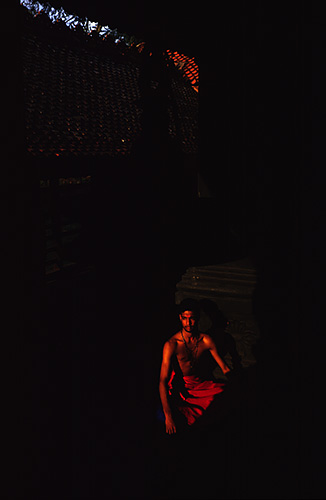
In the late afternoon sun, a senior student relaxes after class by the Koothambalam (temple theatre)

Here’s a link to my work on Shadipur Depot, a slum colony of artists and performers in New Delhi that was a previous post on the Travel Photographer.

Here’s the full story from my website with text.

All images are available through my archive site.