This post is a little late as World Homeless Day was on Monday 10/10/11 and although several kind people (Laurence Watts, Justin Leighton, Panos and Duckrabbit) Tweeted some of my work but I was away and so missed the opportunity to write something.
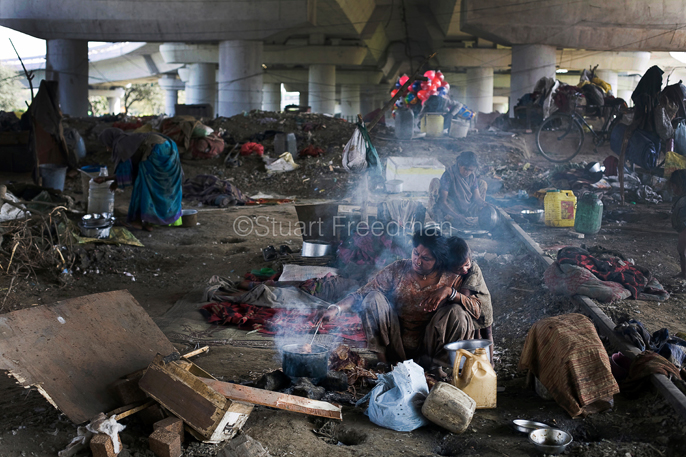
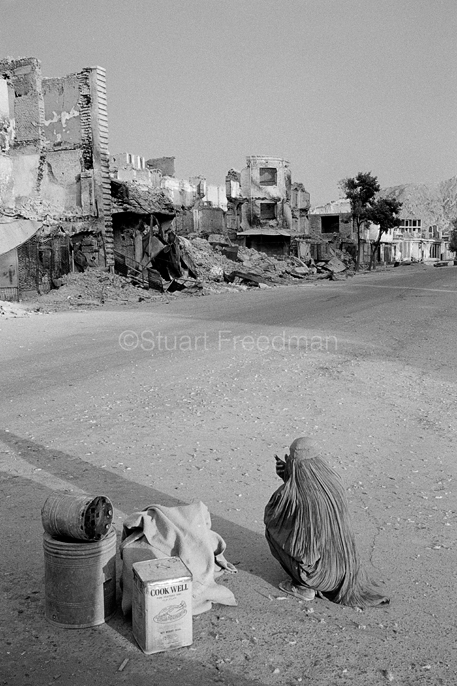
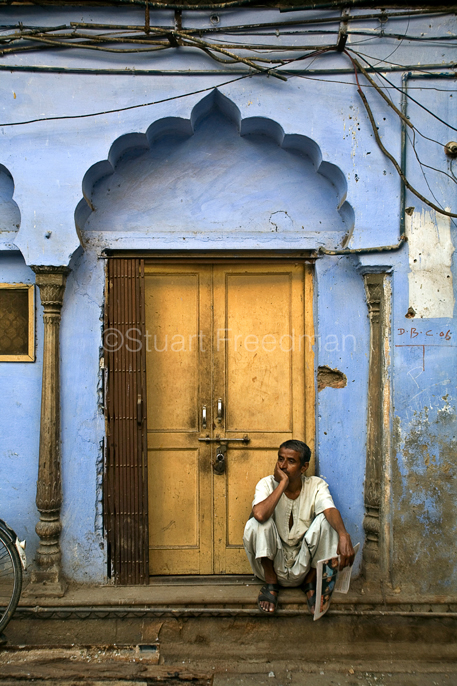
The work here is from an ongoing piece about Delhi and it’s people – where some 100000 people just happen to be homeless. I’m always cautious these days about doing another story about the homeless – you know the nameless victims staring up at the camera but the sheer scale of Delhi’s problem is so significant, so enormous it became inevitable. The work was an assignment from ActionAid (thanks to Laurence who believed in my proposal) and was made through the invaluable assistance of Aashray Adhikar Abhiyan from whom I must thank the wonderful Paramjeet Kaur and Prakash, my invaluable guide and I hope now, friend. I tried very hard to make work that showed people as individuals coping in very difficult circumstances but one that is surprisingly easy to fall into. Normal, ordinary people in difficult situations. These are just three of my current favourite images – you can see a larger set via my archive or the Panos site.
India - New Delhi - Patti Das and his child Khrisha on a piece of waste ground beneath a flyover near Okhla station. New Delhi, India.
India - New Delhi - A mother picks at her child's hair for fleas as a train passes behind them on a piece of waste ground where they live beneath a flyover near Okhla station. New Delhi, India
India - New Delhi - A homeless mother, hugged by her small child, cooks breakfast by the railway tracks where her family live. Okhla, New Delhi, India
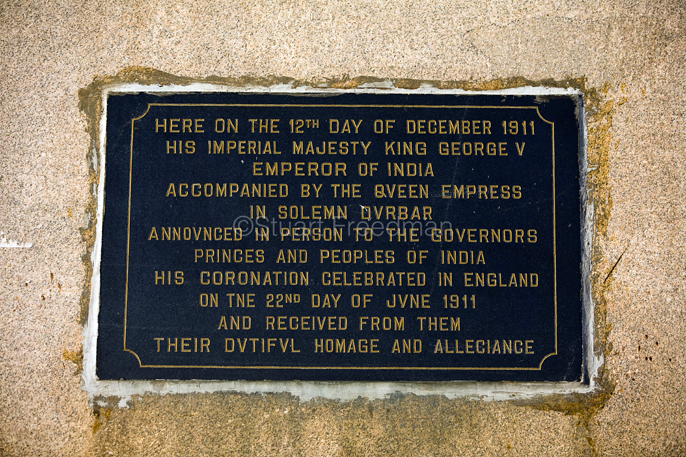
“We are pleased to announce to Our People that on the advice of Our Ministers tendered after consultation with Our Governor-General in Council, We have decided upon the transfer of the seat of the Government of India from Calcutta to the ancient Capital Delhi….” (Quoted in New Delhi Making of a Capital, Malvika Singh and Rudrangshu Mukherjee, Roli Books, 2009)
With that on 12 December 1911, George V sealed Calcutta’s fate as British India’s capital city. Delhi, itself a city of seven (perhaps more) kingdoms became the new political centre of India.
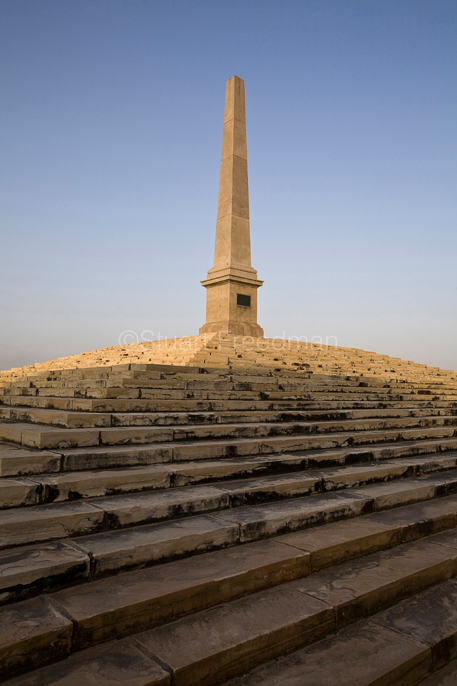
Today, a forgotten, dusty patch of land is all that remains of the Delhi Durbar site; an obelisk marking the spot where George made his speech, Ozymandias like now in its echo. Most Delhi-wallahs know nothing about it, nor the park adjacent which holds statues of Imperial notables and a likeness of the King himself that, until the 1960s, stood beneath a Chhatri next to India Gate.
I first visited the place in 2005 and found, with some difficulty, a silent park off a minor road next to the main highway. Last week, in search of story about New Delhi’s first century as capital I drove out again only to find the place in ruins. Much to my and my taxi driver’s amazement the place was being demolished by hand by day labourers. It seemed to me that some of the statues had gone or were at least moved (although I cannot confirm if this is true or indeed how many) and certainly some of the plinths had been destroyed.
I am by no means a fan or apologist for the Raj – indeed as I’ve written before I hold very little truck with romantic India but I was dismayed that such a crucial piece of India’s history looked so … desolate. I haven’t had chance to ascertain exactly what the plans for this remote graveyard of empire might be but I sincerely hope that they are, as the foreman told me, to restore the place. If true, it is, like the Commonwealth Games building saga, a very furiously last minute – very Indian – job.
It could all of course be a dastardly case for Delhi’s detective extraordinaire, Vish Puri…
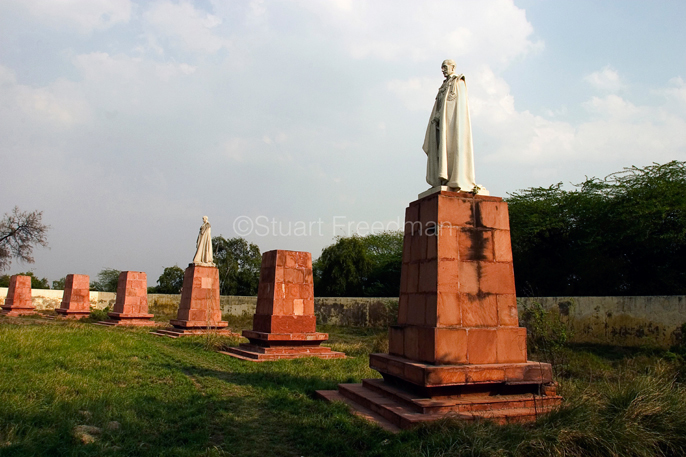
The first image was taken in 2005 – the rest are as I found the site last week:
India - Delhi - Statues of British Imperial notables, with Lord Hardinge, Viceroy Of India (1911-1916) to the right at the Coronation Park next to the site of the Delhi Durbar of 1911
India - Delhi - Commemorative obelisk at the Coronation Park marking the throne of George V during the Delhi Durbar of 1911India - Delhi - Commemoration Plaque below the Obelisk that gives the date of the Delhi Durbar of 1911
India - Delhi - Statue of Sir Guy Fleetwood Wilson at the Coronation Park next to the site of the Delhi Durbar of 1911
India - Delhi - Women construction workers demolishing the Coronation Park next to the site of the Delhi Durbar of 1911
India - Delhi - Security guards watched over by the statue of George V next to the site of the Delhi Durbar of 1911
Finally, the Chhatri that originally housed the statue of George V in the shadow of India Gate –
India - New Delhi - The empty canopy next to India Gate that originally held the statue of George V
No – not some mediaeval torture method but a proposal that after years of delay, the Chadni Chowk redevelopment plan will finally get under way under the auspices of the Shahjahanabad Corporation. Many Delhi residents will of course be skeptical that this will prove to be the success its champions claim. However, if it means preserving at least something of the faded and broken beauty of the Walled City then I wish it very, very good luck. My only concern is that this is not some run-down inner city in the West being gentrified: it’s a vibrant and working area where thousands and thousands of people make a living. The imperative to preserve its heritage, whilst obviously critical, should be tempered at least by a consideration for those that call Old Delhi home. Although I suspect one can guess how that will turn out…
India - Delhi - Heavy traffic on the congested streets of Old Delhi looking towards the Jama Masjid, Delhi, India
India - Delhi - Traffic on Chadni Chowk looking towards the Red Fort, Old Delhi
India - Delhi - A man lounges inside the remains of the Sultan Singh Ghar ki Haveli. Much of Old Delhi's historical architecture has been lost to new development.
According to Hindu tradition, widows are a curse. Many are dumped by their families in a dusty north Indian town called Vrindavan, supposedly the birthplace of Khrishna. Here the widows sing and chant for long periods of the day in ashrams where they are paid small amounts of money – the only employment open to them.
India - Vrindavan - Hari Das, 60. A widow abandoned by her family she lives in a small hut along with 40 others women in a slum on the outskirts of Vrindavan. Ostracized by society, thousands of India's widows flock to, or are forcibly dumped in the holy city of Vrindavan waiting to die and receive a meagre pittance of food and money by chanting in ashrams
India - Vrindavan - Widows chant in an ashram for a meagre allowance of money
India - Vrindavan - A Widow chants in an ashram for a meagre allowance of money
I am woken every morning at dawn by the sounds of men breaking down buildings by hand. New Delhi, because of its absurd land prices is constantly being broken and rebuilt again by thousands of unskilled labourers working for a pittance. All day, every day.
This is the view of the house opposite. A view into other lives, other rooms.
India - New Delhi - Men construct a new house room by room
I’m delighted to be the subject of a post at the rather excellent Verve Photo that features my work on capoeira in Brazil.
I must admit I was a little surprised to be included in such a blog that prides itself on showcasing ‘the new breed of documentary photographers’ as I seem (or feel) like I have already been around the block more than once, but no matter. Geoffrey Hiller was utterly charming and I was very pleased that he chose an image from a series that showcases work that isn’t necessarily dark and serious.
Many thanks to Geoffrey and I reproduce the short interview below.
“The story was on Capoeira, the martial art/dance once the (banned) preserve of African slaves, now a national symbol of Brazil. It was shot on assignment for a car magazine – Lexus – with whom I’ve photographed and written travel pieces on and off for nearly a decade. My fixer had arranged for five models – all expert Capoeiristas, and the idea was that in addition to photographing some Capoeira classes in the city, we’d make the main images on Copacabana and Leblon beaches. I remember it rained for a couple of days so I had to shoot the beach twice before I was happy. Initially I shot with two portable strobes but that felt too ‘fashioney’ so I went back to a much simpler set-up – shooting at dusk with available light and couple of fixed lenses: a much more traditional reportage feel. I’d worked in Brazil only once before in 1999 as part of a five country reportage about the Politics of Hunger. I’d shot a piece with the Landless Peasant’s Union (the MST) on squatted land in the far north: the Capoeira story was far removed from that and some of the images have formed the basis of a lifestyle folio that sees me work on ‘lighter’ stories away from pieces in Africa and Asia that I am perhaps more known for. A good balance, I think.”
I discovered photography – and specifically photojournalism – in the final year of my politics degree. The catalyst for that process was a wonderful magazine called Photography that showcased the very best work, especially from that genre, with writers from the industry interviewing and commenting on significant and interesting work and, unlike most photography magazines, almost ignoring gadgetry and equipment.
One issue stood out for me and solidified my resolve to pursue photography as a career (despite having no portfolio nor ever having taken a photograph). It featured the work of Graham Harrison, already an established photographer who had been commissioned by the British Museum to take photographs in the Far East for their Buddhism: Art and Faith exhibition in 1985. This work is on show again at the University of Edinburgh from September the 12th and I hope will inspire a reprint of the book of the same title.
Some time ago I reviewed the book (as was) and here is what I said.
“It is honest and classic reportage and I looked at the images often. Harrison’s eye is delicate and respectful and one senses a desire to engage with the people in these images and their faith. The access is extraordinary: it is incredibly rare for example to be able photograph inside Eiheji, the headquarters of Soto Zen deep in the mountains of central Japan. Harrison’s work here captures the haste of a young novice scrubbing the wooden floors of the monastery in the ‘raw cold and semi-darkness of a late winter morning’ and the formal zazen of the rows of monks. His portrait of the Abbot of the monastery is as quiet and deceptively simple as is his landscape of the Potala Palace in Lhasa. His pictures of China in the chapter ‘Decline and Destruction’ are touchingly elegant showing what remained of a great culture. I think it’s true to say that Harrison’s photographs come close to capturing the quiet power of a way of life that is very difficult to describe in words.”
After visiting Hackney twice in the last month for the first time in several years (once to work on a story and once to mentor a young photographer), I’m currently re-reading Patrick Wright‘s excellent ‘On living in an old country‘. Wright’s one of those brilliant cultural commentators who should be far better known and the edition I’m reading (because I lost my original copy) has illustrations by another underrated genius, the Polish cartoonist, Andrzej Krauze. I knew Krauze from his biting satire in the Guardian and a few years ago, I got to photograph him for a magazine. I remember that I had very little time (it wasn’t his fault) and that I didn’t have chance to put up the usual lighting rig. Anyway, here are two images from the job… I remembering noticing the label that reads ‘Mr Pen’ at the top right of the chest of drawers he kept his work in…
UK - London - Polish cartoonist Andrzej Krauze at his studio
UK - London - Polish cartoonist Andrzej Krauze at his studio