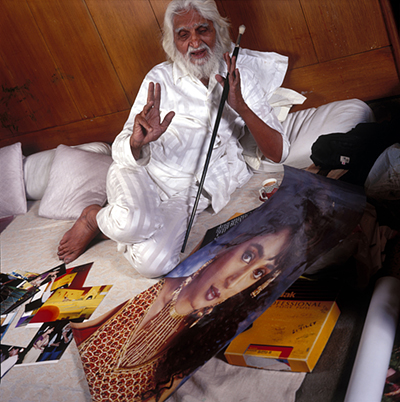
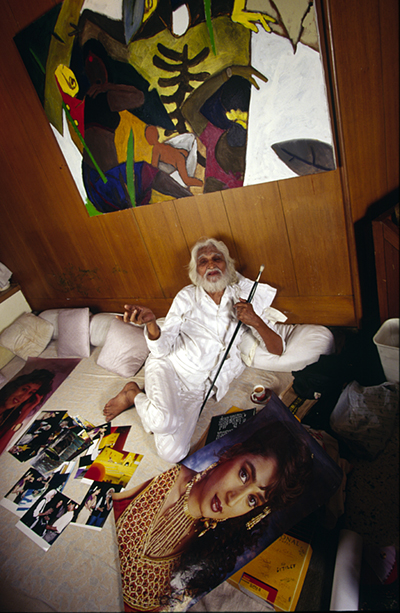
It appears that the great Indian artist, MF Husain has accepted citizenship from Qatar after having to live in exile in London and Dubai since 2006. It may well close one of the saddest episodes in secular India: Husain, now 95, has been the target of Hindu fundamentalists after his depiction of naked Hindu goddesses. The Indian government has been unable to protect either his property or his personal safety and so one of India’s most famous sons is now unlikely ever to return to his home. I photographed him in Mumbai (then Bombay) about a dozen years ago for the Independent on Sunday Magazine. He was as charming as he was extraordinarily talented.
India - Mumbai - MF HusainIndia - Mumbai - MF Husain with an image of his muse, Maduri Dixit
India - Mumbai - MF Husain with an image of his muse, Maduri Dixit
As I sit packing in Delhi waiting to go to the South on a story, a good friend, Martin Beddall emails me about a programme (‘Overexposed’) he was interviewed for on BBC Radio a while ago. Martin was a postgraduate student on the photojournalism course at the (then) London College of Printing nearly twenty years ago. Another former student, Miles Warde has retraced the fate of some former classmates. As the BBC has it:
“Miles Warde presents the story of a group of photojournalists who set out to witness world events. They went to Yugoslavia, Angola, Chechnya, Gaza and Iraq. Two of them were shot dead. A compelling portrait of youthful ambition and the power of photography to change the world”.
The programme, originally broadcast on Monday 25 Jan 2010 is available on BBC iPlayer for another week.
Although I wasn’t a student on the course, I was around the same time finding my feet and as I’ve written previously, was friends with and worked alongside two photographers, Paul Jenks and James Miller who were both subsequently killed.
An odd feeling listening: my friend Gary Calton is featured as well and his and Martin’s comments ring very true. As a generation we seemed to have wanted to change the world. Was it because we had come through the politics-stained 1970’s that were in turn coloured by the 1960’s? I don’t know but I sense something now has changed. The myth of the great days of the magazine photographer has been exposed. There are no great magazines left to run work: TV, video and now the internet has won. We live in a more cynical age and we are all a little older, if not a little wiser.Many of us are struggling to find a way to say the things that still need saying. Perhaps it will not be through photography.
It’s rare these days that a jaded old photographer like me finds something positive about the industry but that is exactly what has happened in the last week in Chittagong in Bangladesh.
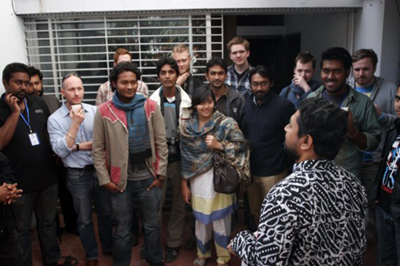
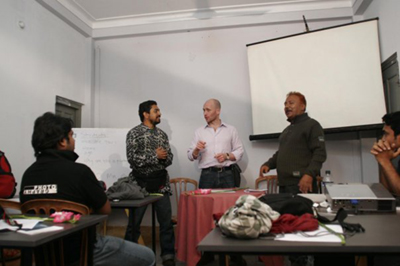
As you may remember, I was asked to lead a workshop for aspiring photojournalism students from Norway and Bangladesh on behalf of the Pathshala Institute
headed by the prolific Shahidul Alam. It was a rather daunting challenge. The only workshop that I’d ever attended was as a young photographer myself at the World Press Masterclass in 1998. I’ve had no formal photographic education and, despite giving a dozen or so lectures and talks over the years, I wasn’t confident that I could add much to these students education. I need not have worried. Ably assisted by the extraordinary Abir Abdullah, an exceptional educator in his own right, I think – I hope – that I managed to pass on something of the little I know to the students.
I must say that the Norwegians were for their age, exceptional visual journalists and it was a lesson for me to see them produce their assignments with an energy and proficiency that would put many established UK professionals to shame. I think to a person their level of visual literacy was far higher than I was expecting. The Bangladeshi’s, some a product of the Pathshala Institute and some having just completed a basic photography course struggled a little with the idea of storytelling – the theme of the workshop. That said, their determination and enthusiasm was a pleasure to witness. I felt by the end that the concept of a photo-essay was firmly entrenched. As a matter of fact, despite some rather cliched ideas of what a documentary project could look like, it was a two Bangladeshi students – both women I should add – that produced ideas for their course projects that impressed me most. Both decided to work on the personal sphere. In an industry dominated by men and seemingly endless stories of poverty and darkness it was a welcome change.
It was also my first visit to Bangladesh – a pleasant journey from the cold English winter and Chittagong and it’s people in particular I have to thank for being so welcoming and open. I’m now due to come back in the summer to shoot a story. I’m looking forward to it already.
Delhi waits for me now – a flight from Dhaka and then almost a month in India. I have a corporate assignment there and then two stories that I need to work on.
As usual I shall be on:
0091 9810941435
It just remains for me to say thank you in particular to Abir, Shoeb and his wife (what a lovely meal), Joseph Rozario (a marvel), Ashraf (for all his patience with me), Shadab (for his kindness) and to the students – firstly for their beautiful and unexpected gifts (you know who you are…) and secondly for their patience and unwavering attention even when I’m sure I was talking rubbish… you all touched me deeply. I hope we stay in touch. Thank you.
For now I leave you with some images from the workshop and one of a couple of frames that I had time to make myself in Chittagong.
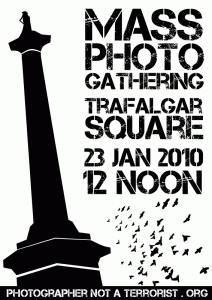
I urge everyone to attend a mass photo gathering in defence of street photography on January 23rd at Midday in Trafalgar Square organised by the pressure group I’m a Photographer not a Terrorist.
As their website eloquently states:
Photography is under attack. Across the country it that seems anyone with a camera is being targeted as a potential terrorist, whether amateur or professional, whether landscape, architectural or street photographer.
Not only is it corrosive of press freedom but creation of the collective visual history of our country is extinguished by anti-terrorist legislation designed to protect the heritage it prevents us recording.
This campaign is for everyone who values visual imagery, not just photographers.
We must work together now to stop this before photography becomes a part of history rather than a way of recording it.
Images are funny things though and far be it from me to suggest that our rights are being eroded on a day to day basis by those that seek to make our lives more secure… but here are just a few recent developments to may be of interest:
As I was late in posting a Christmas message (I feel like the Queen…) I thought I’d better put something up as late as possible on the last day of 2009.
I seem to have lots of pictures of people dancing and partying across the world but when I thought about it, one image of hope and joy seemed to stick in my mind. The image below show a mother reunited with her son who had been kidnapped and forced to fight for Joseph Kony’s Lords Resistance Army in Northern Uganda. He’d been in the bush for a couple of years as I remember and I was present in an airless, dusty hut when he was delivered home by the Ugandan Army. His mother, completely surprised by her son’s miraculous appearance (she thought him dead) was overcome with joy and started to pray just after I took this image. I’ve often wondered what happened to him.
Happy New Year.
Peace.
Uganda - Gulu - A young man with obvious trauma is reunited with his mother and sisters after almost two years in the bush fighting with the Lords Resistance Army
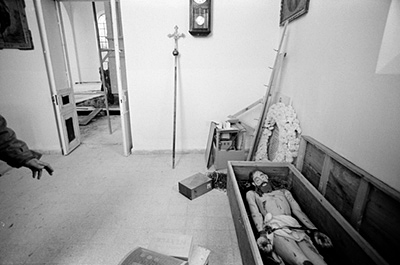
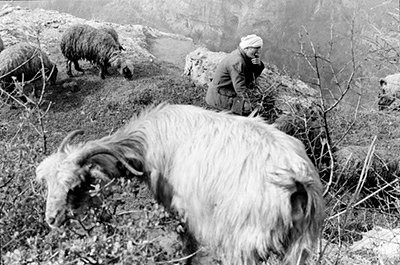
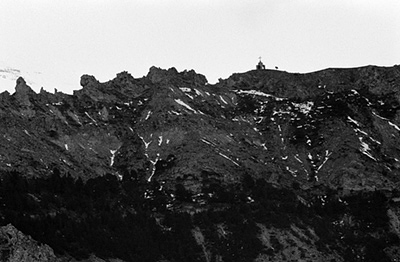
As I slowly melt into the armchair under the weight and fug of too much food, alcohol and bad television I wondered what I could post that had some flavour of Christmas, image-wise… Seeing as I’ve never shot a Christmas story or stock at this time of year, I’m struggling a bit. I have come up with an old story I made in Northern Lebanon in 1998 about the work of Khalil Gibran, author of the Prophet. I travelled to B’sharre, then under the de facto control of the Syrian army of occupation and worked on a piece that illustrated the themes of Gibran’s poetry. Here are some pictures.
Lebanon - B'charre - A effigy of Christ in a coffin in a Maronite church in Khalil Gibran's birthplace in Northern LebanonLebanon - B'charre - A crucifix painted on a wall in the snow in Khalil Gibran's birthplace, B'charre, Northern Lebanon. The area is occupied by Syrian troops and so the indigenous population paint crucifixes as a symbol of oppositionLebanon - B'charre - A mysteriously empty coffin in a graveyard in Khalil Gibran's birthplace, B'charre, Northern Lebanon.."... do not grieve for me... I am gone from this place...". GibranLebanon - B'charre - An elderly Maronite Christian couple leave church in Khalil Gibran's birthplace, B'charre, Northern LebanonLebanon - B'charre - Dying flowers on a tomb in Khalil Gibran's birthplace, B'charre, Northern LebanonLebanon - B'charre - A shepherd and his flock of sheep and goats near Khalil Gibran's birthplace, B'charre, Northern Lebanon.. ..." And He put His hand upon my shoulder and said, "From this day you shall love this sheep more than any other in your flock, for she was lost and now she is found"...GibranLebanon - B'charre - A cross stands on a hillside in the Quadisha Valley near Khalil Gibran's birthplace, B'charre, Northern Lebanon. The Valley was the last refuge of the Maronire Christian hermits after the Islamic (Arab) invasions.
In Bangla literature, the late afternoon light is apparently known as “kone dekhano alo” – “light to show off the bride in”. As someone who’s a bore fascinated with the quality of light, I thought that this was so lovely that I should mention it. That, and the fact that I’m going to lead a Photojournalism workshop in Chittagong, Bangladesh hosted by the Pathshala Institute of Photography. It’s a generous invitation by the prolific Shahidul Alam of Drik Picture Agency fame.
I’m teaching twenty eight students, between the 11th and 17th of January. The participating students will be from Oslo University College, Pathshala students and local students from Chittagong.
I will be on email and My Bangladesh cell will be: 0088-01711-127463. I plan to be in the region for an extra two weeks if anyone needs anything.
I read yesterday that the World Bank is to lend India $1bn to clean up the Ganges River. The Ganges is one of the world’s most polluted waterways and supports perhaps 400 million people. Despite earlier government promises to make its water drinkable by 1989, it flows with industrial effluence and sewerage. As I wrote previously, a solution to the water crisis is crucial to India’s survival and as Sunita Narain (and others) have argued it needs an Indian solution.
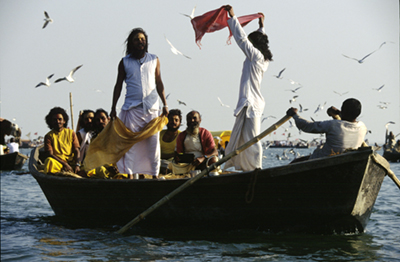
I’ve been lucky enough to have been touched by the magic of this river often over the years. I’ve covered two Kumbh Melas (the enormous religious bathing pilgrimage that takes place four times every twelve years at the confluence of the Ganges and the Yamuna) and visited the extraordinary Varanasi many times. There is something touching, real and honourable about Indian’s reverence and awe at the Ganges; something that speaks about life and its transitory nature. It’s a beautiful thing to see villagers come hundreds of miles just to bathe in the river and feel its coolness at dawn as they submerge themselves. Humbling and puzzling to see the processions of corpse bearers literally running to the cremation grounds on the ghats in Varanasi to burn a body. I shall never forget my first sight of a body (suicides, children and snake bite victims are swallowed by the river whole) bloated, rolling and turning in the gentle waves of my boat one morning at dawn.
Some pictures:
India - Varanasi - A man makes an offering to the Ganges at dawnIndia - Varanasi - A worker at the Burning or 'Manikarnika' Ghat tends a cremation pyre. The men are all from the same low caste called Dons - Dalit's or 'untouchable's' rendered ritually unclean by their workIndia - Allahbad - Pilgrims cross one of the many pontoon bridges erected at the Kumbh MelaIndia - Allahabad - Saddhus dry themselves after a ritual bath at the Kumbh MelaIndia - Allahabad - Pilgrims ritually bathe at the Ardh Kumbh Mela India - Allahabad - Saddhus in a boat at the Kumbh MelaIndia - Allahabad - A pilgrim and his wife get ready to immerse themselves in the Ganges as an act of religious purification
Hardy was a giant of the British documentary press tradition and is best remembered for his work for Picture Post Magazine. Born into poverty in Blackfriars he taught himself photography and was renowned for his sensitive, human images of war and everyday life.
Bert was an inspiration for me and I had the privilege to photograph him shortly before he died in 1995 upstairs in the flat above the darkroom that he’d set up near Waterloo. I had hoped to show that image here but after moving offices recently, I’ve mislaid the transparency. I will post it soon I hope. I’d also like to write more about the Bert Hardy Darkrooms and Charlie who tirelessly printed my work for more than a decade – and I will soon.
It seems that Graham, an extraordinarily talented photographer and now the creator of the Photo Histories website has found a huge number of Hardy’s unpublished images for Picture Post. Some of the very best will be shown for the first time.
A couple of days ago, I read an article in Open Magazine about Indian performance artist, Inder Salim cutting off his finger.
“One hot April morning, I chopped off the little finger of my left hand and threw it into the dead river called Yamuna. They call me crazy. But I call it art.”
Well quite.
It seemed quite a brave thing to do to make a point and I’m not going to give him a hard time for being so literal about highlighting the state of Delhi’s famous river.
The Yamuna is one of India’s greatest rivers. Holy to Hindus, The Imperial Gazetteer of India in 1909 mentions the waters of Yamuna distinguishable as “clear blue” as compared to silt-ridden yellow of the Ganges. Unfortunately, the Yamuna that runs through present day Delhi is an open sewer and clinically dead.
I was so intrigued by Delhi’s water situation a couple of years ago and made some work around it that became a film for More4 news. You can see the piece here.
The point was that Delhi’s water wasn’t in this hellish state as the result of appalling poverty – all those pesky poor people washing and cremating themselves in it – rather a complete lack of infrustructure around water management and wholescale pollution by industry. That hasn’t stopped the Delhi authorities evicting thousands of poor Delhi-wallahs that lived on its banks over the last few years.
There are perfectly sensible answers to the state of the Yamuna – Indian answers too. Brilliantly articulated by Sunita Narain, Director for the Centre for Science and Environment, she says: ‘A city will be more efficient if it collects water locally, supplies it locally and disposes waste locally’. There’s an excellent piece by her here.
Anyway, as Delhi looks forward to the 2010 Commonwealth Games, I’m hoping that someone will finally listen to Narain and the other Indian environmentalists, too numerous to mention, whose message about water, the city and sustainability has yet to seep into the murky waters of government. But I’m sure they will be able to smell it…
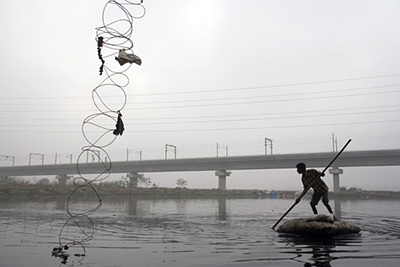
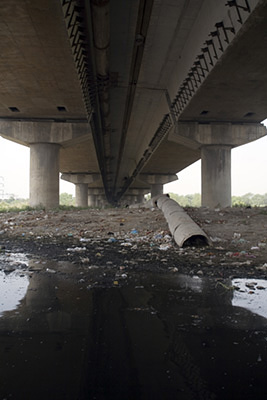
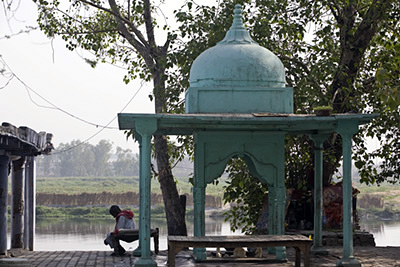
India - Delhi - A scavenger looks for discarded waste to sell on a home made raft of rags in the Yamuna River by the Kudsia Ghat in Delhi. The river is so polluted it can no longer support life yet a community live and work on it's banks. This boy uses a powerful magnet to dredge for coins and other metals which he can sell.India - Delhi - A man made homeless by slum clearance in a shack on the middle bank of the Yamuna River in Delhi by the Kudsia Ghat. An entire settlement was destroyed by the Municipal authorities in December 2006 to clear the bank of people that made a living from scavaging on the river which is so polluted it can no longer support lifeIndia - Delhi - A religious icon half submerged on the banks of the Yamuna River in Delhi by the Kudsia Ghat.India - Delhi - Rubbish on the banks of the Yamuna River by the Kudsia Ghat in DelhiIndia - Delhi - A sewer pipe flowing straight into the Yamuna by the Kudsia Ghat, New Delhi, IndiaIndia - Delhi - An old man sits by a temple at the Nigambodh Ghat on the banks of the River Yamuna in New Delhi IndiaIndia - Delhi - A man cultivates land by the Yamuna River in Delhi by the Kudsia Ghat.India - Delhi - Methane bubbles through the water of the filthy Yamuna River, New Delhi. The river is so polluted that it can no longer support life, however a community still live and work on it's banks.India - Delhi - A group of men come to perform a ritual of casting ashes into the Yamuna River, after a cremation of a family member. Nigambodh Ghat, New Delhi, IndiaIndia - Delhi - A man ritually bathes in the Yamuna River at dawn