Tewfic El Sawy, aka The Travel Photographer Blog has once again very kindly featured my work on his site. This time, it’s the work on the idol makers that I wrote about here a month ago.
Tag: photojournalism
I was a little saddened to read this week that India’s oldest car maker, the Kolkota-based Hindustan Motors, said reduced demand and accumulated losses had wiped out over half its net worth.
Since the liberalisation of the Indian economy in the 1990’s India’s roads have been filled with gleaming new cars. I do sincerely hope that Hindustan’s most famous vehicle has some mileage in it yet.
The Ambassador is such a feature of the Indian landscape that it’s demise is almost unthinkable. I think it’s by far the most reliable and sturdy vehicle on the Indian roads and, by dint of its ubiquity, it can be repaired almost anywhere very quickly. Usually by a combination of hammers, tape and brute force.
The extraordinary Raghubir Singh who it is my great regret never to have met, used the car as a device in his wonderful, A Way into India.
Here’s a recent image of mine of an ‘Ambi’ parked on a quiet street in Tamil Nadu with a rather lovely garland hanging from the mirror

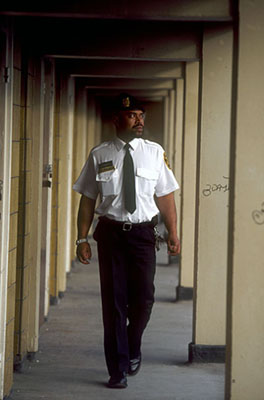
I have written before about the increasing use of private security and the erosion of liberty in public space so I was interested in a piece in today’s Guardian, ironically, the result of a Freedom of Information request:
City of London security guards told to report ‘suspicious’ photographers
It seems increasingly clear that unelected, untrained and under qualified security guards from private companies (operating for profit) are deciding who has freedom to walk the streets and carry out perfectly legal activities … like taking photographs in a public space.
Interestingly, the article asserts that both the Association of Chief Police Officers (Acpo) and John Yates, Britain’s most senior counter-terrorism officer, have warned that police risk losing the support of the public through the inappropriate use of section 44.
Surely not.
I first photographed the burgeoning private security industry in the late 1990s for several magazines and over the years have continued to have assignments to do so.

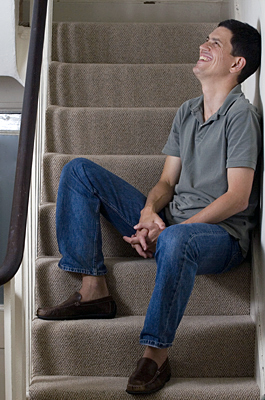
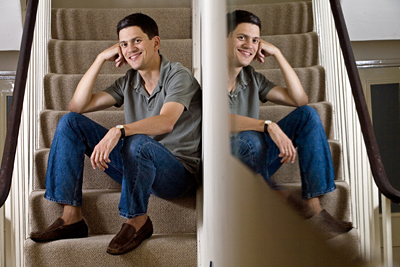
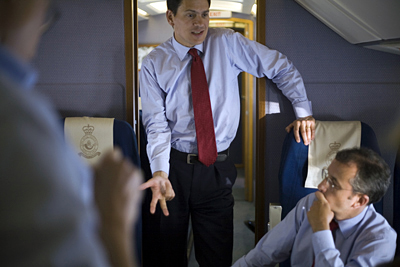
As the Labour government loses power and its party leader, the front runner to take the reins is David Miliband. I made a large story about him for the Times Magazine a little over a year ago.




Today, the Duckrabbit site said some rather lovely (and entirely undeserved) things about my work. Thank you.
So, as two further national newspapers swing their support away from Gordon Brown, all indications a week before the election point to a hung Parliament controlled by the Tories. My views on this are complicated: when all the parties represent the Market and the status quo there IS no choice, however my formative political years were formed under the Thatcher government and so I reserve a particular dread for the Bullingdon Club‘s entry into Number 10.
I haven’t photographed elections – or much British politics – for a long time. I do however remember a particularly depressing April dawn dropping rolls of film off at Der Spiegel’s office after photographing John Major celebrating victory in 1992.
Subsequent years of PR-dominated press conferences and stage-managed photo opportunities made me less interested and I turned my attention to the world outside the UK. I do occasionally get to photograph politicians however. Here’s one of the Man that would be King taken a couple of years ago on assignment for the Times Magazine.

I leave my final thoughts to one of my favourite essayists, Emma Goldman, whose views on the subject echo my own:
“If voting changed anything, they’d make it illegal…”
No gods, no masters.
Happy May Day.
So, I made it through the Ash cloud after all and spent six days on assignment in Israel. Lovely job in Tel Aviv and Jerusalem: travel and food. Nice. I hadn’t spent much time in Tel Aviv before and really enjoyed the experience. Jerusalem was another story however. I’d forgotten that this can be the rudest city on the planet and with some notable exceptions (pretty much all the taxi drivers – notably, Benny and Salim the unfailingly helpful staff at the Addar, Samir at Pasha’s and half a dozen lovely stallholders at Mahane Yehuda market – especially Itzack and his boys), I had to really dig in and grit my teeth. What is it about Jerusalem that makes people so rude and unfriendly? Maybe I caught it on a bad couple of days – I tried, I really did but it was a bit of a slog. I had just had a particularly unpleasant encounter and was packing up for the day when I was beckoned over by a friendly fishmonger. Moses insisted that I sit down and take his picture and that we should pose together…

A real gentleman. Moses, you’ll probably never read this but you restored my faith in the city and it even made up for the hour and more grilling I had at the airport the next day (note to self: next time use the empty passport – not the one with the Saudi, Afghan, Lebanese and Pakistani stamps).
Shalom.
Three years ago, while working in Tamil Nadu, I came across a story that I determined to return to and photograph.
_____________
“What we do here is the work of God and that work is spread through our blood” says Radhakrishna Stapathy.
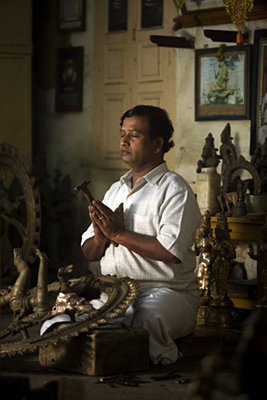
It is just after dawn and Stapathy squats cross-legged on a wooden block, a small hammer between his palms drawn to his forehead in prayer. In front of him, a large statue, freshly cast to which he will bring life by smoothing its metal through long hours of patient work.
Stapathy is an idol maker, a caster of statues, a master craftsman and one whose lineage can be traced backwards twenty three generations to the time that the great Chola Empire that ruled South India more than seven hundred years ago.
Swamimalai is a sleepy temple town deep in Tamil Nadu. Five hours drive from the bustling noisy city of Chennai (formerly Madras); it has a rhythm of a time that has been. Peasants winnow grain under the wheels of passing trucks and bend low in fields ankle deep in rich soil and bullock pull carts along dirt tracks.
This is the heartland of Tamil Dravidian culture and the landscape is linked organically to its religion with every field, every village, paying homage to a deity. A sacred geography links its towns where great palaces of temples provide, in the eyes of the faithful, a real home for the Gods.
The Stapathy studio, fronted by two (relatively) modern offices, is a dark and cavernous space that ironically resembles a temple itself. Men sit of the floors dressed in stained dhotis, deep in concentration, chipping and finishing statues and icons in the warm air filled with incense and the smell of the damp, cool earth under bare feet.
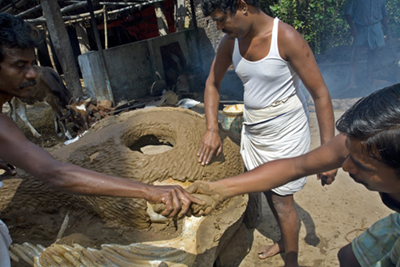
In the courtyard outside, three men mould clay around perfectly carved wax images that will melt on the introduction of molten metal. This ‘lost wax’ process was described by August Rodin as “the most perfect representation of rhythmic movement in art.”
The art of bronze casting can trace its origins from the Indus Valley civilization reaching its zenith during the Chola period in the Thanjavur delta during the 9th-11th centuries A.D.
At the end of the reign of Rajaraja, the greatest Chola king a magnificent temple was built in his capital, Tanjore. On its completion in 1010, the Cholas had donated 500 tons of gold, jewels and silver as well as sixty bronze images of deities to the new structure.
The temples at Tanjore, Chidambaram and Gangaikondacholisvaram are still dark, mysterious places alive with pilgrims prostrating themselves in cavernous halls before oiled black-stone images of gods and demons eerily lit by camphor lamps. They worship before the most famous incarnation of Shiva – Nataraja who elegantly dances the world into destruction and re-birth.
The Stapathy family were originally stonemasons but were called to Tanjore to learn the new art. It was discovered that that the fine silt from the nearby Kauvery River suited the moulding of the bronzes and the process has not changed since.
“Here is our culture,” says Stapathy and rows of half finished pieces peer from the shadows. All around, wax figures sit cool in great bowls of water: arms, legs, and heads like a battle hospital for Gods. Moulds of countless beings are stacked on dusty shelves around the walls. Later, at his house, across the street, Radakhrishna, now joined by his brother Srikanda, perform a puja at their family shrine honouring their ancestors. “It’s like this,” says Srikanda. “We need no training, a fish doesn’t need lessons of how to live in water: we are born for this work. And the work is good… orders are there and money is there”. Indeed, work is brisk and the brothers’ skills are in demand all across the Indian diaspora. Temples in London, California and Canada want idols crafted in the tradition of their fathers and pay handsomely for the privilege. There are other families that make idols “but” says Radhakhrishna, “none know the Sanskrit, none can make the prayers… we only are keeping the Chola king’s tradition.”
As the afternoon draws on, sweating men carefully pour molten metal into a mould held tight in the earth. Later, in a flurry of steam and almost divine heat, a statue will emerge beneath their hammers onto the workshop floor and, if the prayers have been performed properly, the process will produce an idol. Depending on its size it may take weeks to prepare for its ‘birth’ when its eyes are sculpted and its ‘Jeevan’ or life force will be breathed into it, it will, for a set time (depending on where it ‘lives’ and how faithfully it’s worshipped) become in a real sense, a God.
Dawn again, with the streets quiet, Radhakrishna pulls his skirt around him and steadies himself on his wooden seat. Still for a moment, he takes his chisel and checks his cutting line. He makes an incantation and the room is gently filled with the tap-tapping of a hammer. A noise that echoes across the room, across his family and across generations.
©Stuart Freedman 2010
In his recent book, the historian William Dalrymple devotes a chapter to the idol makers.



I’m sitting at home waiting anxiously to see whether an assignment in Israel will actually happen on Thursday as planned or whether the Icelandic volcano, Eyjafjallajökull, will have the last laugh.
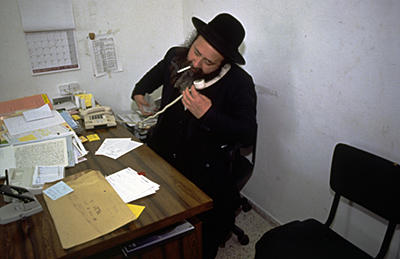
Looking through my archive, I found that the last time I was there, I had an assignment to photograph a Rabbi detective. Very interesting chap – a sort of Yiddish Philip Marlowe. Anyway, here’s a few pictures from that trip when airline travel was easier…


I was (surprisingly) invited to give a talk about ethics and photojournalism at the National Union of Journalists (NUJ) a few nights ago. Here’s the link:
http://londonphotographers.org/2010/03/stuart-freedman-on-ethics-photojournalism/