So, I made it through the Ash cloud after all and spent six days on assignment in Israel. Lovely job in Tel Aviv and Jerusalem: travel and food. Nice. I hadn’t spent much time in Tel Aviv before and really enjoyed the experience. Jerusalem was another story however. I’d forgotten that this can be the rudest city on the planet and with some notable exceptions (pretty much all the taxi drivers – notably, Benny and Salim the unfailingly helpful staff at the Addar, Samir at Pasha’s and half a dozen lovely stallholders at Mahane Yehuda market – especially Itzack and his boys), I had to really dig in and grit my teeth. What is it about Jerusalem that makes people so rude and unfriendly? Maybe I caught it on a bad couple of days – I tried, I really did but it was a bit of a slog. I had just had a particularly unpleasant encounter and was packing up for the day when I was beckoned over by a friendly fishmonger. Moses insisted that I sit down and take his picture and that we should pose together…
Israel - Jerusalem - Me and the friendliest man in town
A real gentleman. Moses, you’ll probably never read this but you restored my faith in the city and it even made up for the hour and more grilling I had at the airport the next day (note to self: next time use the empty passport – not the one with the Saudi, Afghan, Lebanese and Pakistani stamps).
Three years ago, while working in Tamil Nadu, I came across a story that I determined to return to and photograph.
_____________
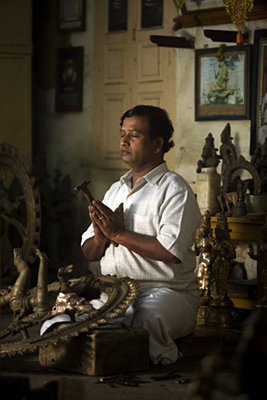
“What we do here is the work of God and that work is spread through our blood” says Radhakrishna Stapathy.
It is just after dawn and Stapathy squats cross-legged on a wooden block, a small hammer between his palms drawn to his forehead in prayer. In front of him, a large statue, freshly cast to which he will bring life by smoothing its metal through long hours of patient work.
Stapathy is an idol maker, a caster of statues, a master craftsman and one whose lineage can be traced backwards twenty three generations to the time that the great Chola Empire that ruled South India more than seven hundred years ago.
Swamimalai is a sleepy temple town deep in Tamil Nadu. Five hours drive from the bustling noisy city of Chennai (formerly Madras); it has a rhythm of a time that has been. Peasants winnow grain under the wheels of passing trucks and bend low in fields ankle deep in rich soil and bullock pull carts along dirt tracks.
This is the heartland of Tamil Dravidian culture and the landscape is linked organically to its religion with every field, every village, paying homage to a deity. A sacred geography links its towns where great palaces of temples provide, in the eyes of the faithful, a real home for the Gods.
The Stapathy studio, fronted by two (relatively) modern offices, is a dark and cavernous space that ironically resembles a temple itself. Men sit of the floors dressed in stained dhotis, deep in concentration, chipping and finishing statues and icons in the warm air filled with incense and the smell of the damp, cool earth under bare feet.
In the courtyard outside, three men mould clay around perfectly carved wax images that will melt on the introduction of molten metal. This ‘lost wax’ process was described by August Rodin as “the most perfect representation of rhythmic movement in art.”
The art of bronze casting can trace its origins from the Indus Valley civilization reaching its zenith during the Chola period in the Thanjavur delta during the 9th-11th centuries A.D.
At the end of the reign of Rajaraja, the greatest Chola king a magnificent temple was built in his capital, Tanjore. On its completion in 1010, the Cholas had donated 500 tons of gold, jewels and silver as well as sixty bronze images of deities to the new structure.
The temples at Tanjore, Chidambaram and Gangaikondacholisvaram are still dark, mysterious places alive with pilgrims prostrating themselves in cavernous halls before oiled black-stone images of gods and demons eerily lit by camphor lamps. They worship before the most famous incarnation of Shiva – Nataraja who elegantly dances the world into destruction and re-birth.
The Stapathy family were originally stonemasons but were called to Tanjore to learn the new art. It was discovered that that the fine silt from the nearby Kauvery River suited the moulding of the bronzes and the process has not changed since.
“Here is our culture,” says Stapathy and rows of half finished pieces peer from the shadows. All around, wax figures sit cool in great bowls of water: arms, legs, and heads like a battle hospital for Gods. Moulds of countless beings are stacked on dusty shelves around the walls. Later, at his house, across the street, Radakhrishna, now joined by his brother Srikanda, perform a puja at their family shrine honouring their ancestors. “It’s like this,” says Srikanda. “We need no training, a fish doesn’t need lessons of how to live in water: we are born for this work. And the work is good… orders are there and money is there”. Indeed, work is brisk and the brothers’ skills are in demand all across the Indian diaspora. Temples in London, California and Canada want idols crafted in the tradition of their fathers and pay handsomely for the privilege. There are other families that make idols “but” says Radhakhrishna, “none know the Sanskrit, none can make the prayers… we only are keeping the Chola king’s tradition.”
As the afternoon draws on, sweating men carefully pour molten metal into a mould held tight in the earth. Later, in a flurry of steam and almost divine heat, a statue will emerge beneath their hammers onto the workshop floor and, if the prayers have been performed properly, the process will produce an idol. Depending on its size it may take weeks to prepare for its ‘birth’ when its eyes are sculpted and its ‘Jeevan’ or life force will be breathed into it, it will, for a set time (depending on where it ‘lives’ and how faithfully it’s worshipped) become in a real sense, a God.
Dawn again, with the streets quiet, Radhakrishna pulls his skirt around him and steadies himself on his wooden seat. Still for a moment, he takes his chisel and checks his cutting line. He makes an incantation and the room is gently filled with the tap-tapping of a hammer. A noise that echoes across the room, across his family and across generations.
In his recent book, the historian William Dalrymple devotes a chapter to the idol makers.
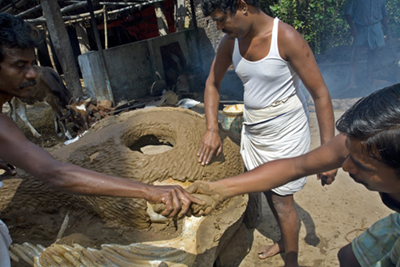
India - Tamil Nadu - Master craftsmen Radhakhrishna Stpathy (r) and his brorther, Srikanda mould an icon in wax in their workshop in Swamimalai, India..The current Stpathy family is the twenty third generation of bronze casters dating back to the founding of the Chola Empire. The Stapathys had been sculptors of stone idols at the time of Rajaraja 1 (AD985-1014) but were called to Tanjore to learn bronze casting. Their methods using the 'lost wax' process remains unchanged to this day..India - Tamil Nadu - Workers sealing and covering a wax mould of an icon with clay ready to be fired in the pit at the workshop in Swamimalai, India.India - Tamil Nadu - Master craftsman Pranava Stapathy instructs another craftsman whilst working on a large statue of Hanuman, the monkey God at the workshop of S. Devasenapathy Stapathy and Sons.India - Tamil Nadu - A craftsman pours wax into a mould from which a statue will be cast from bronze. India - Tamil Nadu - A worker carves a wax mould of an icon in the studio of the Stpathy family of idol makers, Swamimalai, India.India - Tamil Nadu - Workers cast an icon in the pit at the workshop of the Stpathy family, SwamimalaiIndia - Tamil Nadu - Radakrishna Stpathy directs the breaking open of a icon mould at his workshop in SwamimalaiIndia - Tamil Nadu - A finished icon of the God Shiva shown here in the form of the dancing Nataraja.India - Tamil Nadu - A priest by a shrine at the Murugan temple stands in front of a shrine containing a ritual idolIndia - Tamil Nadu - Devotees light oil lamps in the Murugan temple India - Tamil Nadu - Master craftsman Radhakhrishna Stpathy, works on the final touches to a statue of the dancing Nataraja at dawn in his workshop
I’m sitting at home waiting anxiously to see whether an assignment in Israel will actually happen on Thursday as planned or whether the Icelandic volcano, Eyjafjallajökull, will have the last laugh.
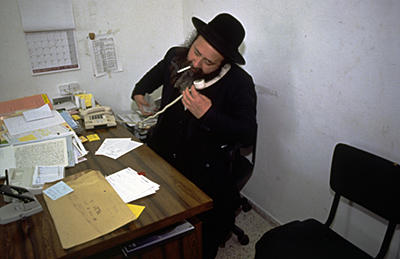
Looking through my archive, I found that the last time I was there, I had an assignment to photograph a Rabbi detective. Very interesting chap – a sort of Yiddish Philip Marlowe. Anyway, here’s a few pictures from that trip when airline travel was easier…
Israel - Jerusalem - Yehuda Gordon, a Jerusalem based Rabbi that is charged by the Rabbinical courts to trace errant husbands that refuse to divorce their wives and so deny them access to the their rights under Jewish law.Israel - Jerusalem - Israeli soldiers pray at the 'Wailing' or Western Wall in JerusalemIsrael - Jerusalem - an Orthodox Jewish boy
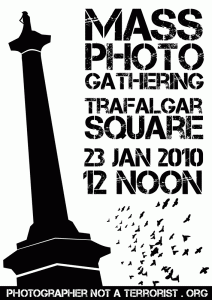
I urge everyone to attend a mass photo gathering in defence of street photography on January 23rd at Midday in Trafalgar Square organised by the pressure group I’m a Photographer not a Terrorist.
As their website eloquently states:
Photography is under attack. Across the country it that seems anyone with a camera is being targeted as a potential terrorist, whether amateur or professional, whether landscape, architectural or street photographer.
Not only is it corrosive of press freedom but creation of the collective visual history of our country is extinguished by anti-terrorist legislation designed to protect the heritage it prevents us recording.
This campaign is for everyone who values visual imagery, not just photographers.
We must work together now to stop this before photography becomes a part of history rather than a way of recording it.
Images are funny things though and far be it from me to suggest that our rights are being eroded on a day to day basis by those that seek to make our lives more secure… but here are just a few recent developments to may be of interest:
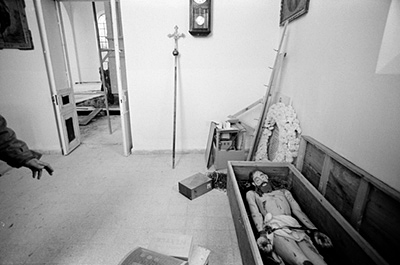
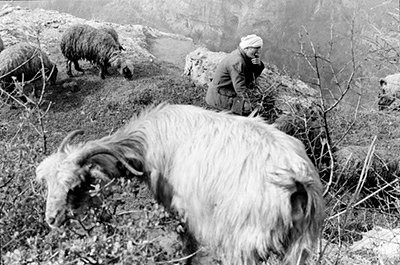
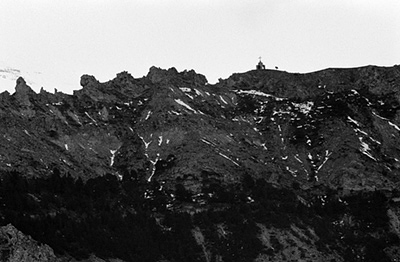
As I slowly melt into the armchair under the weight and fug of too much food, alcohol and bad television I wondered what I could post that had some flavour of Christmas, image-wise… Seeing as I’ve never shot a Christmas story or stock at this time of year, I’m struggling a bit. I have come up with an old story I made in Northern Lebanon in 1998 about the work of Khalil Gibran, author of the Prophet. I travelled to B’sharre, then under the de facto control of the Syrian army of occupation and worked on a piece that illustrated the themes of Gibran’s poetry. Here are some pictures.
Lebanon - B'charre - A effigy of Christ in a coffin in a Maronite church in Khalil Gibran's birthplace in Northern LebanonLebanon - B'charre - A crucifix painted on a wall in the snow in Khalil Gibran's birthplace, B'charre, Northern Lebanon. The area is occupied by Syrian troops and so the indigenous population paint crucifixes as a symbol of oppositionLebanon - B'charre - A mysteriously empty coffin in a graveyard in Khalil Gibran's birthplace, B'charre, Northern Lebanon.."... do not grieve for me... I am gone from this place...". GibranLebanon - B'charre - An elderly Maronite Christian couple leave church in Khalil Gibran's birthplace, B'charre, Northern LebanonLebanon - B'charre - Dying flowers on a tomb in Khalil Gibran's birthplace, B'charre, Northern LebanonLebanon - B'charre - A shepherd and his flock of sheep and goats near Khalil Gibran's birthplace, B'charre, Northern Lebanon.. ..." And He put His hand upon my shoulder and said, "From this day you shall love this sheep more than any other in your flock, for she was lost and now she is found"...GibranLebanon - B'charre - A cross stands on a hillside in the Quadisha Valley near Khalil Gibran's birthplace, B'charre, Northern Lebanon. The Valley was the last refuge of the Maronire Christian hermits after the Islamic (Arab) invasions.
It’s with some relief that I read today in the Times of India that proposals to institute identity cards and entry fees to Bangalore parks have been scrapped.
The extraordinary idea, the brainchild of Horticulture Minister, Umesh Katti was to restrict entry to two of the ‘Garden City’s’ finest public spaces, Lalbagh and Cubbon Park to those that could afford, as he put it, the ‘paltry sum’ of Rs.200/-“. Further, identity cards would only be issued to those that had been ‘vetted’ over security concerns.
Lalbagh (Red Garden) is around two hundred and fifty years old. Cubbon Park, a British creation, is a century old. Both are a counterweight to the modernist, business friendly theme park that are the suburbs of modern Bangalore. Like most Indian parks they are populated by walkers, joggers, lovers, hawkers and the poor, sometimes untidily sleeping where they can. Oh, and Bangalore has a Laughter Club (a very Indian get-together where people laugh in groups to improve their health). Subversives all. Dangerous, anti-social elements that need checking and vetting and searching.
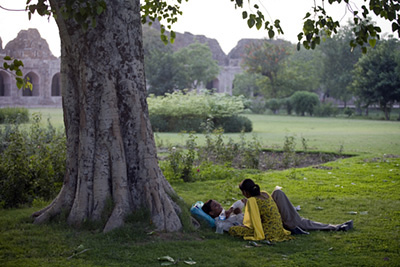
The case is interesting as it touches something that I have been photographing in Delhi for a while – Indian public space. Because cities are so crowded, public spaces become part of the personal, private sphere – a microcosm of Indian society. India has a profound love of gardens and greenery. I have written previously that all the major religions of this country have in some part a great reverence of nature – whether the gardens of the Mughals or the significance of the Bodhi tree for Buddhists or the garlanded offerings of Hindus. To privatise such public spaces for spurious ‘security concerns’ seems to me to be a very profound political statement. As Bhargavi Rao and Leo Saldanha of the local ‘Environment Support Group’ said. “It is an effort to showcase Bangalore as an elite, investment-friendly city where public spaces are out of bounds for local residents, especially the poor.”
“… the era of the Free Market has led to the most successful secessionist struggle ever waged in India – the secession of the middle and upper classes to a country of their own… where they merge with the rest of the world’s elite”.
The poor and those that don’t quite fit into a corporate strategy are an untidy blemish and need to be excluded.
In fact it is entirely analogous to what is happening in much of the Western (well, read the US and the UK) world. Britain is the most spied-on country in the world in terms of CCTV and legislation passed over the last twelve years has meant that fundamental freedoms that we took for granted – like being able to photograph in public where we pleased – are no longer guaranteed. Extensions to pre-charge detention means that suspects in the UK can expect to be detained for periods exceeding those of other comparable democracies. As Simon Jenkins wrote in the Guardian yesterday, since 1997, the UK government has created more than 3000 new offences. 1,472 at the last count were imprisonable. You can be jailed for not having a licence for a church concert, smoking in a public place, selling a grey squirrel, trans-shipping unlicensed fish, or disobeying a health and safety inspector. All underpinned by a profit motive for private companies who have interests in surveillance, security operatives and prisons. If we make citizens afraid of each other they will be more pliable: I know photographers in the UK that have admitted to self-censoring in public. Taking pictures of children, of property, of the police are now likely to lead to confrontation with authority. A company has already found a way to ‘monetise’ this by paying ordinary people to watch CCTV footage and report anything ‘suspicious’.
Section 44 of the Terrorism Act in the UK no longer requires authorities to have reasonable suspicion to search people for such subversive activities as photographing on the streets. We are all suspects that have to be monitored. All the time. For our own good. Usually by private security. For profit.
Soon there will be nothing public left of all our public spaces.
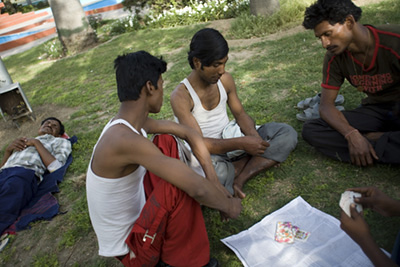
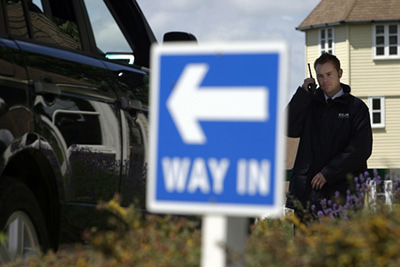
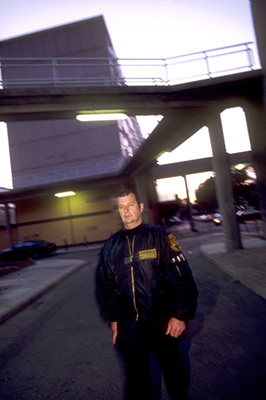
India - New Delhi - a bench in the early morning mist in Nehru ParkIndia - New Delhi - A yoga class in Lodi Gardens in front of the Bara Gumbad TombIndia - New Delhi - A couple in the grounds of the Purana Qila, New Delhi, India. Such parks are often the only place where young lovers can meet away from their parents and familiesIndia - New Delhi - Men play cards on a traffic island in New Delhi, India whilst one of their friends sleep. The traffic islands in the centre of the city often have manicured lawns and are well cared for. Many people sleep here at night but in the daytime they are used as small parks by workersUK - Cirencester - A private Security Guard examines the licence plate of a vehicle outside a Gated Community, UK - London - A Private Security Operative patrols South London council estate
I read yesterday that the World Bank is to lend India $1bn to clean up the Ganges River. The Ganges is one of the world’s most polluted waterways and supports perhaps 400 million people. Despite earlier government promises to make its water drinkable by 1989, it flows with industrial effluence and sewerage. As I wrote previously, a solution to the water crisis is crucial to India’s survival and as Sunita Narain (and others) have argued it needs an Indian solution.
I’ve been lucky enough to have been touched by the magic of this river often over the years. I’ve covered two Kumbh Melas (the enormous religious bathing pilgrimage that takes place four times every twelve years at the confluence of the Ganges and the Yamuna) and visited the extraordinary Varanasi many times. There is something touching, real and honourable about Indian’s reverence and awe at the Ganges; something that speaks about life and its transitory nature. It’s a beautiful thing to see villagers come hundreds of miles just to bathe in the river and feel its coolness at dawn as they submerge themselves. Humbling and puzzling to see the processions of corpse bearers literally running to the cremation grounds on the ghats in Varanasi to burn a body. I shall never forget my first sight of a body (suicides, children and snake bite victims are swallowed by the river whole) bloated, rolling and turning in the gentle waves of my boat one morning at dawn.
Some pictures:
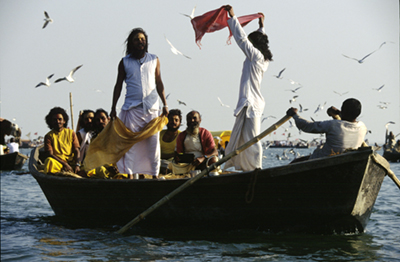
India - Varanasi - A man makes an offering to the Ganges at dawnIndia - Varanasi - A worker at the Burning or 'Manikarnika' Ghat tends a cremation pyre. The men are all from the same low caste called Dons - Dalit's or 'untouchable's' rendered ritually unclean by their workIndia - Allahbad - Pilgrims cross one of the many pontoon bridges erected at the Kumbh MelaIndia - Allahabad - Saddhus dry themselves after a ritual bath at the Kumbh MelaIndia - Allahabad - Pilgrims ritually bathe at the Ardh Kumbh Mela India - Allahabad - Saddhus in a boat at the Kumbh MelaIndia - Allahabad - A pilgrim and his wife get ready to immerse themselves in the Ganges as an act of religious purification
Hardy was a giant of the British documentary press tradition and is best remembered for his work for Picture Post Magazine. Born into poverty in Blackfriars he taught himself photography and was renowned for his sensitive, human images of war and everyday life.
Bert was an inspiration for me and I had the privilege to photograph him shortly before he died in 1995 upstairs in the flat above the darkroom that he’d set up near Waterloo. I had hoped to show that image here but after moving offices recently, I’ve mislaid the transparency. I will post it soon I hope. I’d also like to write more about the Bert Hardy Darkrooms and Charlie who tirelessly printed my work for more than a decade – and I will soon.
It seems that Graham, an extraordinarily talented photographer and now the creator of the Photo Histories website has found a huge number of Hardy’s unpublished images for Picture Post. Some of the very best will be shown for the first time.
The France 24 website has a lovely slideshow tribute to the last, truly great, mid- century French photographer, Willy Ronis.
I have always loved his work for it’s romantic but humanist perspective. The beautiful, evocative portrait of his wife, the Leftist artist Marie-Anne Lansiaux, at the sink – Nu Provençal (1949) is deservedly one of the most famous images in photography.
We used to distribute Rapho’s images at Network and I could never quite get over the thrill of being able to look into that extraordinary archive.
The last word to Ronis though who said that ‘to transform chaos into harmony is the constant quest of the seekers of images’.