Umbra Sumus
I’m usually a day or so late with things and the centenary of International Women’s Day is obviously no exception… A week or so ago on assignment I photographed an extraordinary woman, Sheela, who runs a tiny tea stall that backs onto a rag-pickers’ colony.
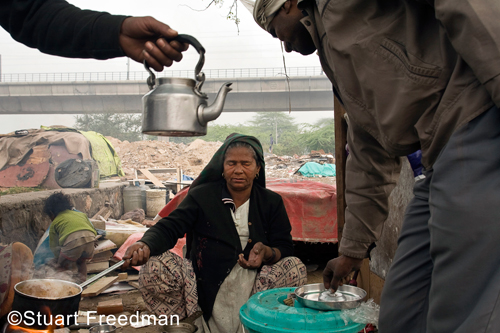
I can’t tell her story any better than see did.
“I came to Delhi a long time ago. I came here with my husband and he was working as a chowkidar. That was in 1981. A long time. Then it all went bad. From the beginning I stayed on this piece of land. My husband died here 21 years ago. My eldest son then became sick and he also died. That was sixteen years ago and then my youngest (son) died I think six years ago. We spent a lot of money to save them all but despite the medicines they all died. I couldn’t save any of them. I don’t know why I am still here. But I am here alone and I must survive.
At my tea stall I get up very early and serve the rag pickers who work on the dump behind me. I have had this business since the children died. I am not happy but I don’t have the means to change my life. I am alone. I am a woman. It is not easy. I don’t make so much money – tea is Rs5 a cup and I have to buy the tea and the sugar and recently all this has increased in price.
I suppose Delhi’s a good a place as another: there’s work, you can survive. I can’t think about the future can I? It’s a waste of time <laughs>.
I have to be happy in the present.”
I was intrigued to find in a copy of today’s Tehelka magazine an article on Raghu Rai, the rather wonderful godfather of Indian photography, where he says that “Shooting a portrait is like making love by surprise”. Now, to be fair, the article is, as they say credited to ‘as told to Yamini Deenadayalan‘ but nevertheless it does strike me as profoundly daft.
Unless of course I’m doing it wrong. On both counts…
It reminds me of ‘Swiss Toni’ of the Fast Show fame – a comic character – a rather sad second-hand car salesman with a natty line in shiny suits whose metaphor for everything in life is that “It’s like making love to a beautiful woman…”. His take on making a cup of coffee is here.
Here’s a recent portrait. I did nothing more than press the shutter. Honest.


Well, really, what were you expecting? Expertly taken by Mr Sharma for Rs30 (a bit heavy on the flash, mind) at Kalkaji Temple in Delhi yesterday.
Madly busy in the last few weeks – assignments from Newsweek, Monocle, Jolie and two clients that unfortunately I am unable to mention at the moment but (hopefully) more images soon…
Some of my images have been published in a new book on politics and photography called the Cruel Radiance by Susie Linfield.
In it, Linfield attempts to refute the argument that engagement with violent imagery makes the reader turn away. She argues that only by engaging with photojournalism and it’s unsettling commitment to documenting atrocity can we understand the world. It is an interesting time to take this line. Modern photojournalism has in the last few years, experienced a bleeding-into from the art world. I’ve written before about a cold un-connectedness that portrays people as butterflies under glass: a seeing that examines every facial detail but tells us nothing about context or the subject’s humaness. Linfield uses the example of Nachtwey, Peress and Capa in what I see as an unabashed attempt to reassert a traditional documentarian’s engaged position against the argument that all journalism of this kind is voyeuristic. Despite my work being included here, I do have reservations about documenting atrocity, but maybe the pendulum has swung far enough the other way: our sanitised, modern media tells us that only celebrity and money and excess are important. What happens over there is just not understandable. Linfield says that it is and it must be. Photojournalism is in need of a defender who can reclaim a moral relevance against Postmodern criticism that has done much to discredit the voracity of photography. We should not “drown in bathos or sentimentality,” Linfield says but “integrate emotion into the experience of looking.” We “can use emotion as an inspiration to analysis rather than foment an eternal war between the two.”

I am delighted to announce that I am now represented in Italy by Luz Photo. Founded by some of my former colleagues from the sadly missed Grazia Neri agency they look after some excellent photographers. I look forward very much to working with them.
You can see my folio page here or click on the image below.
Those nice people at Wonderful Machine in the ‘States have just written a very nice blog post about me and my upcoming assignment in Delhi. Read the full story here.