In 1996 I was assigned by the Independent on Sunday Magazine to photograph and write a story about Chandigarh, a city in India’s Punjab that had been entirely designed and planned along Modernist lines by the architect and planner, Le Corbusier. I first wrote about that assignment on this blog in 2010 – see here.
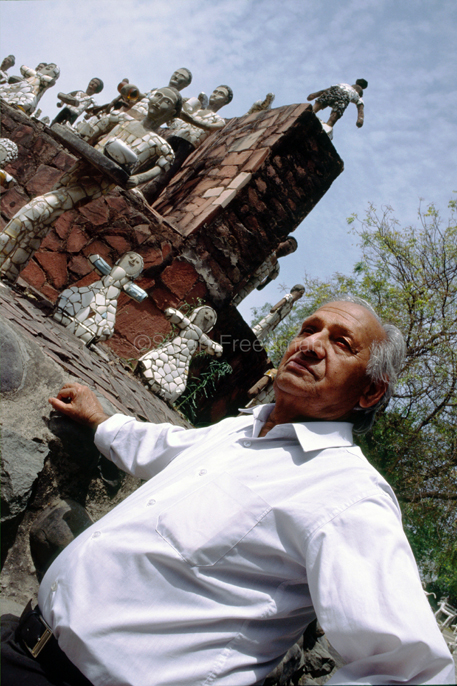
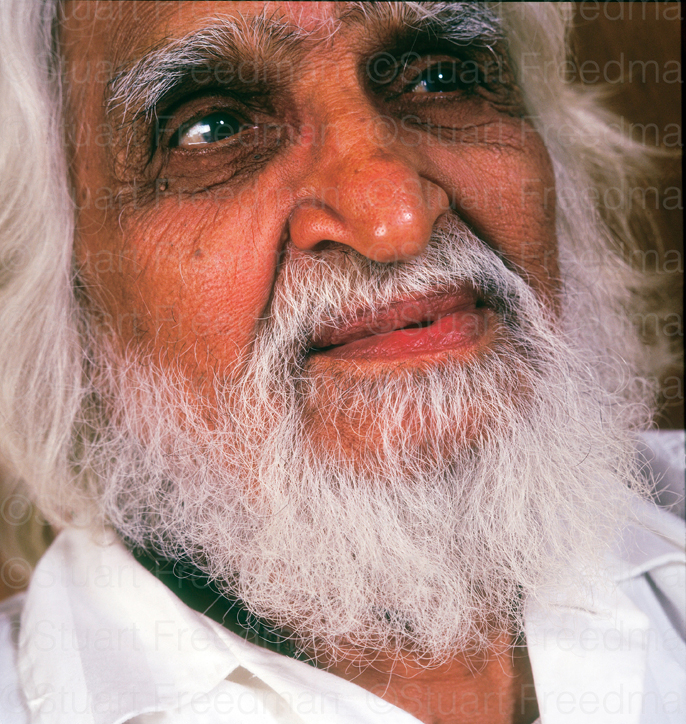
During that assignment, my driver recommended that I go and visit a rather dubious sounding rock garden that had been created. Bored and irritable under the blazing sun I turned up asking for a chap called Nick – responsible for what I believed was a inconvenience between me and my hotel room. I couldn’t have been more wrong. Nek Chand, the charming elderly man that met me had, in his spare time – in secret – over the last two decades, built the most extraordinary statue kingdom out of waste materials. By the time the authorities had discovered it, it had grown into a 13-acre complex of interlinked courtyards, each filled with hundreds of pottery-covered concrete sculptures of dancers, musicians, and animals. It was extraordinary. The garden had been embroiled in a fantastic tale of urban corruption, vandalism and official obfuscation but like all good Indian fables, right had triumphed and the forces of destruction had been defeated. The garden would become one of the most iconic sights in that city and Chandigarh would become proud of its amateur artist and his bizarre dream. This morning I learned that Nek Chand, one of the world’s dreamers had passed away at the grand old age of 90. What a sad loss.
India – Chandigarh – Nek Chand in his Rock Garden.
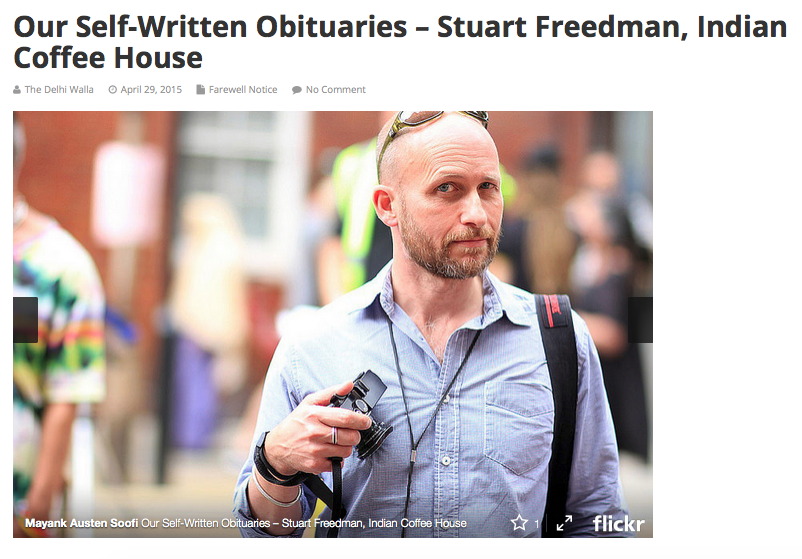
As a long time reader and follower of Mayank Austen Soofi, the Delhi flâneur, writer and photographer I was delighted, if rather daunted, when he chose me to write my own obituary as part of an occasional series on the city. It was, I must say a rather strange and sobering assignment but you can read all about it by clicking on the photograph below…
In 2013, I made a story about the now sleepy town of Chandannagar on the banks of the Hooghly River near Kolkata.
Chandannagar (or Chandernagore) was first established as a French colony in 1673 when the Nawab of Bengal gave permission to establish a trading mission. By 1730 when Joseph Francois Dupleix was appointed governor, Chandannagar had more than two thousand brick built houses and was the main European entry to the subcontinent. The British East India Company inconveniently flattened a good deal of it during its capture in 1756 but returned it to French rule in 1816. It was governed as part of France until 1950 when the inhabitants voted to join with the newly independent India.
As part of my story, I wandered into the Institut de Chandernagar, now a museum that was the original governor’s palace. Inside, amongst Colonial French artifacts, I found a mystery – and one that I found very moving and upsetting.
Here is what I wrote:
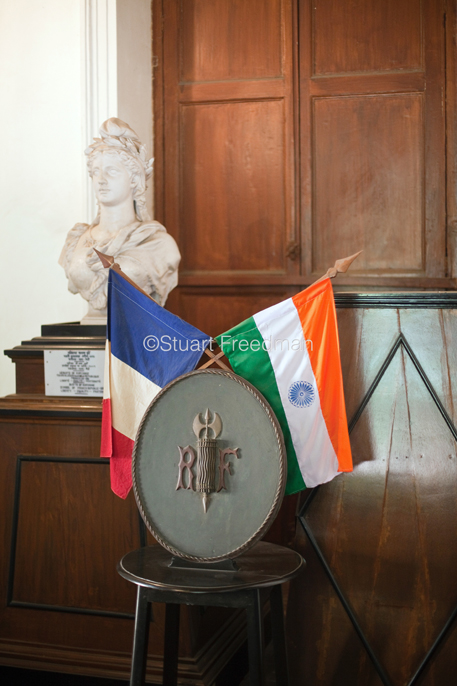
“In another dusty room a harpsichord gently decays, its keys like broken teeth, watched over by a small bust of a stern Napoleon. In a case, the last French flag, dirty and a little tattered. Dupleix’s own bed is enormous but deeply uncomfortable looking. Time has stopped here and moulders in the sticky, wet heat. Perhaps saddest of all, the shattered spectacles of Dr J N Sen MB MRCS Private West Yorkshire Regiment and a son of Chandannagar, killed in action on the night of 22/23rd of May 1916 in France. His, the dubious honour of being the first Bengali to do so. Why he was fighting for a British regiment is a mystery but how sad to die so far from the verdant splendour of the steamy jungle and the smell of jasmine oil in a woman’s hair.”
I had quite forgotten about this until this morning when I heard a short piece on the BBC Radio 4 programme, Today (if you listen it’s at 02:53:51) where Santanu Das (a reader in English at King’s College London) explains why Dr Sen was there. There is also a piece here from BBC Leeds published a few days ago that reports the story.
I remember standing there in the heat of the room feeling so utterly moved by the spectacles that I didn’t take a photograph but just jotted some words down and had to leave.
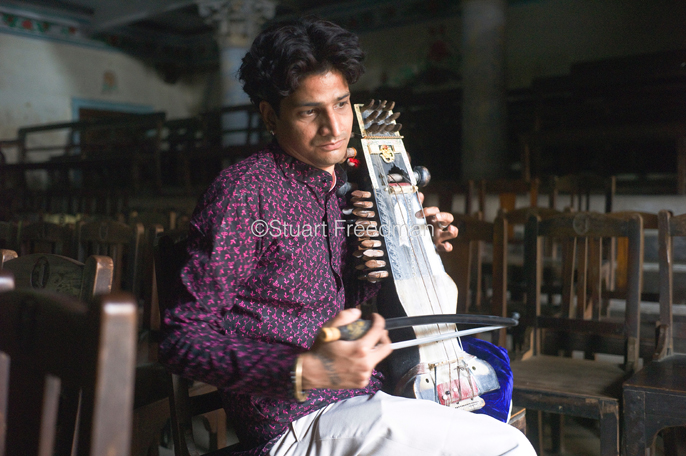
Here are some images from the story. The last frame shows the talented musician Umesh Mishra, playing his sarangi during a practice session for a concert he was giving that night in the town.
Perhaps that might be a fitting visual requiem for Sen.
India – Chandernaggar – Traffic passes the gates to the town of Chandannagar bearing the French inscription, Liberte, Egalite, Fraternite.
India – Chandannagar – A flag and a bust in the museum at Chandannagar, originally the home of Joseph François Dupleix who was appointed governor of the city in 1730.
India – Chandannagar – A statue of Liberty outside the museum in Chandannagar, originally the home of Joseph François Dupleix who was appointed governor of the city in 1730.
India – Chandannagar – Umesh Mishra, 26 a sarangi virtuoso tunes his instrument before a concert later that night at the Nrityagopal Smriti Mandir
Some assignments are straightforward, some take a bit more thought. When the London School of Economics assigned me to photograph Delhi for their global cities conference I was delighted but also slightly nervous.
The brief was to image the city illustrating the difficulties of living in and governing India’s sprawling, chaotic capital. My preference is always to try and make beautiful pictures – but trying to marry that with an exacting shoot list that focused on academic concepts was always going to be challenging. It was however, the shoot list (and my drivers and assistants – notably the ever-cool Sunayana) that saved me. I’m always talking about the importance of scripting what you shoot and this was a perfect example of how it can really help. This wasn’t an assignment about what I wanted to show of Delhi or interpreting the city – but clearly illustrating issues that affect it. In fact, it was a very interesting way to work – trying to find places or people that evidenced concepts as diverse as public/private space and illegal adaptions of utilities.
Born and brought up in London, I’m fascinated by cities and the way that they develop and change and Delhi for me has been a kind of surrogate city – a sort of prism through which to view myself and see how metropolises (and I dare you to find the correct plural of metropolis…) evolve and change. Delhi, like London is palimpsestic in that cities have been built on top of cities. I can walk through any number of places in Delhi and find the exact same things that Dickens wrote about for example – the very foundations of a modern industrial world – but I can also find something much older – the Vedic prayers intoned by people still worshipping on the banks of the hideously polluted Yamuna.
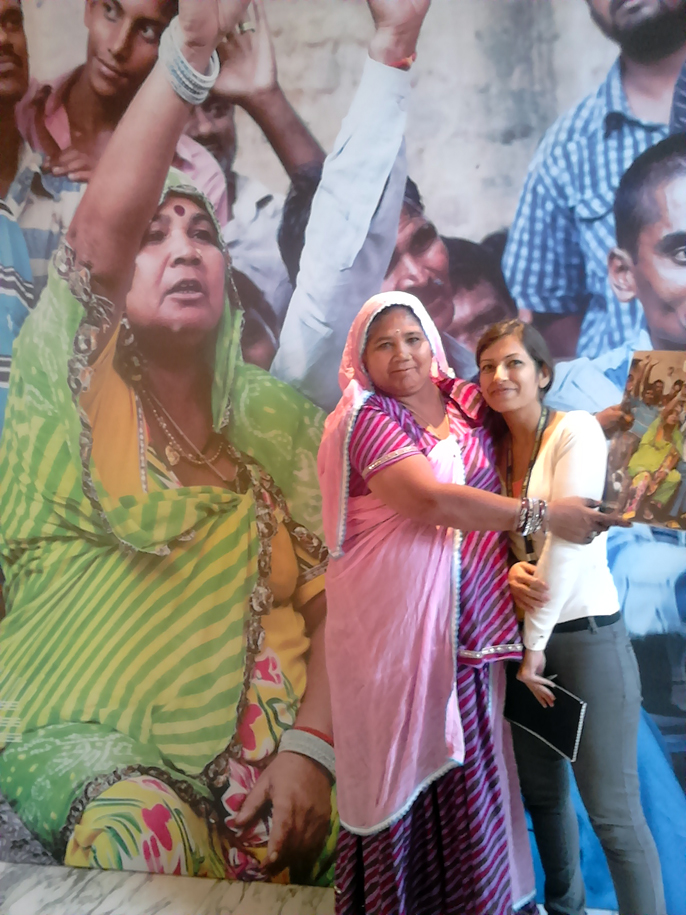
One of the highlights was returning to Kathputli Colony that I’ve written about before and making work with the people there trying to save their homes and way of life. I was delighted to be re-united with the singer Bhagwan Das and it is his wife Sarbati that’s shown at the end in the last picture here at the conference in front of a giant poster and on the cover of the magazine.
Here are some of the images that I made.
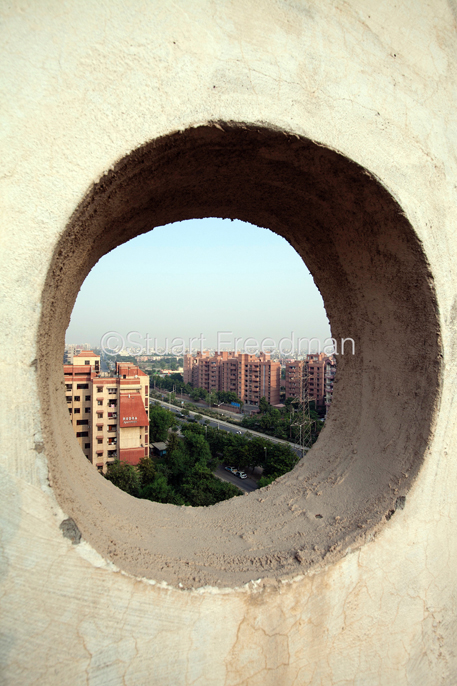
India – New Delhi – An overview of the city from an apartment block in Dwarka
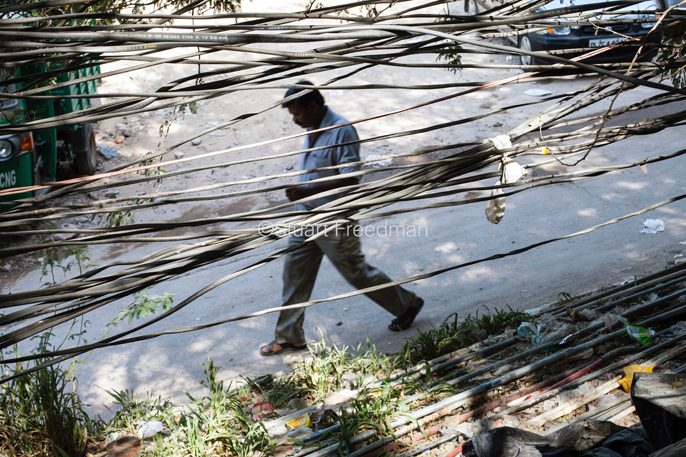
India – New Delhi – A man seen through a tangle of illegal electricity and water cables in the Munika area.
India – Delhi – A local meeting of residents and activists at Kathputli Colony that is faced with destruction and closure
India – Delhi – Crowds in Sadar Bazaar
India – New Delhi – Young people in make up perform a street dance on a road blocked to cars in a section of Connaught Place during a Raahgiri Day where traffic is halted and people take over the streets.
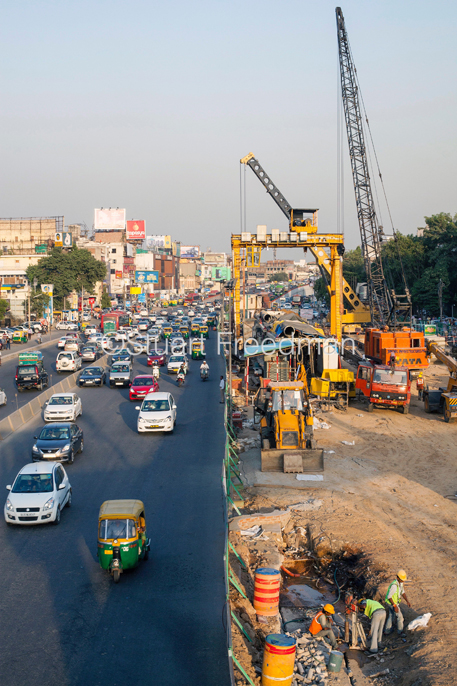
India – New Delhi – Traffic and Metro construction work at South Extension Market
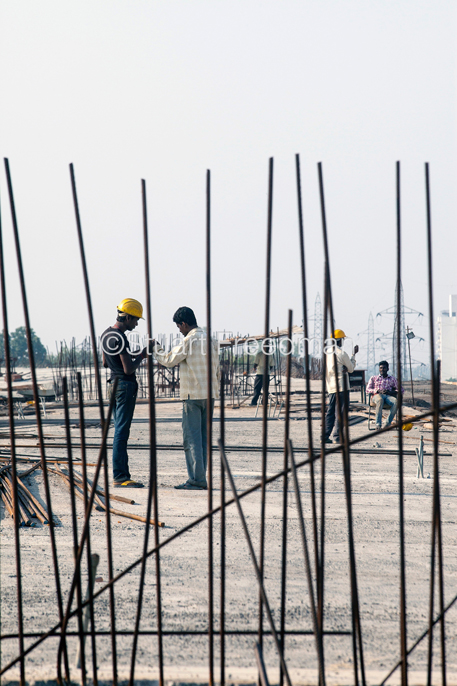
India – Delhi – Workers on the new footbridge over the Yamuna River
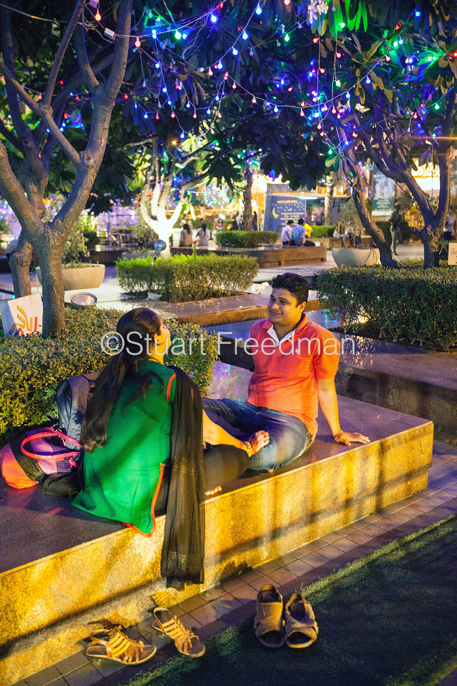
India – Delhi – A romantic couple sit in the gardens of the Ambiance Mall, Saket,
India – New Delhi – Sarbati Das from Kathputli Colony (in front of her cover image used as a poster at the LSE Cities Conference) and the brilliant Sunayana.
I’m quite a traditional photographer. To the surprise of many who see me working, I still expose my digital images the way I shot transparency film: carefully and with a hand-held meter. In this way, I’ve always had a problem with photographers that shoot real life and then work on their files afterwards to create a different, almost hyper reality. For photojournalists I find this very difficult to deal with and, as I’ve said before, I believe it can create a serious problem of authenticity and voracity. I find myself however at a stage of my career where I want to learn new things. I also find myself increasingly shooting personal projects with an eye to more commercial markets. Recently I’ve been trying to learn how to create a look that I feel happy with and that I can manipulate for a new project (that’s under wraps for now). After some deliberation and a lot of help from my friends – I have something I’m happy with. This may not be a very big step for some – very old hat to some people – but for me it’s an enormous one.
And it’s always good to learn something new. When was the last time we can honestly say that we have?
I won’t be shooting anything serious like this (in the sense of documentary work) but I may change and evolve a new process to reinvigorate things a bit on another front. Old dog/new tricks. Here’s one I made earlier.
What do you think?
before
India – Jaipur – An old man working as a scribe outside a shop in a Jaipur Bazaar
and after
India – Jaipur – An old man working as a scribe outside a shop in a Jaipur Bazaar
What a shame. It seems that production of the Ambassador, the first car to be made in India, has been halted. Hindustan Motors said it had suspended work at its plant outside the city of Kolkata, blaming weak demand and financing problems. There was always something reassuringly sturdy about bouncing along Indian roads in one. Never the most comfortable of cars but you could always reckon that a roadside mechanic would be able to bash, bend or replace something that had broken… Here’s a frame of a garland hanging from a mirror in one I hired in Tamil Nadu a few years ago…
India – Swamimalai – A garland of flowers hang from the mirror of an Hindustan Ambassador car in the town of Swamimalai, Tamil Nadu, India. The car, based on a Morris Oxford has been in production since 1948 and is considered as a definitive Indian car and is fondly called “The king of Indian roads”, nicknamed the ‘Ambi’..
I’m delighted that the V&A in London will be hosting a new show of MF Husain’s work this Summer.
I photographed Husain many years ago in his Bombay studio (I’ve previously written about him here and here) and he was as charming as he was prolific. How awful then that his work, a mixture of European Modernism and Indian imagery, is unlikely to be seen again anytime soon in his home country. He had to flee India in 2006 as Hindu militants put a bounty on his head, charging him with “offending religious sentiment”. The London show is, in a sense, a farewell to Husain but perhaps moreover, potentially to the ideas to which his art spoke: of a secular, tolerant India. As India rushes headlong into the clutches of corporations and those that seek to divide it’s people against one another (rigidly defining those who are and who aren’t an ‘acceptable’ Indian), it ironically may take the legacy of an elderly millionaire painter to act as a metaphor for the freedoms that ordinary Indians – indeed perhaps the idea of India itself – are in danger of losing.
India – Mumbai – MF Husain (b. 1915, Maharashtra) India’s foremost modernist painter at his studio in Mumbai (formerly Bombay). In the 1990s some of Husain’s works became controversial because of their portrayal of naked Hindu deities. Charges were brought against him by Hindu Nationalists but were dismissed by the Delhi High Court. Husain died in exile but his painting continue to command prices of several million dollars at auction.
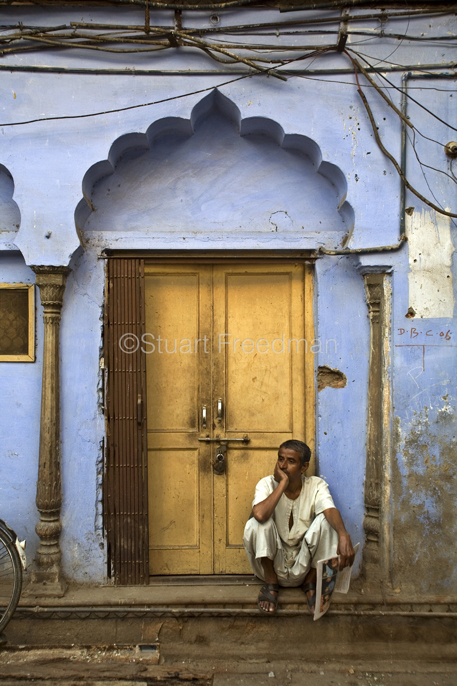
India – Delhi – A man lounges with his morning newspaper inside the remains of the Sultan Singh Ghar ki Haveli. Much of Old Delhi’s historical architecture is being lost to new development. Old Delhi, India
By tomorrow night, according to Human Rights Watch, more than 1,800 children will have died from preventable, treatable diarrhea, largely linked to lack of clean water and sanitary conditions.
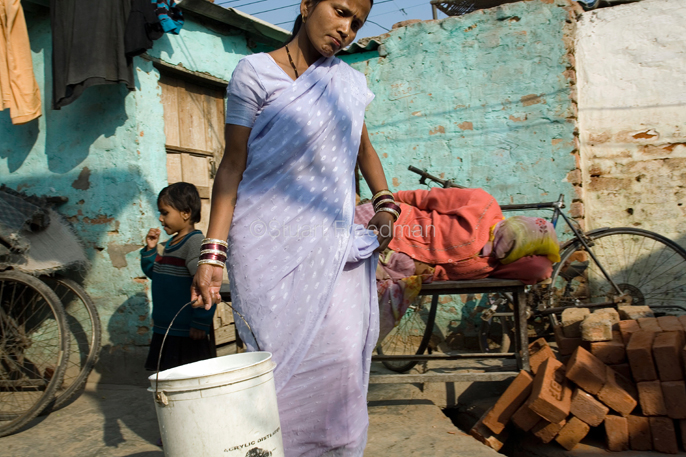
I’ve written several times about Delhi’s water wars and the struggle for its people to find any water, let alone clean water – (see here and here for a start). Here’s an image from the Kusumpur Pahari slum where that struggle for water is a daily one.
India – Delhi – A woman carries water delivered by tanker back to her home in the slum of Kusumpur Pahari. The slum, built more than thirty years ago has no running water or sewage facilities. The only water supply come from the Municipal JAL Board water trucks that visit several times a day. The deliveries are supposed to be free but in reality, residents must pay bribes to have the water delivered.