Growing Old in India


I have, for a long time been photographing around aspects of a changing India. These images, currently being syndicated, show a gentle side of a huge demographic change in that country. It is estimated that by 2020, the elderly population in India will nearly double to 150 million people. Better medical care and low fertility rates have made the elderly the fastest growing section of society. New wealth and urbanisation are starting to erode the foundations of traditional values and kinship. Today fewer than 40 percent of Indians live in so-called “joint families” where brothers share the family home with their parents even after they are married. In a country where only 10 per cent has any form of pension, “old people have to work till they die” says Mathew Cherian, Help Age India’s chief executive. Even specialised medical care is rare, as India has only two medical colleges in the entire country teaching geriatric care. After the Asian Tsunami, HelpAge India set up a pioneering experimental scheme called the Tamaraikulam Elders’ Village (TEV) in Tamil Nadu that initially cared for elderly people displaced by the tragedy. Today, the village is a self-sustaining community providing a family environment where more able-bodied residents assist the less able-bodied. The village provides 100 older people with a safe place to live, free healthcare, emotional security, a good diet and professional support.

I was fortunate enough to visit for a few days and make some work there. Work that for personal reasons has an enormous resonance for me.

Despite great effort (especially on the part of Jon Jones at the Sunday Times Magazine) they remain unpublished. Of all the stories that I have shot over the last few years, I really want to see this run somewhere: not because my images are so wonderful but rather because of what they show and the issue that they address.

My agency, Panos is syndicating a 35 image set that can be viewed here.

Here are seven of my favourites.
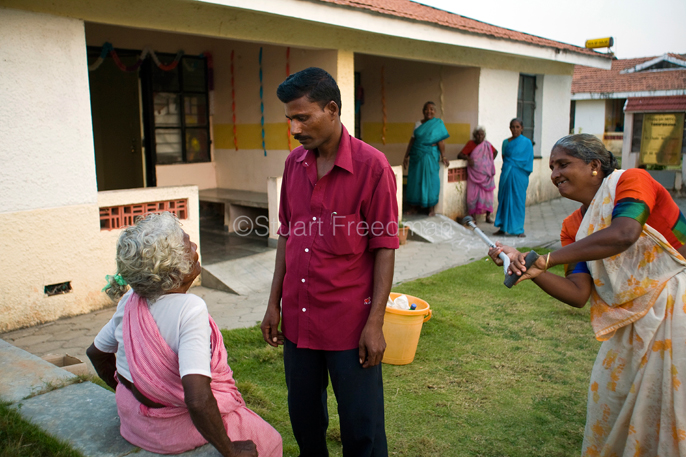


India – Tamil Nadu – Meena, 65 pretends to hit a male nurse with a crutch after he teased Janagi, 76 who is always cleaning around the village. Tamaraikulum Elders village, Tamil Nadu, India


India – Tamil Nadu – Manjani, 75 inside his room.


India – Tamil Nadu – An elderly resident shares a joke with her social worker in her room.


India – Tamil Nadu – Ganapadi and his wife, Khrisaveni residents in their room.


India – Tamil Nadu – A daily exercise class for residents.


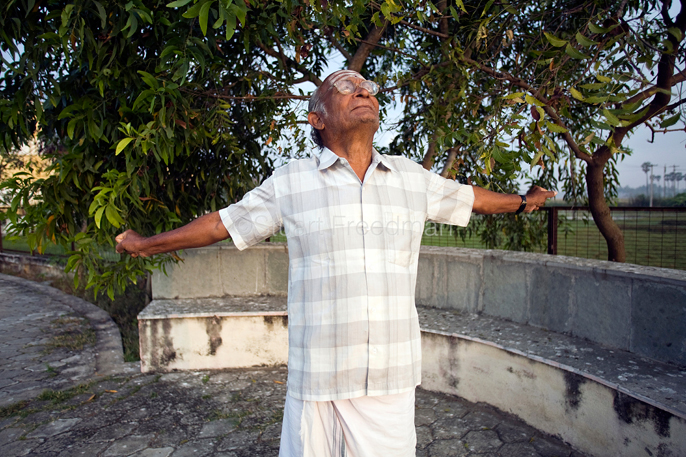
India – Tamil Nadu – An elderly resident stretches and takes the morning air at dawn by the lake at the Tamaraikulam Elders’ Village


India – Tamil Nadu – Meena, 65, an elderly resident, makes a fuss of one of the villages two dogs


The future of the rag-pickers


According to a piece in the Guardian, it seems that authorities in Delhi are piloting a project to tackle the city’s enormous waste problem but the solution may affect those whose livelihood depends on it. Currently, waste is sorted manually by an informal army of men, women and children and then passed on to middle-men to sell or recycle. Three new plants (one at Ghazipur) will, it is hoped, sort the 8000 tonnes of Delhi’s daily waste automatically. It is estimated that more than 50,000 people work in this informal sector (known as ‘rag-pickers’) in and around the capital. The work is terrible and dangerous but for a significant section of the transient population of one of the world’s fastest growing cities, it is at least a living.

Over the years, I’ve photographed and written about many of the city’s rag pickers who exist in a twilight, Dickensian world ignored by almost everyone, quietly making the city function in a most human but terrible way.


India – New Delhi – Buddhi Lal, 30, a rag-picker, works before dawn collecting refuse to recycle and resell. On a good day he can make perhaps Rs150-200


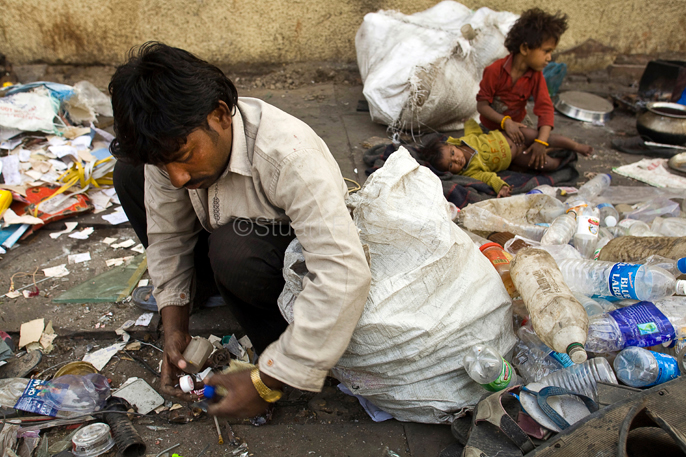
India – New Delhi – Buddhi Lal, 30, a rag-picker with his small children playing behind him on the pavement, sorts the refuse that he has collected during his dawn round to sell


India – New Delhi – A child rag-picker collecting plastic bottles (and anything else he can scavenge) from the carriage of a train at New Delhi Railway station


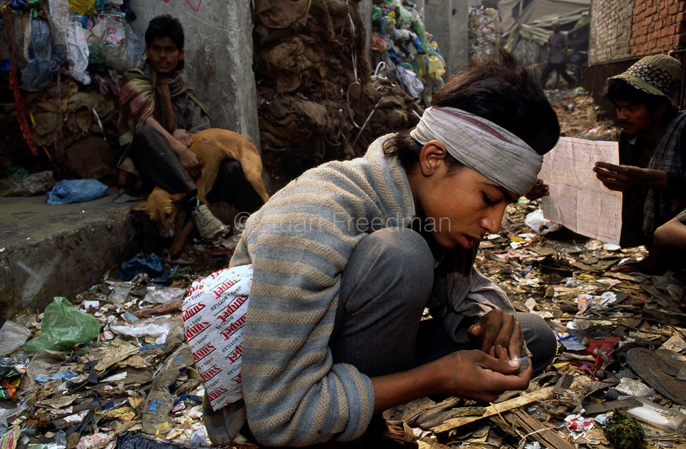
India – Delhi – A child rag-picker cleans his fingernail with an old razor blade at a rubbish depot in Old Delhi


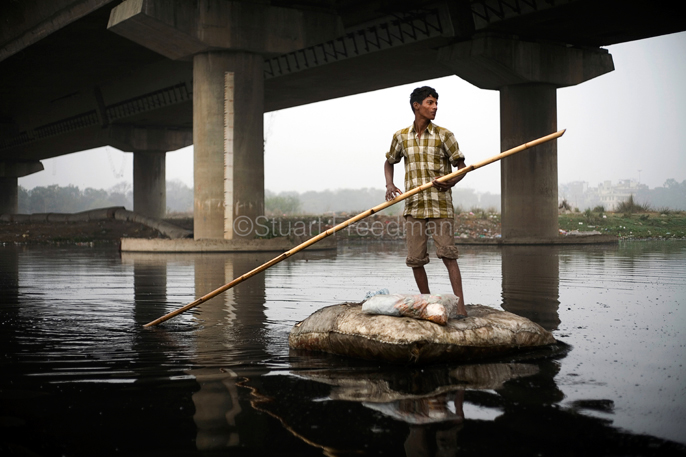
India – Delhi – A boy scavenger on the Yamuna River on a home-made raft of sacking and polystyrene. By dragging a magnet through the filthy water he collects scrap metal to sell


Delhi’s water mafia

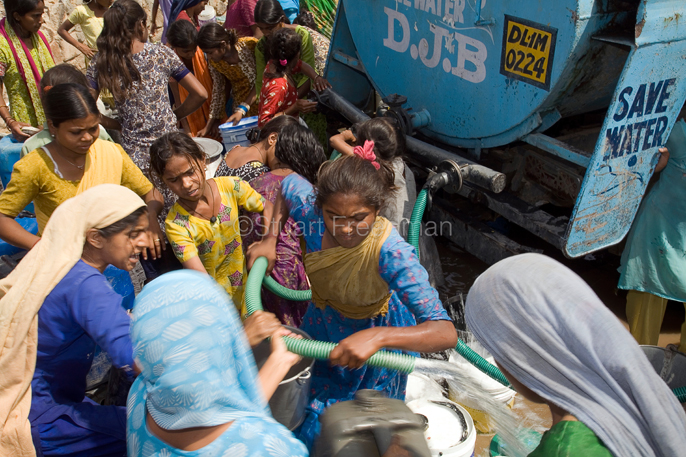
As Delhi labours under relentless 45 degree heat, the availability of water is as ever, a battleground. According to India Today (quoting an investigation by The Mail) reporters have uncovered a nexus of corrupt Delhi Jal Board (the local authority that looks after water in the city) employees and private tanker operators offering water for sale at inflated prices. Delhi, like many Developing World cities has a particularly rickety infrastructure when in comes to water supply. Illegal drilling of underground aquifers and horrendous pollution mean that at the best of times water supply is erratic. Add in seemingly endless low-level corruption and you have a perfect storm. I made a film about Delhi’s water wars a couple of years ago for Channel 4. You can see it here. As I said at the time, for the middle classes, access to water is an expensive and miserable inconvenience but to the poor and the slum dwellers, it is literally a daily fight. As my images show…


India – New Delhi – Slum dwellers scramble for water in Jai Hind Camp. The camp is home to perhaps 3000-4000 migrant workers from all over India. It has no water supplies at all so once a day, the Municipal JAL Board truck delivers some water. There is never enough for the expanding population to go around and some are left with nothing.


India – New Delhi – Women at the Kusumpur Pahari slum fight for water after a tanker delivery. Built more than thirty years ago the slum has no running water or sewage facilities. The only water supply come from the Municipal JAL Board water trucks that visit several times a day. The deliveries are supposed to be free but in reality, residents must pay bribes to have the water delivered.


India – New Delhi – A woman pushes her bike home after filling many cans from a water tanker in Kusumpur Pahari.


India – New Delhi – Middle class housewives in the Vasant Kunj area wait for water to be pumped into their water tanks from a JAL Board tanker. Vasant Kunj is one of many places in New Delhi that has frequent loss of mains water and relies on such infrequent tanker deliveries


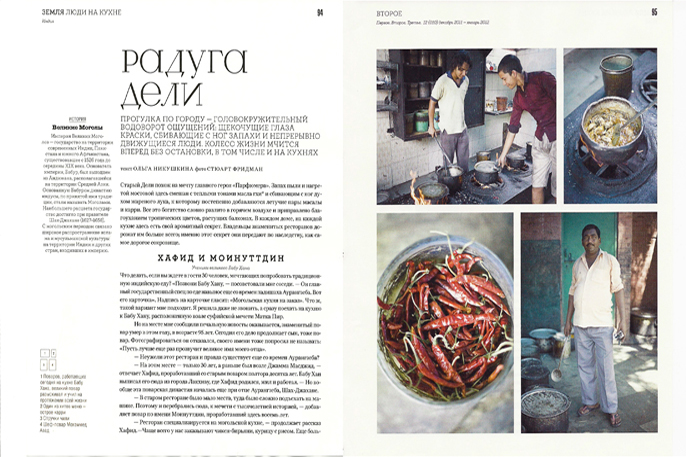
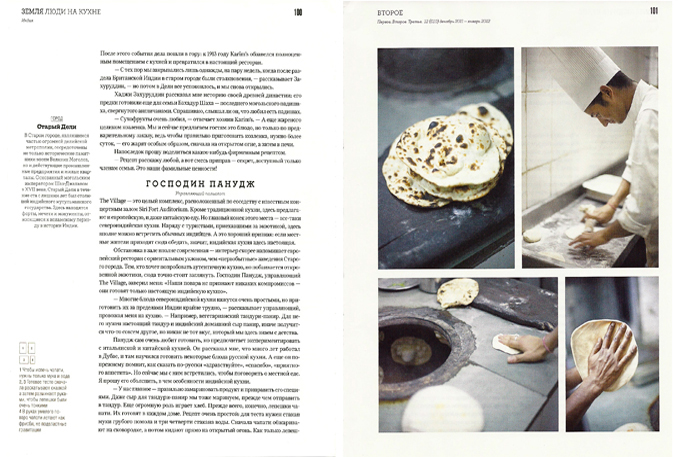
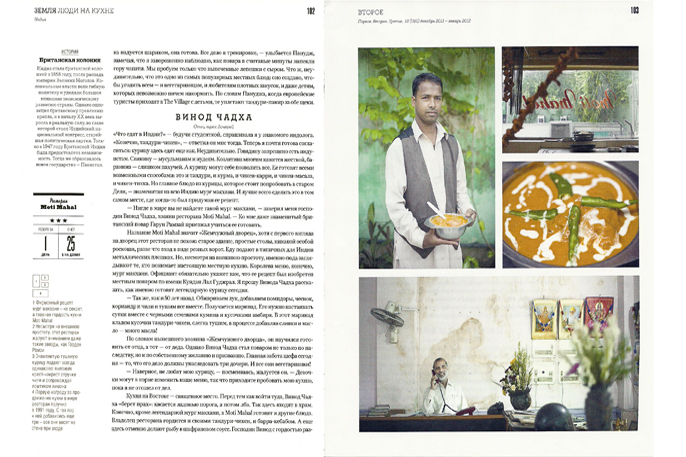
Tearsheet – Pervoe Vtoroe Tretye magazine

No, I don’t know how to say it either but this Russian magazine that commissioned me were utterly charming, paid well – before time – and were a pleasure to work with… My thanks to Olga, Evegeny and Natalia.

Another Delhi food story again soon…


Dickensian Delhi


I visited the Dickens exhibition at the Museum of London yesterday – a really powerful evocation of the writer and his times.

What always struck me about Dickens was his ability to convey the despair and misery that the city around him housed: no stranger to debt, his past was marked by the fear of slipping back into poverty. I think that the exhibition gave me a very apt adjective to describe the dark underside of a city that I have worked in so much, namely Delhi. Perhaps all societies lurching through such painful Capitalist development are like this – but certainly Delhi is Dickensian in its mercilessness and its cruelty. The lack of a safety net and not-so-subtle machinations of caste mean that the people who produce the city’s wealth by selling their labour are completely at the mercy of the vagaries of the Market and the violence of the street. In a similar fashion to Dickens’ time they must struggle against a whole moral code that tells them they are nothing if they have no status. I’ve mentioned here before a slim volume of reportage and writing from those at the bottom of the dark underbelly of this metropolis called Trickster City and the more that I looked at the exhibition yesterday, the more I thought of Delhi.

Dickens’ “slime and ooze of the Thames” is the realm of the boy who picks bits of detritus out of the poisoned Yamuna River on a pathetic raft of polystyrene and rags. Budi Lal, pouring through other people’s filth and rubbish and ignored by all except the snarling dogs and his debtors is Boffin, the Rag Picker from Our Mutual Friend. The men burning plastic bags could be from the slum in Bleak House; Tom-All-Alone’s.

All of them would recognise Victorian London.


India - New Delhi - A young scavenger on a raft, beneath the road bridge across the Yamuna River by the Kudsia Ghat, New Delhi. Scavengers trawl the filth of the river to find objects to sell. The river is so polluted that it can no longer support life, however a community still live and work on it's banks.


India - New Delhi - Buddhi Lal, 30 works before dawn collecting refuse to recycle and resell. Known as 'rag-picking' he can make perhaps Rs150-200 a day and is often chased and attacked by stray dogs because of the smell of his work


India - Delhi - Destitute men gather around a fire made from refuse and plastic bags to try and keep warm. It is estimated that around 100000 people are homeless in the city


Action Aid Photos of the Year

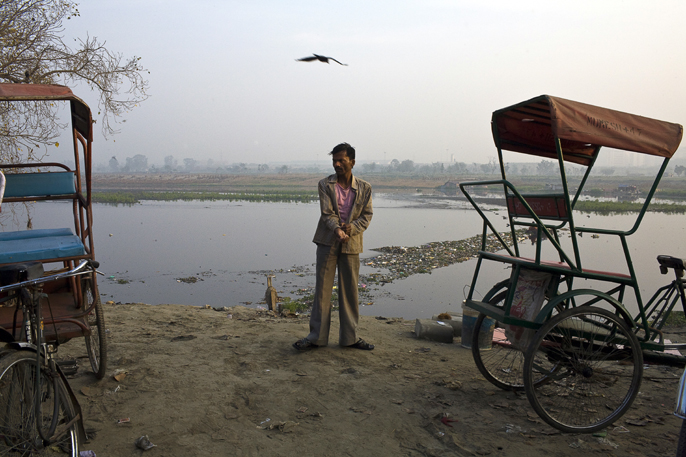
India - Delhi - A homeless cycle rickshaw driver dresses at a parking lot next to the Yamuna River where he sleeps


I’m delighted to say that this image has just been chosen as one of Action Aid’s images of the Year. The full set is here.


Delhi at 100

There’s a rather charming slideshow on the BBC here on the changing face of Delhi by one of its elderly residents. A shame that the city authorities haven’t made more of this to be honest. Delhi remains an enigmatic and petulant youth amongst other capitals: certainly for me infuriating and engaging at the same time.


Of course, as Kanika Singh, Convener of Delhi Heritage Walks told Tehelka magazine, not everyone shares that view, “Only last year, we evicted all street hawkers while preparing for the Commonwealth Games—and now we are celebrating their contributed (sic.) to our ‘heritage’. I don’t feel like celebrating this occasion. Whose Delhi are we celebrating?”.

The point is surely that cities only belong to their inhabitants when they feel they have some stake in them. I agree that most of Delhi is too busy trying to earn a crust to survive to be bothered about the anniversary but surely (and, if you’ve read this blog before you will know that I am the very last person to romanticise or excuse the Raj) the city is the sum of it’s parts: Hindu, Muslim and the British all have legacies that has made Delhi what it is and decrying any of those for some neo-nationalist point is surely counter-productive. Delhi is what it is and pretending that the city – or indeed much of India for that matter, doesn’t have some English blood is as pointless and saying it isn’t a melting pot of past empires. Selective cultural memory is a very dangerous thing for all societies (remember Ayodya?) and only by melding the various strains in a city (certainly one as large and anarchic as Delhi) can you hope to create a genuinely inclusive society…

Anyway, lecture over. Here’s one I made earlier…

India - Gurgaon - Bricklayers constructing a house in the shadow of an exclusive new development