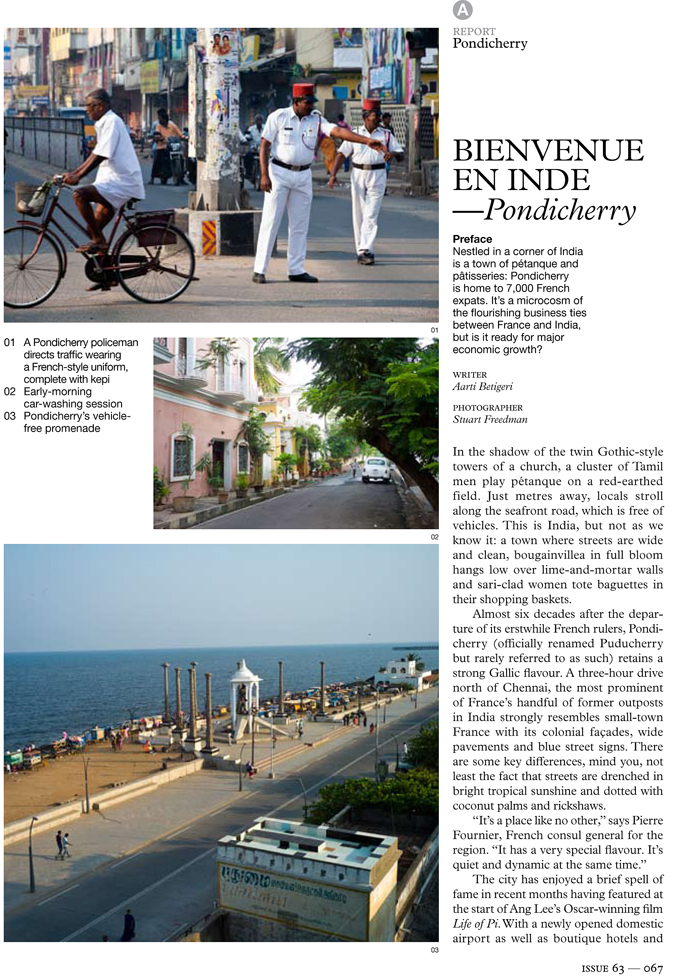
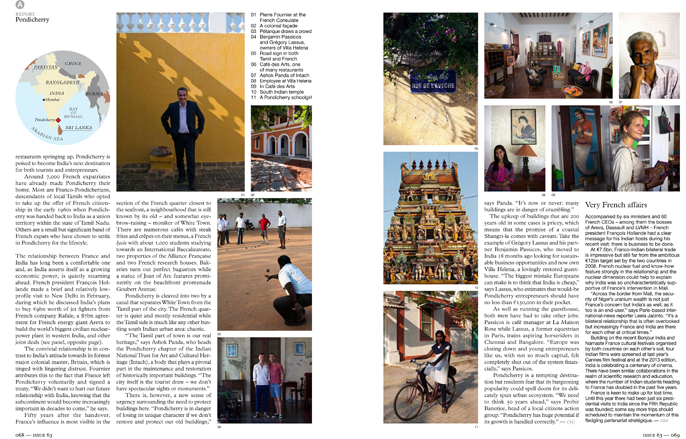
Here’s a spread from this month’s Monocle Magazine of a story I shot for them a few weeks ago in Pondicherry, the former French territory in southern India. I’ll post a couple of my favourite images from the set in a day or two.
 Umbra Sumus
Here’s a spread from this month’s Monocle Magazine of a story I shot for them a few weeks ago in Pondicherry, the former French territory in southern India. I’ll post a couple of my favourite images from the set in a day or two.
Last week I was on assignment for a magazine in Pondicherry, Tamil Nadu photographing the French influence on the place.
As you can see, my presence didn’t go unnoticed… The local newspaper decided that me laying on the floor to get a better angle on a military band was front page news… as was the arrest of the poor chap who, slightly worse for wear on the local hooch, chose that moment to have a little dance in front of me and then squared up to the band leader – presumably for not playing his favourite tune…
In any case, I made a frame and clearly gave the local newsroom a laugh.

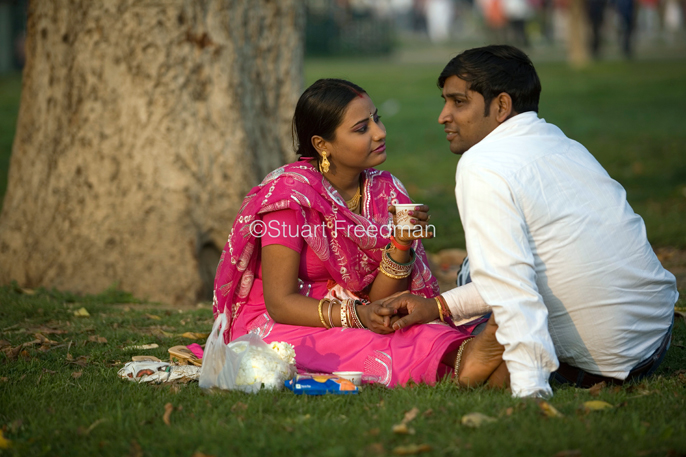
Appropriately on Valentine’s Day, the New York Times carries a piece today about the changing landscape of romance and especially kissing in Indian society. During my project about documenting Delhi’s green spaces, I photographed many couples seeking intimacy in public places unable to do so at home. Here are a couple of images from the series Public Spaces, Private Lives. A fuller set ran on the Camera Obscura blog in 2009 with a little interview about the work.
Happy Valentine’s Day.

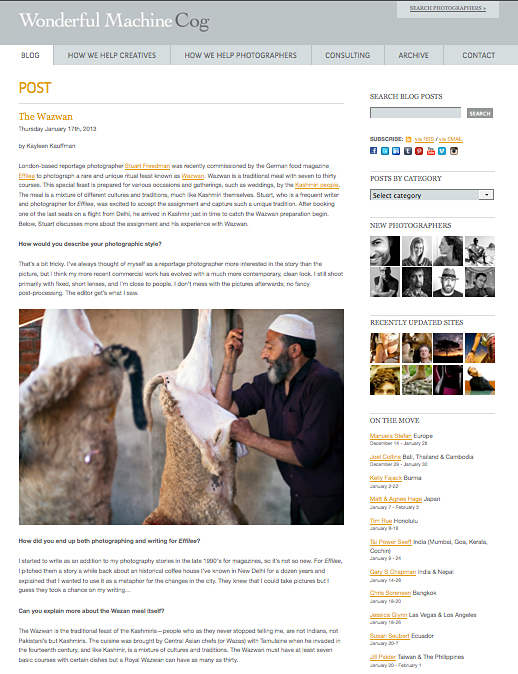
Many thanks to Wonderful Machine for featuring my interview about the Wazwan story on the blog today.
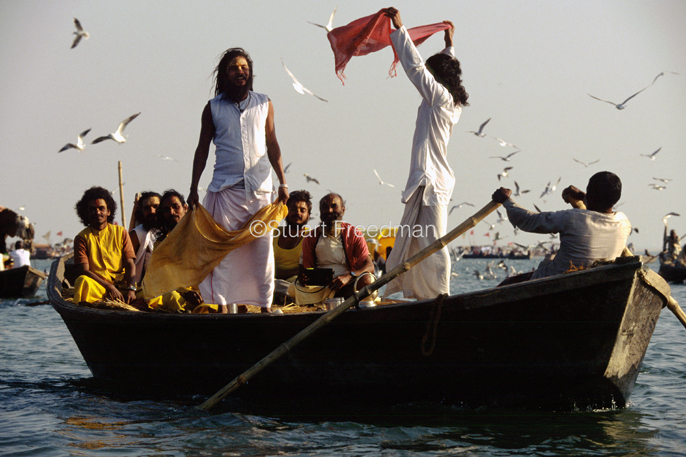
As you will by now no doubt have seen (by the tsunami of images generated) humanity’s greatest gathering is taking place on the banks of the River Ganges in Allahbad, India. The Kumbh Mela, a bathing festival for Hindus that draws millions of devotees (and photographers and tourists) to bathe in the confluence of the Ganges and the Yamuna has just started.
This year, up to 100 million people are expected to attend. I last covered it in 2001 when there were ‘only’ 70 million in attendance. I’d also shot one in 1995 – an Ardh (or half) Kumbh so I sort of knew what I was letting myself in for. They both feel a long, long time ago. I remember that in 2001 I was working a good deal in medium format and all I took with me were two Mamiya 6s and an old Vivitar flashgun. I remember shooting the entire set on Kodak colour neg film (I used to be sponsored by Kodak). It felt like I was trying to do something different, something new.
On that trip I travelled up to Allahabad with Kalpesh Lathigra and Jason Eskanazi. I seem to remember bumping into Stephen Dupont and the late Tim Hetherington (then at Network with me). Bruce Gilden saved me from getting beaten with a lathi by an Indian policeman (a long story…) and I remember being freezing cold every day before dawn as I rose from my inadequate sleeping bag. My fondest memories are reserved however for another fellow Network photographer, Nikolai Ignatiev, who died tragically a few years later. A very talented journalist, Nikolai had a colourful life story to say the least. Sadly, few traces of his work – nor indeed of Network Photographers – remain online (but see here for an archived obituary) but good memories.
Some pictures and thoughts of absent friends.

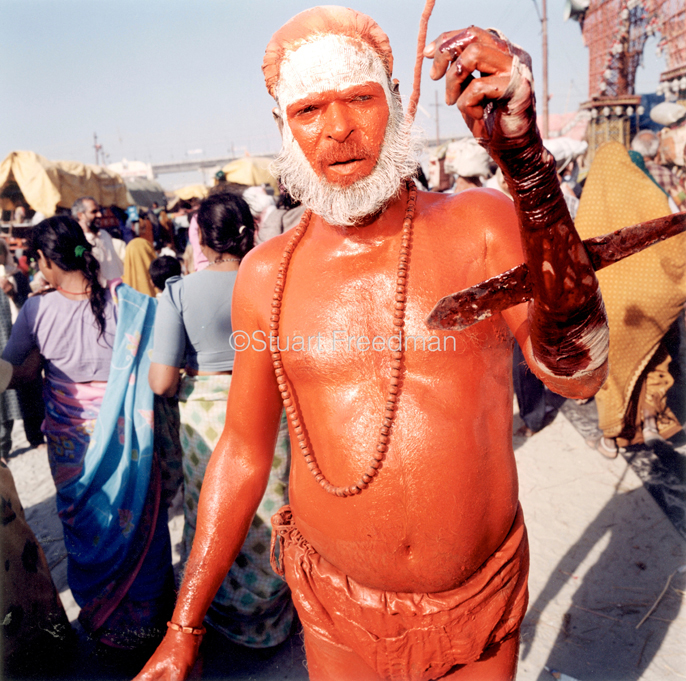
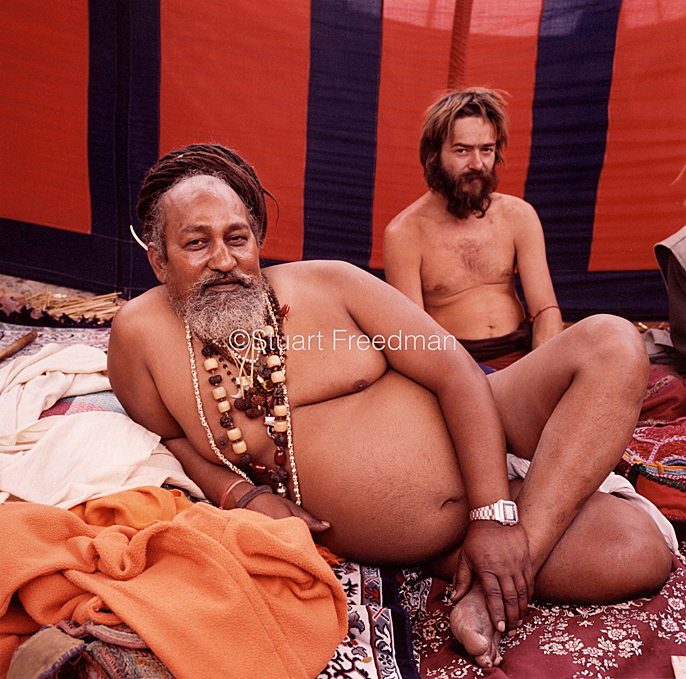


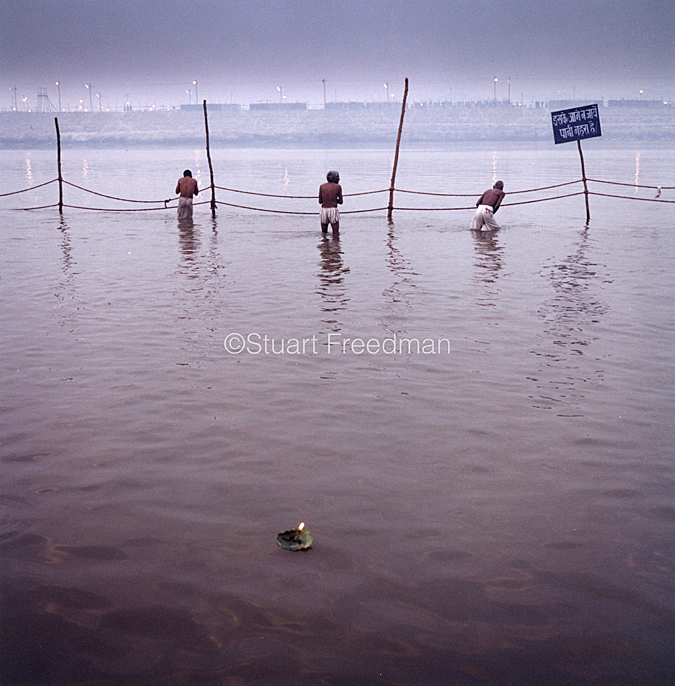


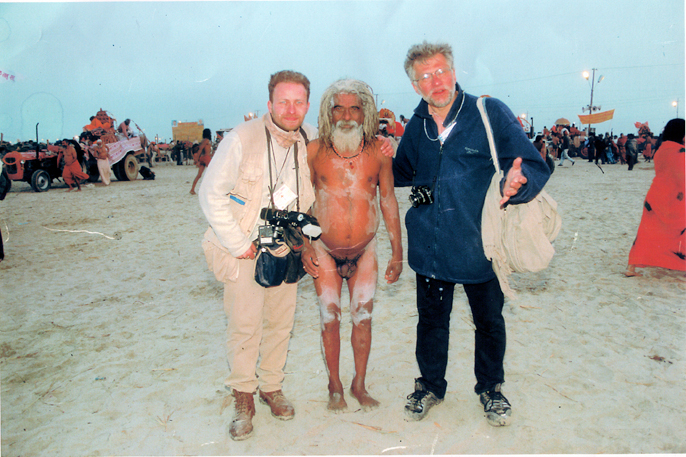
And just because I feel nostalgic today, here are a couple of my favourite images from the Ardh Kumbh way back in 1995…

I’m delighted to announce that my exhibition – The Art of Getting By – will open the 8th Jersey Amnesty International Human Rights Festival where I’ll be doing some teaching and workshops.
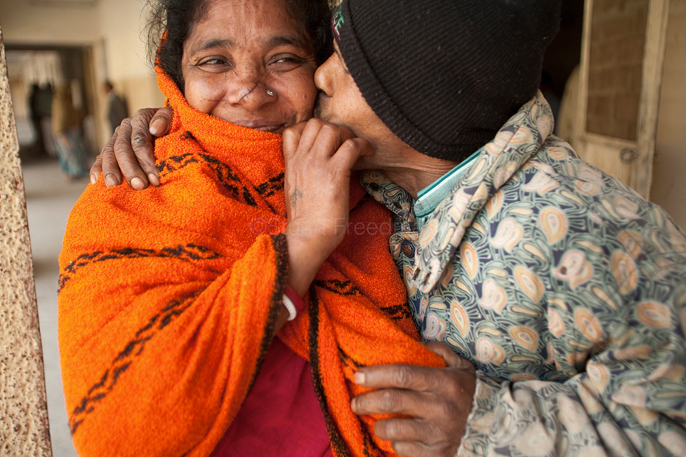
The French, as always have a word for it. Débrouillardise. The art of getting by – resourcefulness – surviving and laughing. I heard it first in French Africa in the ‘90s and I realised that I have been trying over the last two decades (even before I really knew the word) to make it a motif in the reportage that I made in even the most difficult circumstances. It is no less than the human condition – why shouldn’t the poor, the maimed, the brutalised somehow steal a smile, fall in love? A determination to live. To be normal. To be just like us.
These images are not romantic – although I hope that some are beautiful – rather they reflect the everyday struggles of common people. They also aren’t meant as rosy depictions of poverty from an outsider and they aren’t meant to patronise. I have worked consistently in the Developing World for most of my career and that was a choice made from the low horizons of my own childhood and the desire to escape the grey landscape of a Hackney past.
I consciously sought difference but found similarity and common ground.
These images are taken from stories from many countries. They show people touched by war and poverty living as best they can. They are small stories from larger narratives and by and large show small lives but they are no less important for that.
For me, this is a kind of retrospective: photographs of what I have tried to see – sometimes forced myself to see – to remember that the world is not dark, dangerous and other, but that it is beautiful and full of life.
You just have to know where to look.
My enormous thanks to Stuart Smith for curating and Metro for printing