What’s happening…?
- Post author By Stuart Freedman
- Post date April 6, 2011
 Umbra Sumus
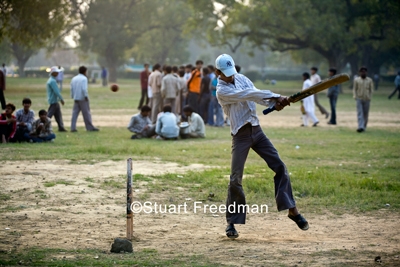
In case you hadn’t heard – or had been made deaf by the firecrackers and screaming – India won the Cricket World Cup…
Not a huge fan myself but who can argue with 17% of the world’s population? Here’s a few of them in Delhi playing… cricket… the batsman here being a little less successful than a certain Mr Dhoni…
I’m usually a day or so late with things and the centenary of International Women’s Day is obviously no exception… A week or so ago on assignment I photographed an extraordinary woman, Sheela, who runs a tiny tea stall that backs onto a rag-pickers’ colony.
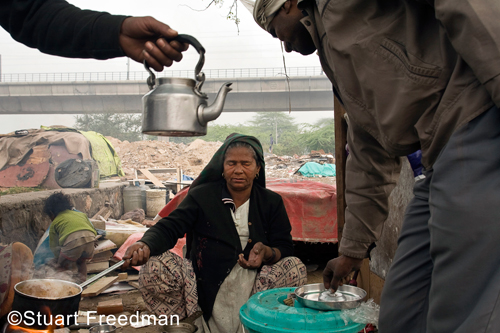
I can’t tell her story any better than see did.
“I came to Delhi a long time ago. I came here with my husband and he was working as a chowkidar. That was in 1981. A long time. Then it all went bad. From the beginning I stayed on this piece of land. My husband died here 21 years ago. My eldest son then became sick and he also died. That was sixteen years ago and then my youngest (son) died I think six years ago. We spent a lot of money to save them all but despite the medicines they all died. I couldn’t save any of them. I don’t know why I am still here. But I am here alone and I must survive.
At my tea stall I get up very early and serve the rag pickers who work on the dump behind me. I have had this business since the children died. I am not happy but I don’t have the means to change my life. I am alone. I am a woman. It is not easy. I don’t make so much money – tea is Rs5 a cup and I have to buy the tea and the sugar and recently all this has increased in price.
I suppose Delhi’s a good a place as another: there’s work, you can survive. I can’t think about the future can I? It’s a waste of time <laughs>.
I have to be happy in the present.”

Well, really, what were you expecting? Expertly taken by Mr Sharma for Rs30 (a bit heavy on the flash, mind) at Kalkaji Temple in Delhi yesterday.
Madly busy in the last few weeks – assignments from Newsweek, Monocle, Jolie and two clients that unfortunately I am unable to mention at the moment but (hopefully) more images soon…
Those nice people at Wonderful Machine in the ‘States have just written a very nice blog post about me and my upcoming assignment in Delhi. Read the full story here.


According to NATO’s senior civilian representative, Mark Sedwill, children are safer in Kabul than in Glasgow.
Of course the statement is nonsense – the NATO propaganda machine in full spin mode – but he actually raises some interesting points.
There is appalling child poverty in Glasgow (as there is in much of the UK) but little from bombs or direct warfare. As Justin Forsyth from the NGO Save the Children put it, one in four children living in Afghanistan will die before they reach the age of five.
“Last year was the deadliest for children since late 2001, with more than a thousand killed because of the conflict” and “a staggering 850 children die every day, many from easily preventable diseases such as diarrhoea or pneumonia, or because they are malnourished”.
Actually, what Sedwill meant was that significant and direct violence was not the greatest risk for (especially) Kabul’s children despite them living on the edge of a live war zone. In other respects of course Kabul children illustrate perfectly the issues of young lives in the Developing World. They are forced by and large to forego what a childhood looks like to us.
A significant issue that divides children in Glasgow and Kabul is work and Afghanistan has a large proportion of working children. The development of the idea of childhood as we know in the West is a product of the Enlightenment and Victorian social reform. For many of the world’s children, work is not a matter of choice and going to school is an unaffordable dream. Families send their children to work through economic necessity not profit. We may find this deeply unpalatable but the world is as it is, not as we wish it to be. In recognition of this situation, there are small scale moves to unionise child workers and give those who have no choice, a voice and some rudimentary protection. The National Movement of Street Boys and Girls in Brazil is one example, there is another in Delhi. A basic conviction of these movements is that through community participation and the development of democratic practice, poverty can be challenged. All of these schemes involve lengthy intervention by social workers but represent a real-life (if partial) solution to the reality of working children.
Here are some pictures from Kabul and Delhi that illustrate the issues…