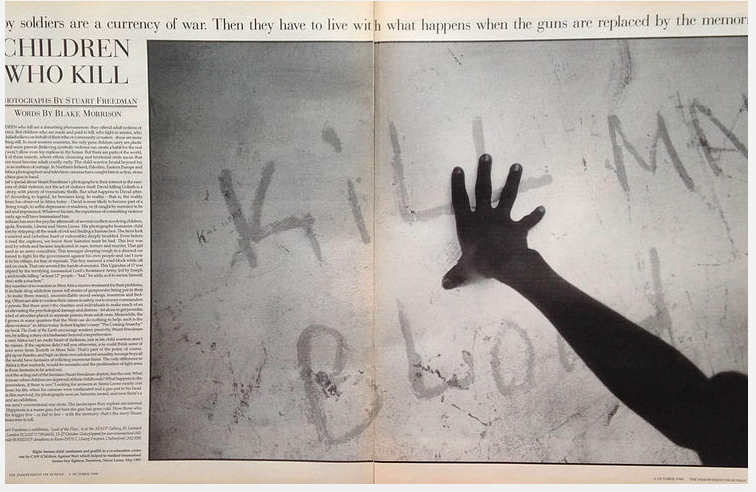
Amateur Photographer Magazine recently asked me what image that I’ve made, had had a profound effect on me. I told them about photographing a deeply disturbed boy forced to commit atrocities by the Lord’s Resistance Army in Uganda. Here’s the full piece …
There was some inevitability about it of course but after thirty years, The Independent Newspaper has decided to close the print edition(s) and move online. In the late 1990s and early 2000s I worked on quite a few stories for the excellent Sunday Magazine picture desk that was Victoria Lukens and Susan Glen.
Susan, now a respected photography consultant is featuring some of the Independent’s work on her site and has just published my story about the mental landscape of war amongst child soldiers in Africa, The Lord of the Flies
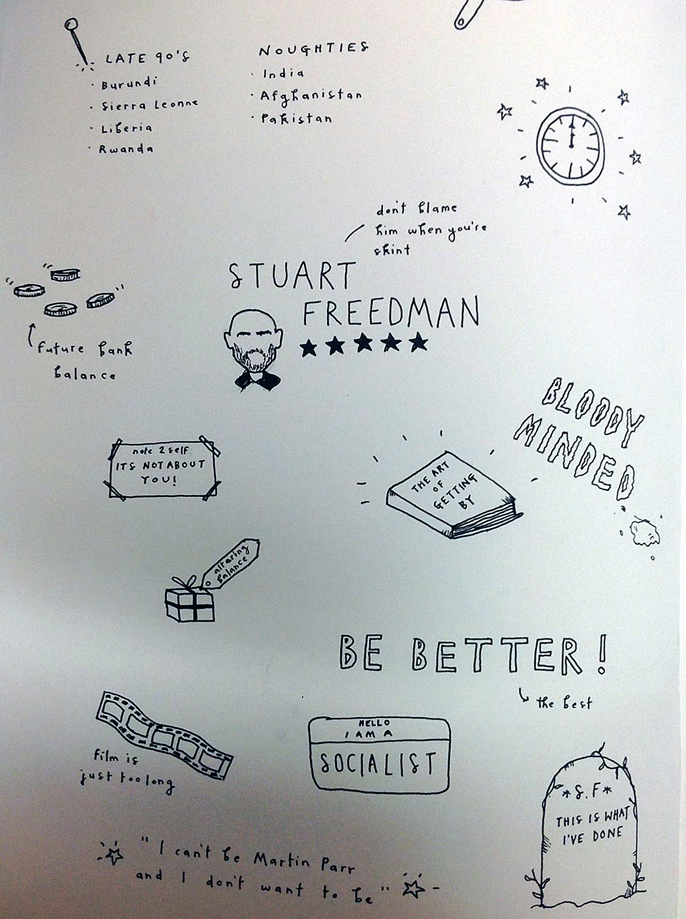
On Saturday I gave a lecture about my work at the Photographers Gallery to a group of talented young photographers. I was delighted that one student, Melissa Fund encapsulated those couple of hours in an excellent diagram with my portrait at its centre. I thought I’d share that here.
Thanks to her and the excellent Lottie Davies for the opportunity.
I was delighted to record two live interviews last night for BBCWorld’s Newsday (shown at breakfast time in Asia) about my new book, The Palaces of Memory, my love letter to the Indian Coffee Houses.
You can see one of them here or by clicking the image below.
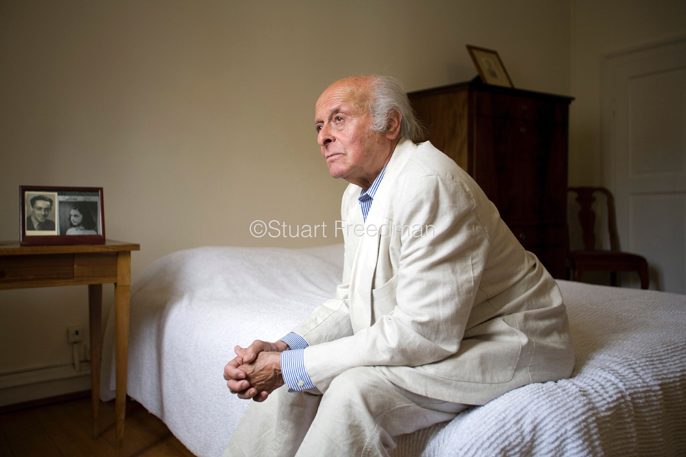
A few years ago I was delighted to photograph Anne Frank’s cousin, the mercurial Buddy Elias in Basel for the Times Magazine. Elias, the force behind the Anne Frank Foundation was charming and entertaining and we spent a very enjoyable day together.
His mood quietened only when I photographed him at his bedside where he keeps a photograph of Anne.
Switzerland – Basel – Bernhardt “Buddy” Elias, Anne Frank’s cousin. Elias sits on the bed in the room that was occupied by Otto, Frank’s father after World War Two. Behind him are photographs of Frank and himself before the war.
Some assignments are straightforward, some take a bit more thought. When the London School of Economics assigned me to photograph Delhi for their global cities conference I was delighted but also slightly nervous.
The brief was to image the city illustrating the difficulties of living in and governing India’s sprawling, chaotic capital. My preference is always to try and make beautiful pictures – but trying to marry that with an exacting shoot list that focused on academic concepts was always going to be challenging. It was however, the shoot list (and my drivers and assistants – notably the ever-cool Sunayana) that saved me. I’m always talking about the importance of scripting what you shoot and this was a perfect example of how it can really help. This wasn’t an assignment about what I wanted to show of Delhi or interpreting the city – but clearly illustrating issues that affect it. In fact, it was a very interesting way to work – trying to find places or people that evidenced concepts as diverse as public/private space and illegal adaptions of utilities.
Born and brought up in London, I’m fascinated by cities and the way that they develop and change and Delhi for me has been a kind of surrogate city – a sort of prism through which to view myself and see how metropolises (and I dare you to find the correct plural of metropolis…) evolve and change. Delhi, like London is palimpsestic in that cities have been built on top of cities. I can walk through any number of places in Delhi and find the exact same things that Dickens wrote about for example – the very foundations of a modern industrial world – but I can also find something much older – the Vedic prayers intoned by people still worshipping on the banks of the hideously polluted Yamuna.
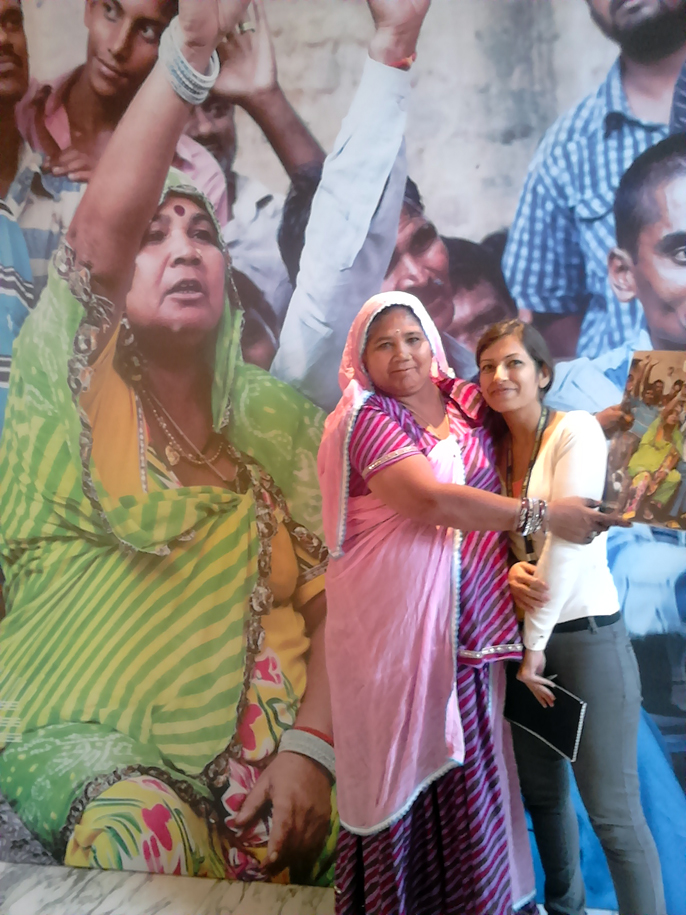
One of the highlights was returning to Kathputli Colony that I’ve written about before and making work with the people there trying to save their homes and way of life. I was delighted to be re-united with the singer Bhagwan Das and it is his wife Sarbati that’s shown at the end in the last picture here at the conference in front of a giant poster and on the cover of the magazine.
Here are some of the images that I made.
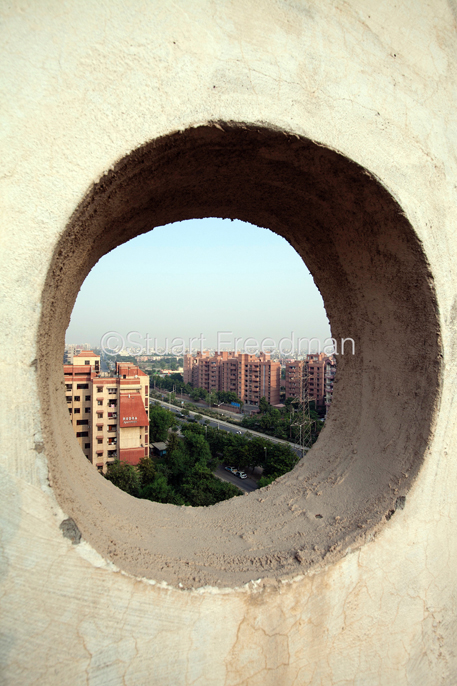
India – New Delhi – An overview of the city from an apartment block in Dwarka
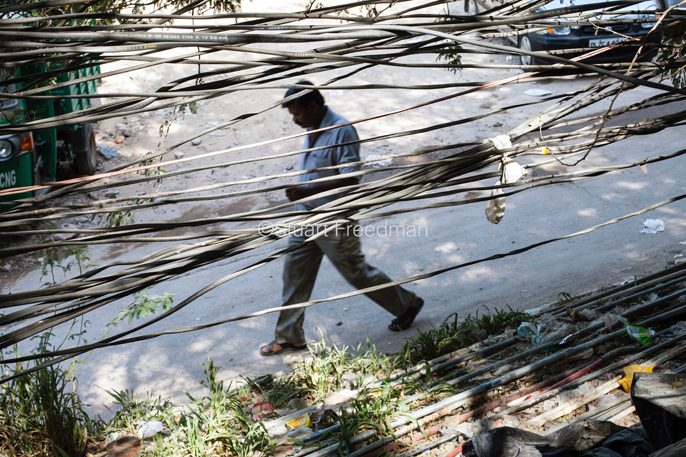
India – New Delhi – A man seen through a tangle of illegal electricity and water cables in the Munika area.
India – Delhi – A local meeting of residents and activists at Kathputli Colony that is faced with destruction and closure
India – Delhi – Crowds in Sadar Bazaar
India – New Delhi – Young people in make up perform a street dance on a road blocked to cars in a section of Connaught Place during a Raahgiri Day where traffic is halted and people take over the streets.
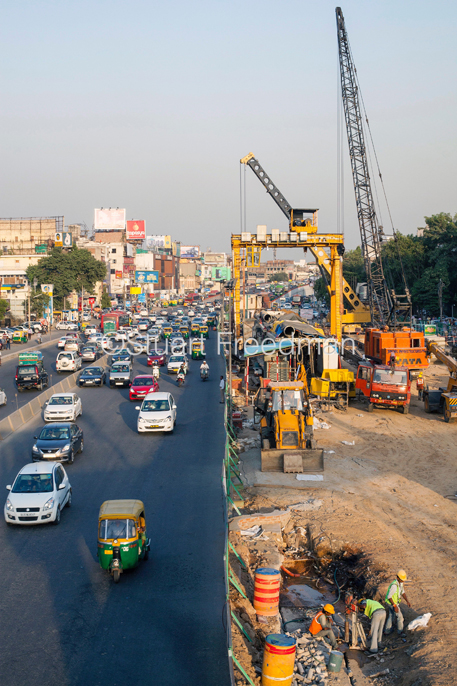
India – New Delhi – Traffic and Metro construction work at South Extension Market
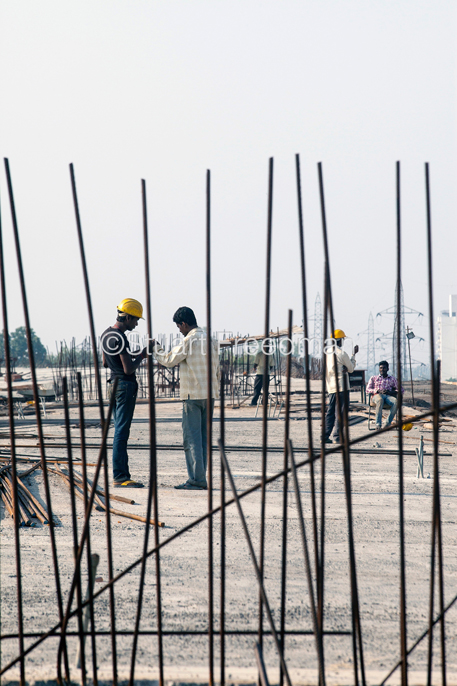
India – Delhi – Workers on the new footbridge over the Yamuna River
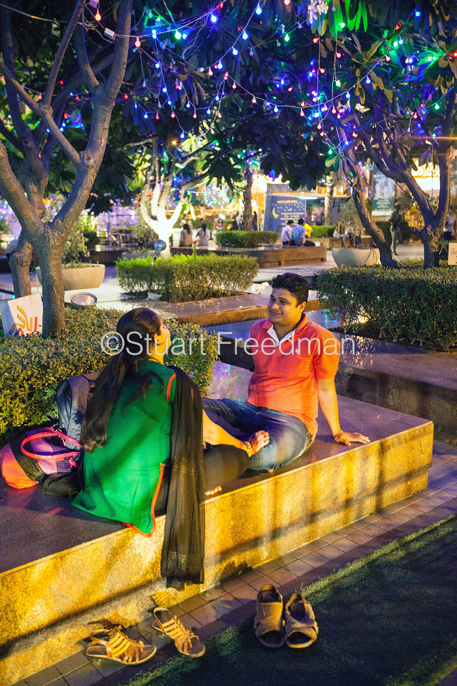
India – Delhi – A romantic couple sit in the gardens of the Ambiance Mall, Saket,
India – New Delhi – Sarbati Das from Kathputli Colony (in front of her cover image used as a poster at the LSE Cities Conference) and the brilliant Sunayana.
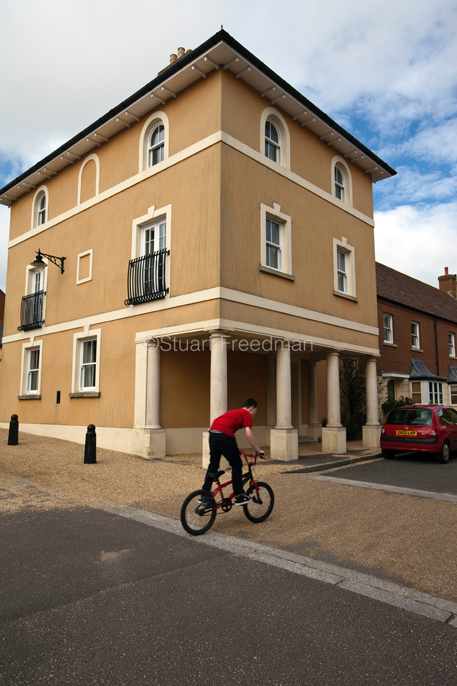
Britain has a housing crisis. The Queen’s speech yesterday underlined the current government’s commitment to develop Ebbsfleet as a Garden City – an idea ironically propounded in the early twentieth century by the Socialist-leaning Ebenezer Howard in Letchworth.
A year or so ago, I wrote a piece for a special edition of the German Magazine, Brand Eins (Brand Eins Wissen) where I traced the history of the British planned communities from the earliest industrial worker’s housing to Prince Charles’ architectural monstrosity, Poundbury. The piece, The Strange Death of the British Utopia (or how Britain lives in her own past) can be found on the writing section of my website here.
UK – Dorset – A boy rides his bicycle past a traditionally styled building in Poundbury. Poundbury on Duchy of Cornwall land is Prince Charles’ attempt to create an urban extension to Dorchester famed for Its pastiche of traditional architecture.
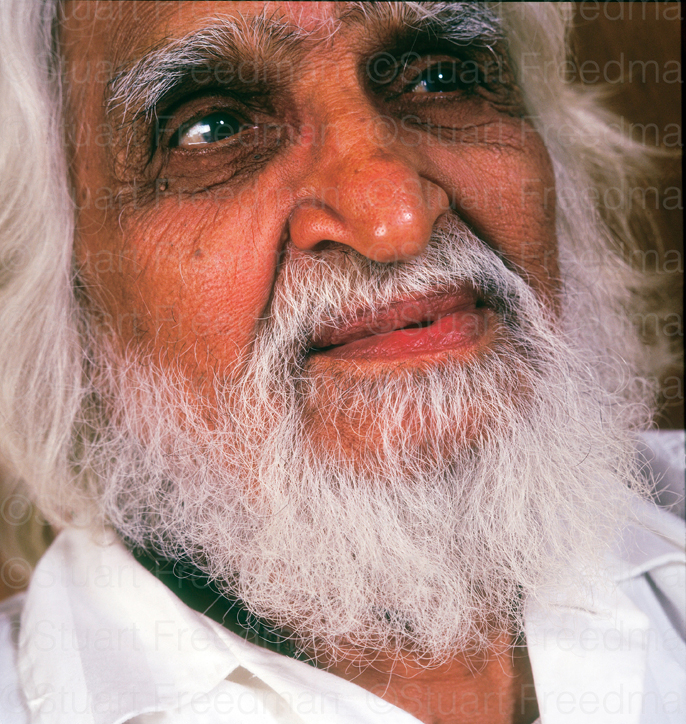
I’m delighted that the V&A in London will be hosting a new show of MF Husain’s work this Summer.
I photographed Husain many years ago in his Bombay studio (I’ve previously written about him here and here) and he was as charming as he was prolific. How awful then that his work, a mixture of European Modernism and Indian imagery, is unlikely to be seen again anytime soon in his home country. He had to flee India in 2006 as Hindu militants put a bounty on his head, charging him with “offending religious sentiment”. The London show is, in a sense, a farewell to Husain but perhaps moreover, potentially to the ideas to which his art spoke: of a secular, tolerant India. As India rushes headlong into the clutches of corporations and those that seek to divide it’s people against one another (rigidly defining those who are and who aren’t an ‘acceptable’ Indian), it ironically may take the legacy of an elderly millionaire painter to act as a metaphor for the freedoms that ordinary Indians – indeed perhaps the idea of India itself – are in danger of losing.
India – Mumbai – MF Husain (b. 1915, Maharashtra) India’s foremost modernist painter at his studio in Mumbai (formerly Bombay). In the 1990s some of Husain’s works became controversial because of their portrayal of naked Hindu deities. Charges were brought against him by Hindu Nationalists but were dismissed by the Delhi High Court. Husain died in exile but his painting continue to command prices of several million dollars at auction.