The cruel radiance…

Some of my images have been published in a new book on politics and photography called the Cruel Radiance by Susie Linfield.

In it, Linfield attempts to refute the argument that engagement with violent imagery makes the reader turn away. She argues that only by engaging with photojournalism and it’s unsettling commitment to documenting atrocity can we understand the world. It is an interesting time to take this line. Modern photojournalism has in the last few years, experienced a bleeding-into from the art world. I’ve written before about a cold un-connectedness that portrays people as butterflies under glass: a seeing that examines every facial detail but tells us nothing about context or the subject’s humaness. Linfield uses the example of Nachtwey, Peress and Capa in what I see as an unabashed attempt to reassert a traditional documentarian’s engaged position against the argument that all journalism of this kind is voyeuristic. Despite my work being included here, I do have reservations about documenting atrocity, but maybe the pendulum has swung far enough the other way: our sanitised, modern media tells us that only celebrity and money and excess are important. What happens over there is just not understandable. Linfield says that it is and it must be. Photojournalism is in need of a defender who can reclaim a moral relevance against Postmodern criticism that has done much to discredit the voracity of photography. We should not “drown in bathos or sentimentality,” Linfield says but “integrate emotion into the experience of looking.” We “can use emotion as an inspiration to analysis rather than foment an eternal war between the two.”

Suffer little children

According to NATO’s senior civilian representative, Mark Sedwill, children are safer in Kabul than in Glasgow.

Of course the statement is nonsense – the NATO propaganda machine in full spin mode – but he actually raises some interesting points.

There is appalling child poverty in Glasgow (as there is in much of the UK) but little from bombs or direct warfare. As Justin Forsyth from the NGO Save the Children put it, one in four children living in Afghanistan will die before they reach the age of five.

“Last year was the deadliest for children since late 2001, with more than a thousand killed because of the conflict” and “a staggering 850 children die every day, many from easily preventable diseases such as diarrhoea or pneumonia, or because they are malnourished”.

Actually, what Sedwill meant was that significant and direct violence was not the greatest risk for (especially) Kabul’s children despite them living on the edge of a live war zone. In other respects of course Kabul children illustrate perfectly the issues of young lives in the Developing World. They are forced by and large to forego what a childhood looks like to us.

A significant issue that divides children in Glasgow and Kabul is work and Afghanistan has a large proportion of working children. The development of the idea of childhood as we know in the West is a product of the Enlightenment and Victorian social reform. For many of the world’s children, work is not a matter of choice and going to school is an unaffordable dream. Families send their children to work through economic necessity not profit. We may find this deeply unpalatable but the world is as it is, not as we wish it to be. In recognition of this situation, there are small scale moves to unionise child workers and give those who have no choice, a voice and some rudimentary protection. The National Movement of Street Boys and Girls in Brazil is one example, there is another in Delhi. A basic conviction of these movements is that through community participation and the development of democratic practice, poverty can be challenged. All of these schemes involve lengthy intervention by social workers but represent a real-life (if partial) solution to the reality of working children.

Here are some pictures from Kabul and Delhi that illustrate the issues…

Afghanistan - Kabul - a boy sells snacks and drinks on a stall in the street with his mother
Afghanistan - Kabul - A child mechanic welds a metal frame in a car breaker's yard
India - New Delhi - A child worker scavenges for plastic to recycle (and sell) from a train carriage in New Delhi Railway Station
India - Delhi - A meeting of a Child Trades Union on the streets facilitated by adult outreach/social workers

A small step

It seems that the Pope has signaled that condom use might be justified to stop the spread of HIV and AIDS. A brave, welcome and clearly significant decision that will certainly save thousands of lives.

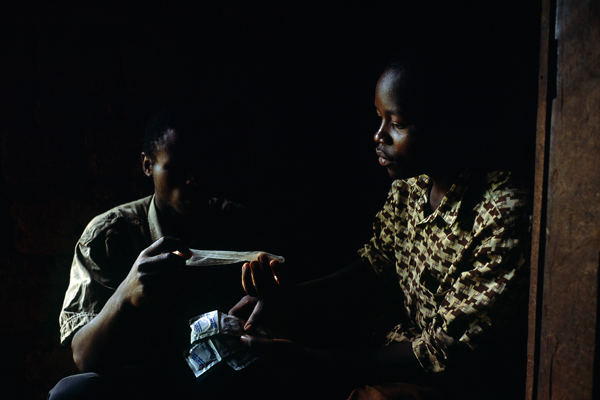
Rwanda - Kibileze - Emmanuel Singizumakiza, a health educator shows a boy how to use a condom

David Cameron and the Leni Riefenstahl moment…

Roger Tooth in today’s Guardian makes an excellent point when he comments about David Cameron, the Prime Minister appointing two visual journalists as ‘vanity photographers’.

“Yes, we know what their kitchens look like, thank you”

“But we’ve had a surfeit of “behind the scenes” pictures of both coalition leaders; too many pictures of Cameron gurning at his new baby have led to this sort of material becoming a devalued currency”.

Quite. As if having the majority of the unquestioning press having bought into the ‘spending review’ to pay for an economic crisis caused by the gamblers of international finance wasn’t enough, Cameron’s ’embeds’ – both of whom have done extensive work for the Conservative Party – have been paid for from the public purse. At a time of alleged attrition. Both have been recruited as civil servants on short-term contracts thus avoiding the normal competitive employment process.

As the true heir to New Labour spin, Cameron (whose only other job was as a PR executive at Carlton) has similarly surrounded himself with ‘advisors‘. The issue here is that unlike the White House Press corp or Presidential photographers, there is little explanation about the context, the voracity or the quality of the ‘historical’ archive that these two will produce. Artists have always had wealthy patrons and the excuse is usually vanity, but to have such control of images at the heart of government seems to me a paranoia par excellence.

I’m sure that the images will be carefully crafted to show just how much the former PR man, married to an Astor and his chancellor (a man who will inherit a knighthood and the fortune of the present Baronet of Ballintaylor) are really just like us and are also having to tighten their belts. We are all in it together … I’m also sure that the images will be used by lazy picture desks clamouring for ‘intimacy’. Interesting though that the prevalence of military embedding in the wars in Iraq and Afghanistan has spread and, in the age of ‘citizen journalism’, just how much the Centre is able to get its message out in exactly the way that it wants.

Sometimes however, there are more important things than photography and journalism. At a time of the dismantling of the post-war consensus, the welfare state and perhaps the very idea of a society perhaps we as citizens should ask of these appointments: cui bono – who benefits?

Here are some pictures from an assignment for the Times Magazine on David Cameron that I think were intimate, human and, despite my personal opinions, I gave what I felt to be a fair and balanced impression.

Because that was my job.

As a journalist.

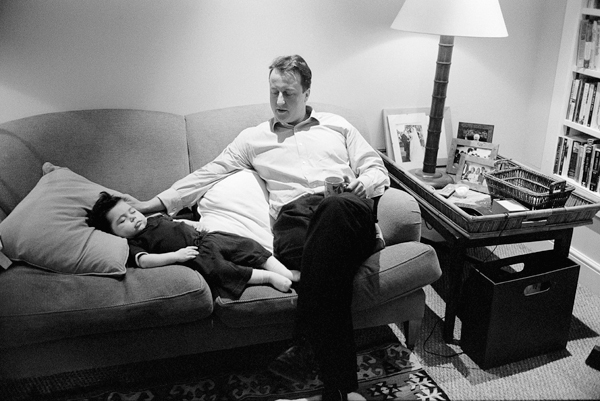
UK - Oxfordshire - David Cameron, Prime Minister and leader of the Conservative Party, with his late son Ivan, who suffered from cerebral palsy and epilepsy

UK - Oxfordshire - David Cameron, Prime Minister and leader of the Conservative Party

UK - Oxfordshire - David Cameron, Prime Minister and leader of the Conservative Party carries his daughter whilst pouring coffee at home
UK - Oxfordshire - David Cameron, Prime Minister and leader of the Conservative Party at a local meeting

UK - Oxfordshire - David Cameron, Conservative Party Leader and Conservative MP for Whitney in his constituency office

Selling the family silver

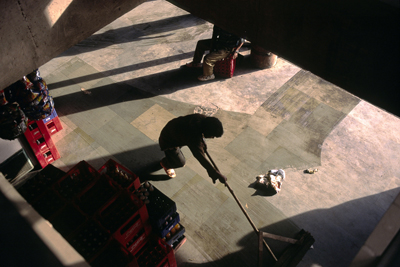
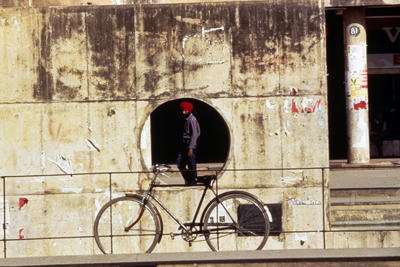
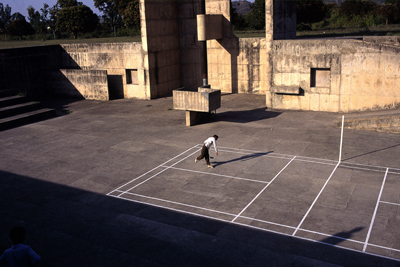
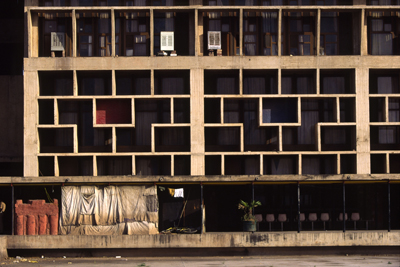
I first went to Chandigarh in 1996 to shoot a story for the Independent on Sunday Magazine. A fascinating place, it was chosen as the capital of the Punjab after India lost Lahore to Pakistan after Partition. Nehru famously said that Chandigarh should to be “unfettered by the traditions of the past, a symbol of the nation’s faith in the future.” The originally commissioned architect, Matthew Nowicki, died in a ‘plane crash and the rather difficult Charles-Édouard Jeanneret-Gris replaced him. Jeanneret-Gris was better known as Le Corbusier. He made a bold modernist statement of concrete and angles and by the time I got there, it had started to decay nicely under the unforgiving Indian sun. It was however a rather wondrous if slightly odd beauty to behold: a thoroughly Indianised but planned city that worked. Recently it has transformed itself again into a successful metropolis of New India: plush bars, hotels and now has India’s highest per capita income. However, shortly after I left (and I had nothing to do with this, honestly) some enterprising wags started selling off anything that wasn’t bolted down to Western collectors desperate for anything Corbusier. Lamps, manhole covers and as much furniture as could be, ahem… ‘lost’ have been turning up in auction houses mostly in the UK. Andrew Buncombe in today’s Independent has a good write up on it and how many in the Indian government have been trying to lobby to stop this rather sad episode.

Anyway, here’s some of my favourite pictures…

India - Chandigarh - A man cycles past The Open Hand statue
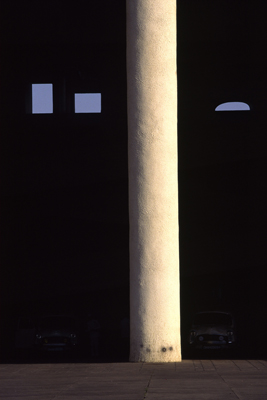
India - Chandigarh - A column and window of the Parliament Building
India - Chandigarh - A man carries a bundle of clothing past the High Court building
India - Chandigarh - In the middle of the day, an Indian man sleeps amidst the concrete of Chandigarh
India - Chandigarh - Chief architect Jaspreet Prakash and map of Chandigarth
India - Chandigarh - A man sweeps the pavement in Chandigarh
India - Chandigarh - A man walks through a pedestrian zone in Chandigarh
India - Chandigarh - A man sleeps under some stairs in the modernist city of Chandigarh
India - Chandigarh - A man bowls a cricket ball to his friend in a car park
India - Chandigarh - A man rests by a concrere pillar in Chandigarh
India - Chandigarh - Detail of the High Court building