I was saddened but entirely unsurprised to see in a recent BBC report that Delhi’s excellent street hawkers were being evicted before the Commonwealth Games. With grinding monotony it seems that vegetable sellers, cobblers, presswallahs, hawkers and other undesirables that the city depend on are being moved off – often despite applying for licenses that never come.
According to the National Association of Street Vendors, Delhi has something like 350000 hawkers that sell their wares on the streets. Most live a hand-to-mouth existence and, if they are the main breadwinners in families of perhaps five people, the economic fallout from a large section of Delhi’s working class will be enormous.
The streetwallah’s plight follows Delhi’s drive to evict as many beggars and ‘undesirables’ from the city as it can. Andrew Buncombe’s piece for the Independent here is worth reading.
Earlier this year I read a fascinating book, Trickster City; an anthology of writings from the ‘belly of the metropolis’ by young, working class writers dealing with slum life and eviction. A voice rarely heard – an almost Dickensian cityscape rarely seen by Westerners and desperate to be hidden by the State authorities.
The irony is that many countries celebrate their street culture – especially food – and make them a tourist attraction: one has only to think of Singapore and Vietnam. Delhi’s depressing desire to imitate a corporate driven monoculture is certain to lead to a lessening of the city’s heritage.
My images start with Kishori Lal and his family. Lal, a tailor from Rajasthan, set up his little stall outside the wall of a ‘big man’ twenty two years ago. He takes up the story: “There was no footpath here then. The tree that you see on the footpath is standing on a narrow strip of land between two sewage lines that run underneath. I asked the maali (gardener) to plant it there and got
the sapling for him. If I have any trouble, the Saheb helps me out. After so many years here, like this tree I have also taken roots in Delhi. But who belongs to this place? Even the sahibs are from outside.”
India - New Delhi - Kishori Lal, a tailor and his family under an Ashoka tree
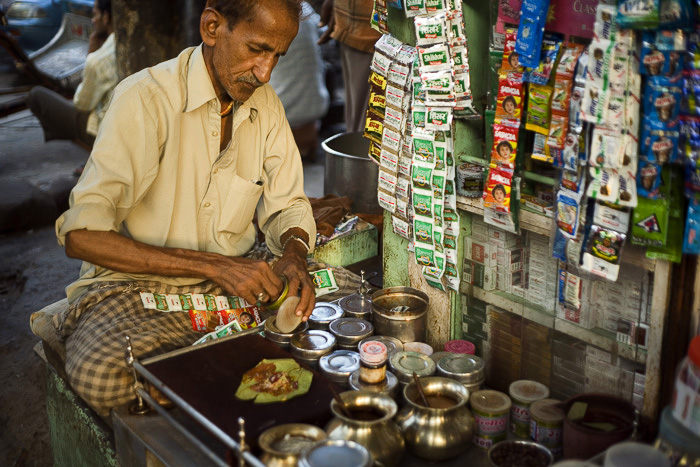
India - Delhi - A paan wallah making paan in Old Delhi. Paan consists of chewing Betel leaf (Piper betle) combined with the areca nut. It is chewed as a palate cleanser and a breath freshener. It is also commonly offered to guests and visitors as a sign of hospitality and as an "ice breaker" to start conversation. It also has a symbolic value at ceremonies and cultural events in south and southeast Asia. Paan makers may use mukhwas or tobacco as an ingredient in their paan fillings. Although most types of paan contain areca nuts as a filling, some do not. Other types include what is called sweet paan, where sugar, candied fruit and fennel seeds are used.India - Delhi - A street vendor frying potato cakes on a stallIndia - Delhi - A Chai Wallah or tea maker makes tea in Old Delhi, India. Traditionally Indian tea is a mixture of tea leaves, water, sugar and sometimes spices boiled together and strained into cupsIndia - Delhi - A man eats a plate of street foodIndia - Delhi - A man eats street food bought from a hawker
Today’s newspapers are full of jubilant American troops leaving Iraq after completing their mission to bring peace, democracy and their ‘way of life’ to the uncivilised. A tremendous success. The ‘surge’ worked and all those Allied soldiers didn’t die in vain.
Well, not true. The war, born of a lie, born of greed and evil has been a disaster for America and for the world. There is also no end to the violence: more civilians died last month in Iraq than in Afghanistan. There is no political settlement and the Iraqi Resistance is as strong as it ever was. The Occupation hasn’t ended, it’s just been privatised. Apparently there around 10000 armed mercenaries in the country working in the State Department’s interests and the American’s want this increased (Blackwater helpfully calls this ‘the coming surge’). Of course the advantages of having cheap mercenary armies made up of contractors (notably from the Developing World) are clear: cost and (non) accountability. In any case, someone has to patrol the oil fields under (long, probably illegal) contract to the Americans and their friends joyfully raping Iraq’s natural resources.
Still, we haven’t really seen this. What we have seen is the war as viewed from the back of American and (sometimes) British armoured cars. It’s rare to see or hear Iraqi voices despite the war lasting seven years and we’ve generally had to endure the war through embedding and spin. The few cracks in the information blackout have been enlightening but as rare and as elusive as peace itself.
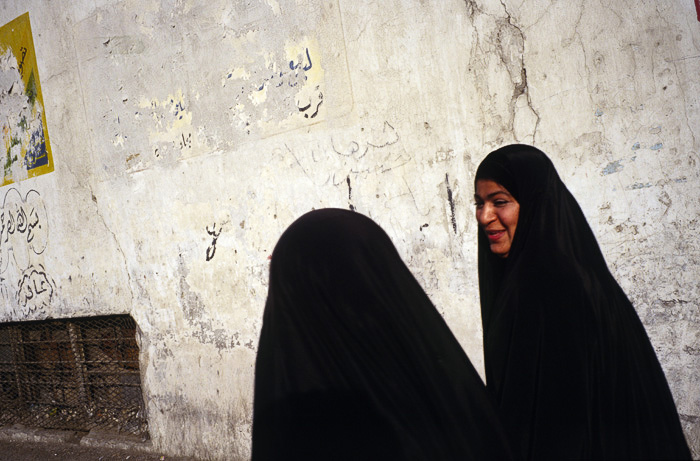
Iraq - Baghdad - Two women wearing chador gossip and laugh on the street
Iraq- Basra - Boys climb what is know locally as the tree of Adam at Al Qurnah near Basra. The Holy Tree, according to the legend marked the Garden of Eden, at the convergence of the Euphrates and the Tigris Rivers
Iraq- Baghdad - A man in the Oum Kalsoum cafe
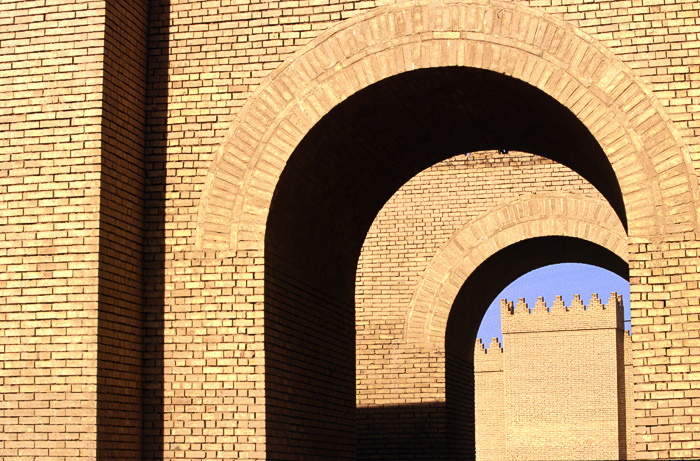
Iraq - Babylon - The restored walls of the Temple complex. Babylon, an ancient city when mention in the Bible is dated at around the 24th Century BC. In 1985, Saddam Hussein started rebuilding the city on top of the old ruins (because of this, artifacts and other finds may well be buried under the city), investing in both restoration and new construction. To the dismay of archaeologists, he inscribed his name on many of the bricks in imitation of Nebuchadnezzar. One frequent inscription reads: "This was built by Saddam Hussein, son of Nebuchadnezzar, to glorify Iraq".
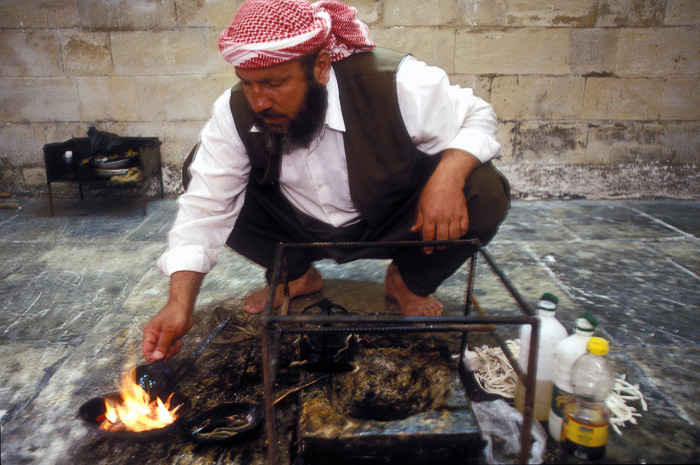
Iraq - Mosul - A Yezidi priest lights a lamp in a religious service at a Yezidi temple. The Yazidis believe in God as creator of the world, which he placed under the care of seven angels the chief of whom is Melek Taus - the Peacock Angel. Speculation that worship of Melek Taus was worship of Satan (who fell) have resulted in Yezidi's being persecuted as 'devil worshippers' throughout their history and persecuted.
Iraq - Mosul - An old Yezidi woman
Iraq - Ur- A man walks past the ziggurat at Ur, supoosedly the city of the prophet Abraham's birth. Ur was a principal city of ancient Mesopotamia. The Ziggurat was dedicated to the moon and was built approximately in the 21st century BC by king Ur-Namma. In Sumerian times it was called Etemennigur.
Iraq- Basra - A shepherd boy and his flock
Iraq - Samarra - A man climbs the minaret of the Al-Mutawakkil mosque. The first mosque, built in 836, has now disappeared; it was replaced in 849-852 by a new mosque built on a grand scale, which for a long time was the largest mosque of the Islamic world. It continued to be used until the end of the 11th century.
Iraq - Basra - A boat on the River Euphrates at sunset
A taste of a new project that I started to work on this year about the mental health crisis in Delhi is showcased by my agency Panos here.
The poor have fallen out of the narrative of modern India. Delhi, the nation’s capital, has been transformed into a vibrant, wealthy metropolis. But where extremes of wealth tread, illness and despair follow, and Delhi is today in the grip of a mental health crisis.
An estimated 20 million Indians suffer from serious mental disorders, many of them hidden from public view by their families. Delhi is a city of migrants and every day thousands more arrive to try to escape the poverty of the village. Many will remain homeless, divorced from the traditional family structure and culture. Delhi’s army of homeless is conservatively estimated to number around 100,000 people. Mental illness in this group is treated either by violence from the rest of the community or traditional ‘quack’ or faith healers. Delhi has had a traumatic history. The city was destroyed by the British in 1857, by Partition nearly a century later and riven by anti-Sikh violence in 1984 after Indira Gandhi’s murder. It seems to me that Delhi has lost a great deal of its culture and sense of itself; a dangerous thing to lose. A psychiatrist might contend that by its rampant consumerism it is trying to ‘feed itself’ an identity.
Nimesh Desai, head of psychiatry at the New Delhi-based Institute of Human Behaviour and Allied Sciences, estimates that India has fewer than 4,000 psychiatrists, and even fewer general mental health professionals. ‘The lack of psychiatrists is bad and the shortage of psychologists, social workers and councellors is even more alarming,’ Desai told me. ‘It meets about five to seven percent of the projected need.’ Desai has however attempted a solution. After eight years of intense lobbying, his team have started to conduct weekly open air surgeries for the mentally ill homeless in Old Delhi. He is accompanied by a High Court judge who assesses each patient to decide whether or not Desai can inject them with anti-psychotic drugs. On rare occasions he sections them to his mental hospital in the east of the city.
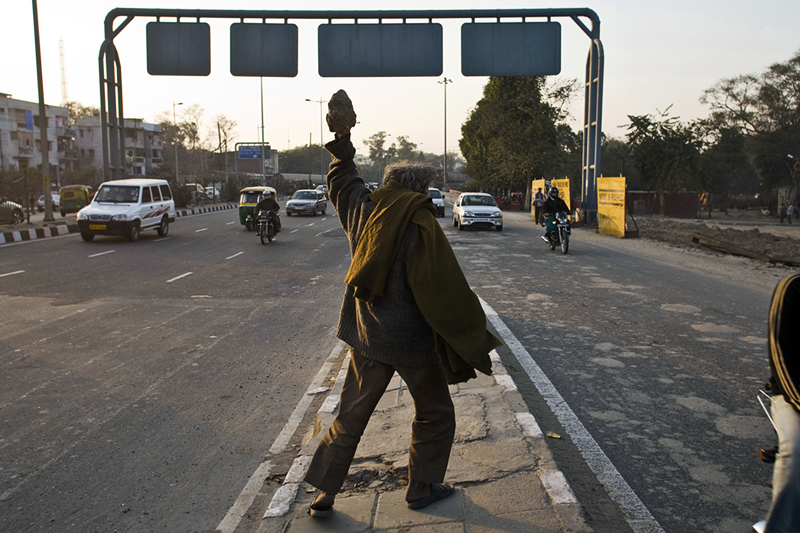
India - Delhi - A homeless mentally ill man picks up a rock to throw at passing traffic
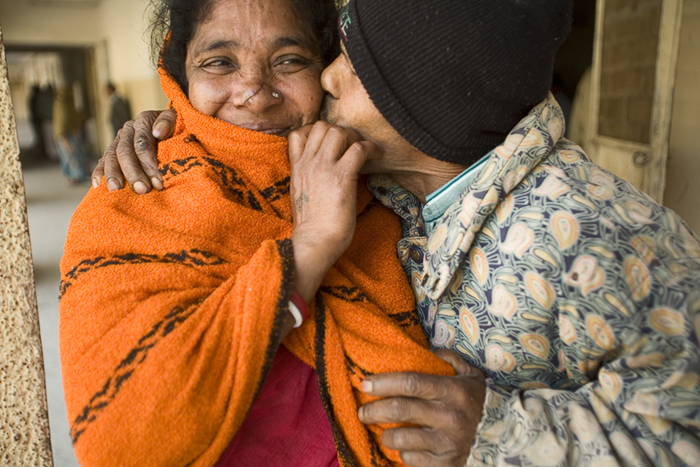
India - Delhi - A mentally ill man kisses his wife who visits him in the secure ward
India - New Delhi - A Pir, exorcises a spirit from a mentally troubled who believes herself possessed at a dargah (shrine) in South Delhi
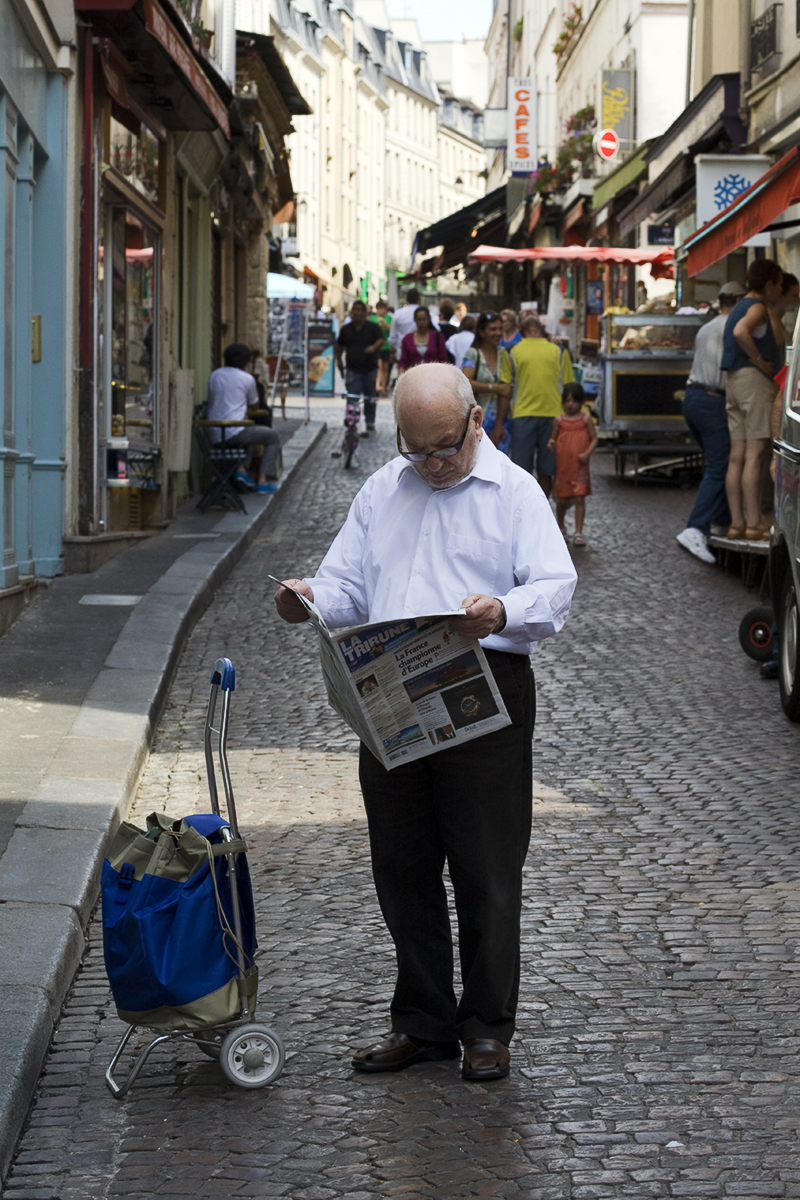
I spotted this chap defiantly reading his morning ‘paper in the middle of the street in Paris recently on assignment for a magazine. He’s reading La Tribune, so maybe he’s playing the markets…
France - Paris - An elderly man reads his newspaper on the street on the Rue Mouffetard.
Here’s a couple of more images – not from the edit set – that I liked from the same job.
France - Paris - Graffitti and apples on a stall in the market on the Rue Mouffetard.
France - Paris - A baker pulls croissants from the oven at the Maison Morange Patisserie on the Rue Mouffetard
I’m currently going through a rather time consuming process with a really excellent editor, to upgrade my website and portfolios (more about this another time). The project involved going back over many of my stories and looking beyond the initial edit to images that were discarded or forgotten. Unfortunately, many of my originals have been lost or damaged over the years but I seem to have made some interesting discoveries: pictures that I’d forgotten about or simply overlooked. During the next weeks, I thought I might post some significant finds. I start with an image from a story in Mauritania about the wind and the desert.
Mauritania - Chinguetti - A sad woman in a house in Chinguetti.
I remember photographing this woman in a house and her looking terribly forlorn, distant and sad. I never could find out why. My notebook tells me that I was with her and her husband for only ten minutes. Sometimes, perhaps its better not to know…
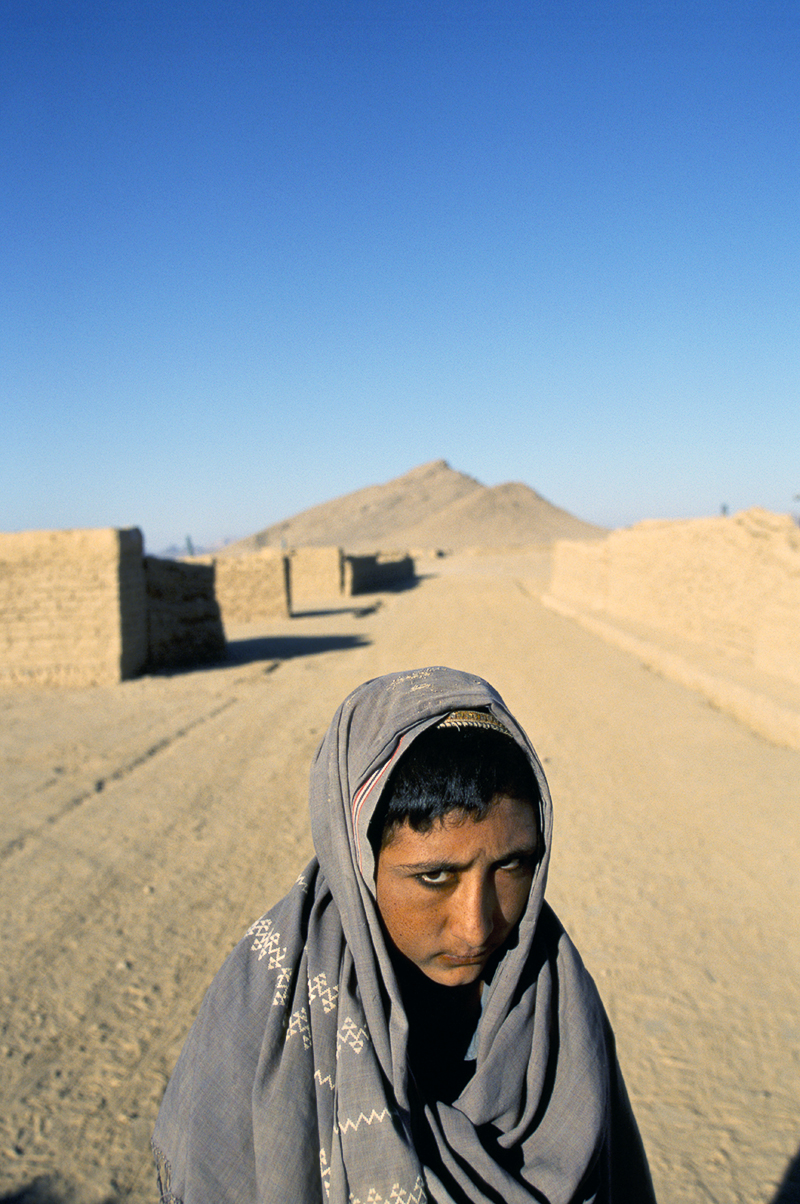
Afghanistan - Kandahar - A portrait of an Afghan boy
I had been debating for days whether to post something on Afghanistan (in light of our Great Leader’s brilliantly orchestrated ‘outburst’ about Pakistan’s involvement) when Time Magazine produced its most blatantly propogandist cover story for decades. The piece cynically manipulates Jodi Bieber‘s (a friend and ex-collegue from Network Photographers) dignified image of a mutilated woman to suggest that a withdrawl from this illegal, NeoCon war would lead to more barbarity. Presumably similar barbarity to the drone attacks killing countless civilians in both Pakistan and Afghanistan and the illegal, drug-infested, torture-soaked, Karzai government.
Let’s make no mistake here, the excuse that the brave forces of democracy are in South Asia to prevent another 9/11 is entirely spurious. Afghanistan did not attack America. The majority of those that did came from our staunch ally, Saudi Arabia – known for its robust defence of human, especially women’s rights. That a minority of Islamicists may have had bases in Afghanistan is more the result of Indo-Pak (and therefore CIA) intelligence machinations. Afghanistan has been raped and used by every invading army since the British had a go twice in the Nineteenth century. Are we surprised that such actions have spawned amongst the Pashtun tribes a spiteful and extreme Islam? I’m more surprised that it hasn’t been worse. My visits to Afghanistan (starting in 1994 to cover the Siege of Kabul for Der Spiegel) have consistently shown Afghans to be peaceful and kind – not that you’d get that from a whole generation of photographers and writers who have covered this forago ’embedded’ courtesy of the American Industrial-Military Complex. Surely they are all turban headed (‘rag-heads’ are Iraqis… obviously) women-hating, primitives. Still, if we can’t understand ’em and they don’t want our democracy, let’s bomb them, eh? Bomb them ‘back to the Stone Age…’.
According to Matthew Hob, the former US Marine who resigned his post as Political Officer in 2009, “The Pashtun insurgency, which is composed of multiple, seemingly infinite, local groups, is fed by what is perceived by the Pashtun people as a continued and sustained assault, going back centuries, on Pashtun land, culture, traditions and religion by internal and external enemies … I have observed that the bulk of the insurgency fights not for the white banner of the Taliban, but rather against the presence of foreign soldiers and taxes imposed by an unrepresentative government in Kabul.”
I was indebted to learn from every single media outlet today that a minor British celebrity who used to be married to a footballer and apparently sings, has contracted malaria. And on holiday too…
Apparently she’ll live. Unlike the approximate 850000 people still die from malaria every year even though simple insecticide-treated mosquito nets could significantly reduce mortality if made readily available to all people in regions where the disease is endemic. This according to Ann Veneman, head of UNICEF speaking on World Malaria day on April 25th. No – funny I didn’t hear much about that either.
According to Veneman, 90 per cent of those afflicted live in sub-Saharan Africa, and the majority of those deaths are children under five years old. “This shocking disparity is even more unacceptable” she concludes. I completely agree. Thankfully I am no longer cynical about how the media works (…) and certainly wish no-one to be ill… however – on recovery, expect brave celeb to do more charity work on said disease with full media coverage and nothing to change.
Burundi - Ruyigi - Jean, an orphan of Burundi's ethnic conflict at Shalom House shivers under a blanket with malaria. Shalom House was founded by Marguerite Barankitse (known as the 'Angel of Burundi') in 1994. During the genocide, Barankitse, at great personal risk, managed to save 25 orphans, Hutu, Tutsi and Twa and built a home for them. Currently, she has helped more than 10,000 orphans and separated children who can grow up in an "extended adopted family" in security, education and love.
My usual response to a magazine (or indeed anyone these days) asking for images for nothing usually elicits a response that is better left unwritten. However I was recently approached by a very interesting Dutch academic journal in the Hague called Donau who were making a special about sex and money… specifically permission to use the Albanian Virgin images in relation to a fascinating article by Gerda Dalipaj. Of course I said yes. It’s here.
You can see my last posting about the Avowed Virgins here
Some years ago I travelled to Pakistan to make a set of images about religious persecution. I lasted only a few days – for the first time in my career, I left a story because I honestly felt that my presence was putting lives at risk.
I had been invited to Rabwah, the spiritual home of the Ahmadiyya community, a peaceful minority Islamic movement that questions the finality of the Prophet Mohammed. Pakistan is the only country to classify Ahmadiyya’s as non-Muslims.
In 1984 General Zia issued Ordinace XX supposedly to prevent “anti-Islamic activities”. It forbids Ahmadiyya’s to call themselves Muslims, call their places of worship mosques and worship publicly. It forbids them from quoting from the Koran, preaching in public, seeking converts, or producing, publishing, and disseminating their religious materials. To gain a passport, all Pakistanis must declare themselves non-Ahmadiyyas.
The repression is of course a smokescreen to hide Pakistan’s myriad social and political problems and the Ahmaidiyyas are a perfect scapegoat. This is not about religion, it’s about state power. As Tariq Ali wrote in the London Review of Books in 2007:
“Back in the heart of Pakistan the most difficult and explosive issue remains social and economic inequality. This is not unrelated to the increase in the number of madrassas. If there were a half-decent state education system, poor families might not feel the need to hand over a son or daughter to the clerics in the hope that at least one child will be clothed, fed and educated. Were there even the semblance of a health system many would be saved from illnesses contracted as a result of fatigue and poverty. No government since 1947 has done much to reduce inequality”.
Ali Dayan Hassan of Human Rights Watch told the BBC the worshippers were “easy targets” for militant Sunni groups who consider the Ahmadis to be infidels. The Pakistani state is in trouble however and Ahmadiyyas are not the only minority to suffer persecution. According to Minority Rights, Baluchis, Hindus, Mohhajirs, Pushtuns, Sindhis and Christians all suffer.
Today, I read with interest an opinion piece in Dawn by Moshin Hamid (an author whose Moth Smoke I read and enjoyed some time ago) called Fear and Silence from which I take the liberty of quoting from at length. I think it elegantly echoes Pastor Martin Niemöller’s famous (attributed) quote “First they came for the Jews…”. Hamid says:
“Because the heart of the issue isn’t whether Ahmadis are non-Muslims or not. The heart of the issue is whether Muslims can be silenced by fear.
Because if we can be silenced when it comes to Ahmadis, then we can be silenced when it comes to Shias, we can be silenced when it comes to women, we can be silenced when it comes to dress, we can be silenced when it comes to entertainment, and we can even be silenced when it comes to sitting by ourselves, alone in a room, afraid to think what we think.
That is the point. ”
One can only hope that all people of tolerance and faith will not be silenced.
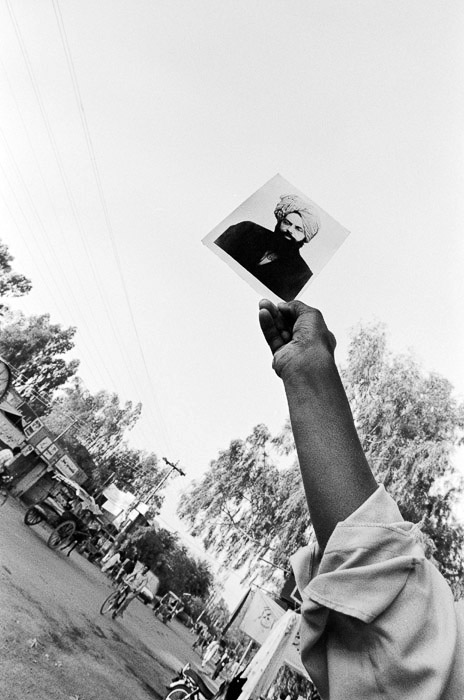
Pakistan - Rabwah - A man holds a portrait of the Ahmadiyya prophet, Ahmed. Also known as Qadiani's, the Ahmadiyyas are the followers of Hazrat Mirza Ghulam Ahmad Qadiani (1835-1908). According to his followers, he was the founder of the Ahmadiyya Muslim Jama'at and The Promised Messiah and Imam Mahdi. The Ahmadiyya (Qadiani) movement in Islam is a religious organisation with more than 30 million members worldwide. Ahmadiyyas are now banned from calling themselves Muslim in Pakistan and suffer terrible discrimination under anti-blasphemy laws and are regularly murdered for their faith.
Pakistan - Rabwah - Two Ahmadiyya men after prayers at their mosquePakistan - Rabwah - An Ahmadiyya imam leads his congregationPakistan - Rabwah - An Ahmadiyya woman weeps at the grave of her murdered childPakistan - Rabwah - An Ahmadiyya elder, blinded for his faithPakistan - Rabwah - A woman beneath a portrait of her murdered husbandPakistan - Rabwah - Ahmadiyyas praying at their mosquePakistan - Rabwah - After prayers, a boy plays ball in a mosque
Tewfic El Sawy, aka The Travel Photographer Blog has once again very kindly featured my work on his site. This time, it’s the work on the idol makers that I wrote about here a month ago.