So, I made it through the Ash cloud after all and spent six days on assignment in Israel. Lovely job in Tel Aviv and Jerusalem: travel and food. Nice. I hadn’t spent much time in Tel Aviv before and really enjoyed the experience. Jerusalem was another story however. I’d forgotten that this can be the rudest city on the planet and with some notable exceptions (pretty much all the taxi drivers – notably, Benny and Salim the unfailingly helpful staff at the Addar, Samir at Pasha’s and half a dozen lovely stallholders at Mahane Yehuda market – especially Itzack and his boys), I had to really dig in and grit my teeth. What is it about Jerusalem that makes people so rude and unfriendly? Maybe I caught it on a bad couple of days – I tried, I really did but it was a bit of a slog. I had just had a particularly unpleasant encounter and was packing up for the day when I was beckoned over by a friendly fishmonger. Moses insisted that I sit down and take his picture and that we should pose together…
Israel - Jerusalem - Me and the friendliest man in town
A real gentleman. Moses, you’ll probably never read this but you restored my faith in the city and it even made up for the hour and more grilling I had at the airport the next day (note to self: next time use the empty passport – not the one with the Saudi, Afghan, Lebanese and Pakistani stamps).
Three years ago, while working in Tamil Nadu, I came across a story that I determined to return to and photograph.
_____________
“What we do here is the work of God and that work is spread through our blood” says Radhakrishna Stapathy.
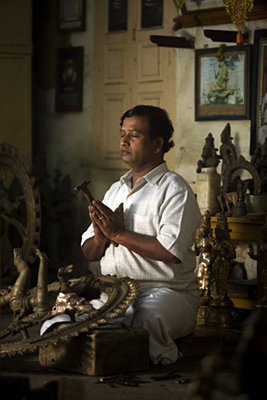
It is just after dawn and Stapathy squats cross-legged on a wooden block, a small hammer between his palms drawn to his forehead in prayer. In front of him, a large statue, freshly cast to which he will bring life by smoothing its metal through long hours of patient work.
Stapathy is an idol maker, a caster of statues, a master craftsman and one whose lineage can be traced backwards twenty three generations to the time that the great Chola Empire that ruled South India more than seven hundred years ago.
Swamimalai is a sleepy temple town deep in Tamil Nadu. Five hours drive from the bustling noisy city of Chennai (formerly Madras); it has a rhythm of a time that has been. Peasants winnow grain under the wheels of passing trucks and bend low in fields ankle deep in rich soil and bullock pull carts along dirt tracks.
This is the heartland of Tamil Dravidian culture and the landscape is linked organically to its religion with every field, every village, paying homage to a deity. A sacred geography links its towns where great palaces of temples provide, in the eyes of the faithful, a real home for the Gods.
The Stapathy studio, fronted by two (relatively) modern offices, is a dark and cavernous space that ironically resembles a temple itself. Men sit of the floors dressed in stained dhotis, deep in concentration, chipping and finishing statues and icons in the warm air filled with incense and the smell of the damp, cool earth under bare feet.
In the courtyard outside, three men mould clay around perfectly carved wax images that will melt on the introduction of molten metal. This ‘lost wax’ process was described by August Rodin as “the most perfect representation of rhythmic movement in art.”
The art of bronze casting can trace its origins from the Indus Valley civilization reaching its zenith during the Chola period in the Thanjavur delta during the 9th-11th centuries A.D.
At the end of the reign of Rajaraja, the greatest Chola king a magnificent temple was built in his capital, Tanjore. On its completion in 1010, the Cholas had donated 500 tons of gold, jewels and silver as well as sixty bronze images of deities to the new structure.
The temples at Tanjore, Chidambaram and Gangaikondacholisvaram are still dark, mysterious places alive with pilgrims prostrating themselves in cavernous halls before oiled black-stone images of gods and demons eerily lit by camphor lamps. They worship before the most famous incarnation of Shiva – Nataraja who elegantly dances the world into destruction and re-birth.
The Stapathy family were originally stonemasons but were called to Tanjore to learn the new art. It was discovered that that the fine silt from the nearby Kauvery River suited the moulding of the bronzes and the process has not changed since.
“Here is our culture,” says Stapathy and rows of half finished pieces peer from the shadows. All around, wax figures sit cool in great bowls of water: arms, legs, and heads like a battle hospital for Gods. Moulds of countless beings are stacked on dusty shelves around the walls. Later, at his house, across the street, Radakhrishna, now joined by his brother Srikanda, perform a puja at their family shrine honouring their ancestors. “It’s like this,” says Srikanda. “We need no training, a fish doesn’t need lessons of how to live in water: we are born for this work. And the work is good… orders are there and money is there”. Indeed, work is brisk and the brothers’ skills are in demand all across the Indian diaspora. Temples in London, California and Canada want idols crafted in the tradition of their fathers and pay handsomely for the privilege. There are other families that make idols “but” says Radhakhrishna, “none know the Sanskrit, none can make the prayers… we only are keeping the Chola king’s tradition.”
As the afternoon draws on, sweating men carefully pour molten metal into a mould held tight in the earth. Later, in a flurry of steam and almost divine heat, a statue will emerge beneath their hammers onto the workshop floor and, if the prayers have been performed properly, the process will produce an idol. Depending on its size it may take weeks to prepare for its ‘birth’ when its eyes are sculpted and its ‘Jeevan’ or life force will be breathed into it, it will, for a set time (depending on where it ‘lives’ and how faithfully it’s worshipped) become in a real sense, a God.
Dawn again, with the streets quiet, Radhakrishna pulls his skirt around him and steadies himself on his wooden seat. Still for a moment, he takes his chisel and checks his cutting line. He makes an incantation and the room is gently filled with the tap-tapping of a hammer. A noise that echoes across the room, across his family and across generations.
In his recent book, the historian William Dalrymple devotes a chapter to the idol makers.
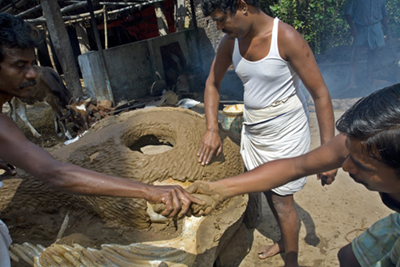
India - Tamil Nadu - Master craftsmen Radhakhrishna Stpathy (r) and his brorther, Srikanda mould an icon in wax in their workshop in Swamimalai, India..The current Stpathy family is the twenty third generation of bronze casters dating back to the founding of the Chola Empire. The Stapathys had been sculptors of stone idols at the time of Rajaraja 1 (AD985-1014) but were called to Tanjore to learn bronze casting. Their methods using the 'lost wax' process remains unchanged to this day..India - Tamil Nadu - Workers sealing and covering a wax mould of an icon with clay ready to be fired in the pit at the workshop in Swamimalai, India.India - Tamil Nadu - Master craftsman Pranava Stapathy instructs another craftsman whilst working on a large statue of Hanuman, the monkey God at the workshop of S. Devasenapathy Stapathy and Sons.India - Tamil Nadu - A craftsman pours wax into a mould from which a statue will be cast from bronze. India - Tamil Nadu - A worker carves a wax mould of an icon in the studio of the Stpathy family of idol makers, Swamimalai, India.India - Tamil Nadu - Workers cast an icon in the pit at the workshop of the Stpathy family, SwamimalaiIndia - Tamil Nadu - Radakrishna Stpathy directs the breaking open of a icon mould at his workshop in SwamimalaiIndia - Tamil Nadu - A finished icon of the God Shiva shown here in the form of the dancing Nataraja.India - Tamil Nadu - A priest by a shrine at the Murugan temple stands in front of a shrine containing a ritual idolIndia - Tamil Nadu - Devotees light oil lamps in the Murugan temple India - Tamil Nadu - Master craftsman Radhakhrishna Stpathy, works on the final touches to a statue of the dancing Nataraja at dawn in his workshop
I’m sitting at home waiting anxiously to see whether an assignment in Israel will actually happen on Thursday as planned or whether the Icelandic volcano, Eyjafjallajökull, will have the last laugh.
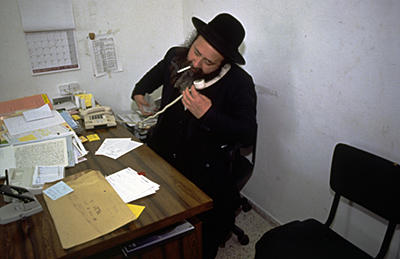
Looking through my archive, I found that the last time I was there, I had an assignment to photograph a Rabbi detective. Very interesting chap – a sort of Yiddish Philip Marlowe. Anyway, here’s a few pictures from that trip when airline travel was easier…
Israel - Jerusalem - Yehuda Gordon, a Jerusalem based Rabbi that is charged by the Rabbinical courts to trace errant husbands that refuse to divorce their wives and so deny them access to the their rights under Jewish law.Israel - Jerusalem - Israeli soldiers pray at the 'Wailing' or Western Wall in JerusalemIsrael - Jerusalem - an Orthodox Jewish boy
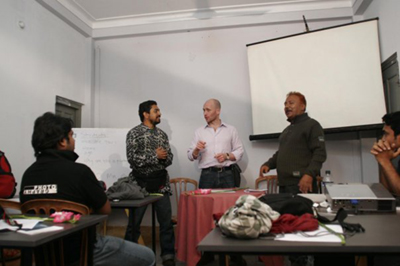
It’s rare these days that a jaded old photographer like me finds something positive about the industry but that is exactly what has happened in the last week in Chittagong in Bangladesh.
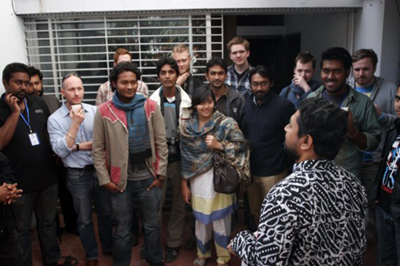
As you may remember, I was asked to lead a workshop for aspiring photojournalism students from Norway and Bangladesh on behalf of the Pathshala Institute
headed by the prolific Shahidul Alam. It was a rather daunting challenge. The only workshop that I’d ever attended was as a young photographer myself at the World Press Masterclass in 1998. I’ve had no formal photographic education and, despite giving a dozen or so lectures and talks over the years, I wasn’t confident that I could add much to these students education. I need not have worried. Ably assisted by the extraordinary Abir Abdullah, an exceptional educator in his own right, I think – I hope – that I managed to pass on something of the little I know to the students.
I must say that the Norwegians were for their age, exceptional visual journalists and it was a lesson for me to see them produce their assignments with an energy and proficiency that would put many established UK professionals to shame. I think to a person their level of visual literacy was far higher than I was expecting. The Bangladeshi’s, some a product of the Pathshala Institute and some having just completed a basic photography course struggled a little with the idea of storytelling – the theme of the workshop. That said, their determination and enthusiasm was a pleasure to witness. I felt by the end that the concept of a photo-essay was firmly entrenched. As a matter of fact, despite some rather cliched ideas of what a documentary project could look like, it was a two Bangladeshi students – both women I should add – that produced ideas for their course projects that impressed me most. Both decided to work on the personal sphere. In an industry dominated by men and seemingly endless stories of poverty and darkness it was a welcome change.
It was also my first visit to Bangladesh – a pleasant journey from the cold English winter and Chittagong and it’s people in particular I have to thank for being so welcoming and open. I’m now due to come back in the summer to shoot a story. I’m looking forward to it already.
Delhi waits for me now – a flight from Dhaka and then almost a month in India. I have a corporate assignment there and then two stories that I need to work on.
As usual I shall be on:
0091 9810941435
It just remains for me to say thank you in particular to Abir, Shoeb and his wife (what a lovely meal), Joseph Rozario (a marvel), Ashraf (for all his patience with me), Shadab (for his kindness) and to the students – firstly for their beautiful and unexpected gifts (you know who you are…) and secondly for their patience and unwavering attention even when I’m sure I was talking rubbish… you all touched me deeply. I hope we stay in touch. Thank you.
For now I leave you with some images from the workshop and one of a couple of frames that I had time to make myself in Chittagong.
After writing about Delhi street food a few days ago, I was pleased to see that Pamela Timms on her blog, Eat and Dust has posted a very informative article about Daulat ki chaat the chilled milk sweet that I mentioned. There’s even a phone number for one of the elusive wallahs. See the whole story here.
I’ve been associated with Delhi in one way and another almost fourteen years. I’m sometimes based there for months on end and, although it is perhaps one of the most frustrating and brutal cities I can think of, I find endless fascination with it. Like London, Delhi is a palimpsest of perhaps nine, perhaps more cities built, destroyed and rebuilt. It’s usually recorded, with some notable exceptions (and again) as unknowable and unloveable. Choked with people and displaying more violence than India would like to admit, journalists tend to concentrate on its chaos poverty and pollution. I’ve done those pieces myself, most recently a film for More4 News about Water in the city that you can see here. But Delhi is certainly more than that. During that film I was working in Kusumpur Pahari, a thirty year old slum or jhuggi cluster. The slum is entirely illegal but is home to thousands of people. Some have rather nice houses and of course some have tried to beautify them as best they can. Many have little flat roofs where they have gardens made of pot plants. It struck me that this didn’t really fit with the poverty stricken Dickensian idea that we in the West have of helpless slum-dwellers and I started to photograph them. That led me onto an as yet unfinished body of work about imaging Delhi in a different way. I wanted to look at Delhi’s relationship with Gardens and space and so for the last couple of years have been trying to photograph not only the acres and acres of green space in the city but crucially in such a crowded conservative place, people’s relationship to it. A couple of weeks ago I was approached by Fabiano Busdraghi who publishes online the small but beautifully formed Camera Obscura magazine/blog. He asked me if I’d write something and I immediately thought of this project. You can see the piece, The Gardens of Delhi – Public Spaces, Private Lives, here. I hope that you enjoy it.
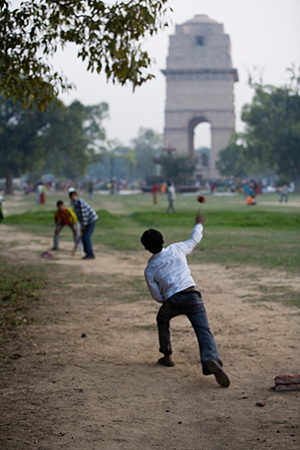
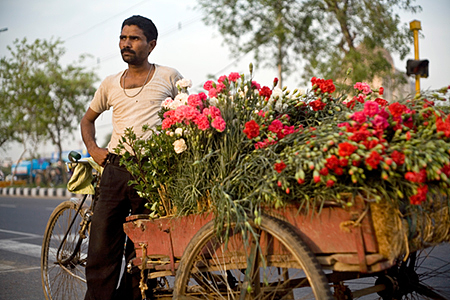
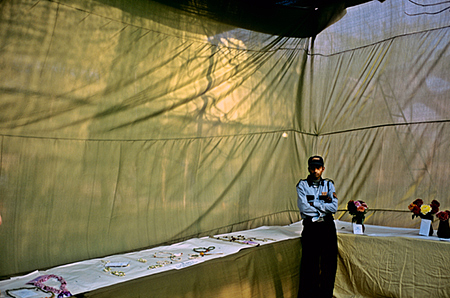
The text on the Camera Obscura site is pretty explanatory about the project so I won’t bang on about it here. Instead, here are some more images that I like from it.
India - New Delhi - Boys play cricket in the park at India Gate.
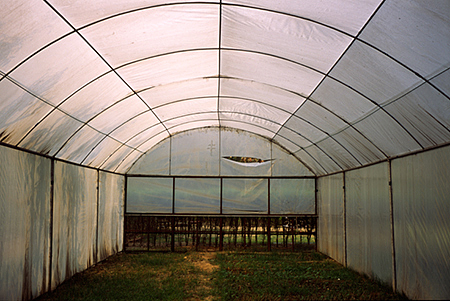
India - New Delhi - An early morning yoga class in Lodi Gardens in front of the Bara Gumbad TombIndia - New Delhi - A 'phool wallah' (or flower seller) delivering flowers on tricycle, MehrauliIndia - New Delhi - A guard in a judging tent at a particularly Raj style event, The Delhi Flower showIndia - New Delhi - The roots of a tree in the grounds of Humayan's Tomb in New Delhi, India. The tomb itself built in 1570, is of particular cultural significance as it was the first garden tomb on the Indian subcontinent. It inspired several major architectural innovations, culminating in the construction of the Taj Mahal.India - New Delhi - A tear in the plastic of a greenhouse in the Rose Garden that is behind Safdardjung's Tomb
To my surprise and delight, Tewfic El-Sawy who runs the popular Travel Photographer blog has again chosen to highlight some of my work in India, this time on Kathakali.
The students at the academy rise at dawn and undergo hours of daily exercise and academic studies for years to learn by heart the dances and the intricate movements of Kathakali. I thought Kathakali reminded me very much of classical Japanese Noh – a mute mixture of precise dance and theatre where slight eye and hand movements indicate an entire language.
The first picture has always reminded me of a pond of small frogs…
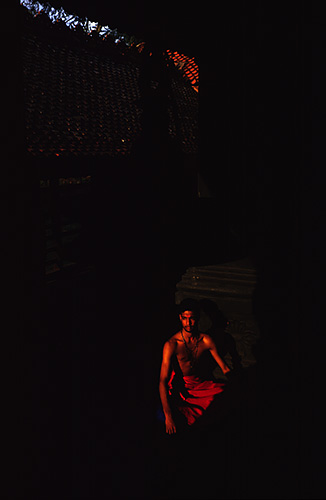
Young students at the Kalamandalam practice eye exercise at dawn in a classroom lit by ghee (butter) lamps. Kathakali uses very intricate eye and hand movements to communicate with the audienceA boy is massaged by his teacher at the Kalamandalam. Massage is seen as an essential part of Kathahakali practice making the body supple.Professor Balasubramanian pauses before he finishes his make-up in preparation for a production of the RamayanaIn the late afternoon sun, a senior student relaxes after class by the Koothambalam (temple theatre)
Here’s a link to my work on Shadipur Depot, a slum colony of artists and performers in New Delhi that was a previous post on the Travel Photographer.
I just returned from a job in Bologna several pounds heavier. It was actually the most enjoyable trip I’ve had in years: not only could I wander endlessly but the people were extraordinarily nice. In five days no one objected to being photographed, everyone was unerringly polite and everyone humoured my laboured and almost non-existant Italian.
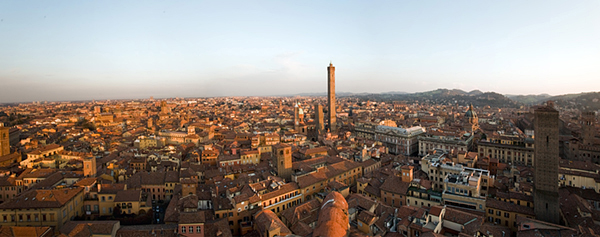
I was searching for a way to photograph the city and quite by chance, after a long walk, wandered into a newsagent that sold books and found a panoramic image from the top of somewhere obviously very high. The guy in the shop was convinced it was taken from the top of a famous church but the caption read ‘O Coronato’… Confused, I called my new editor at Grazia Neri, Anna Savini. As luck would have it, Anna is from Bologna and the Coronato is actually a privately owned tower – and her Mum knew the owner. Very handy. Matteo Giovanardi who lives in and owns the tower was charm itself – but I had to climb the tower alone as he was waiting for his daughter to come back from school… I have to say that the tower was a marvel. It was also very high. For someone who isn’t great at heights and had already climbed the The Asinelli Tower, sweating and gripping the frail handrails tightly swearing never to do this kind of thing again, it was a bit of a trial. The view was however, extraordinary. The light, just before sunset, sublime. I remembered why I’d become a photographer. As I heaved myself down, Matteo showed me around his home that is the Prendiparte Tower…
I was terribly fortunate to be allowed to photograph from the Tower: I think Matteo has only granted permission twice – both for books. Anyway, this is what I saw:
I have to thank Caroline, digital guru extroaordinaire, for stitching together several images (obviously I came prepared – without a panoramic attachment on the tripod…).