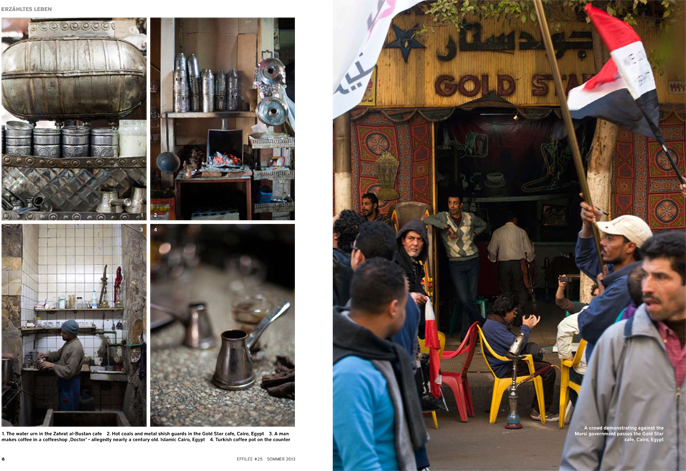
Tearsheet – The Ahwas of Cairo


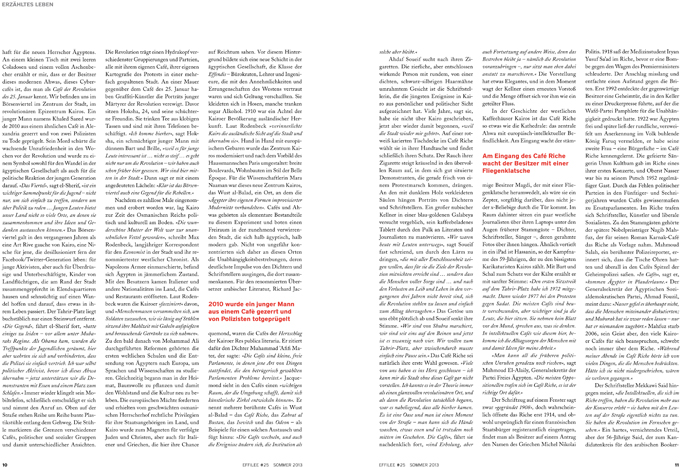
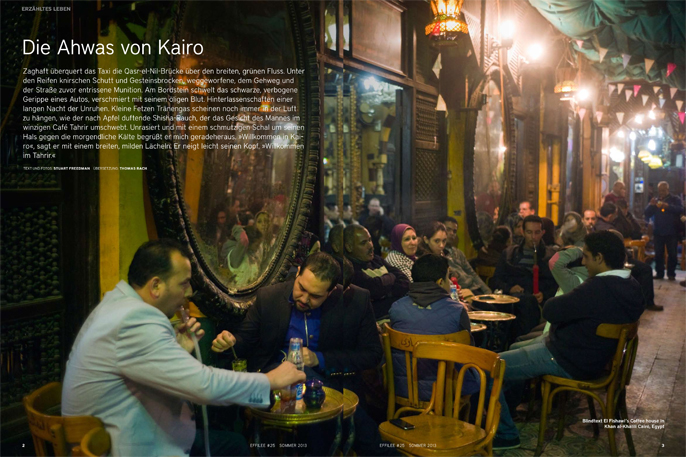
Here is a recent tearsheet from the wonderful Effilee Magazine for whom I wrote and photographed a really unusual piece about the Ahwas (coffeehouses) of Cairo. I wanted to write about the situation in Egypt without watching people fighting and using the prism of the Ahwas allowed me to examine protest and the way that the Revolution has evolved through them. The piece is an historical look at the heritage of the coffee houses and their resurgence after years of political repression. Under Nasser, Sadat and Mubarak, dissent and free thought were controlled. Networks of informers and secret policemen used cafes as an access point to the Arab Street. Novelists and poets like Naguib Mafouz still patronised them but had to write and speak in metaphor. Despite this coffeehouses had and continue to hold a significant rôle in Arab (and specifically) Egyptian literature and culture.
The Revolution of 2011 was sparked at least in part by the killing of a young man by the security forces outside an Ahwa that was used as an internet cafe. The cafes have become political again and, in this work, I’ve tried to explore the downtown splendour of the Art Nouveau, Cafe Riche that is home to a new generation of political activists, the street cafes of the Bourse (Cairo’s Left Bank during the Revolution) as well as a survey of Ahwas less well known – simple backstreet cafes and those of the Zaballeen (the Christian minority). Interviews include (amongst others) political commentator and Booker Prize nominated novelist Ahdaf Soueif, Arab Booker nominee (also head of Al-Dar publishing house) and flâneur Makkawi Said and Max Rodenbeck, the Economist’s correspondent and author of the encyclopaedic, ‘Cairo, the City Victorious’. Currently, a new Egyptian soap opera called Coffee Shop is attracting very negative attention from Egypt’s secularists about the way women are (or actually not) portrayed within the programme. The debate goes to the heart of what society was being created under the Morsi government.

Here’s the tearsheet:
 

11418_ahwa-copy-1a


11418_ahwa-copy-2


11418_ahwa-copy-3


11418_ahwa-copy-4


11418_ahwa-copy-5


11418_ahwa-copy-6

World Street Photography Day

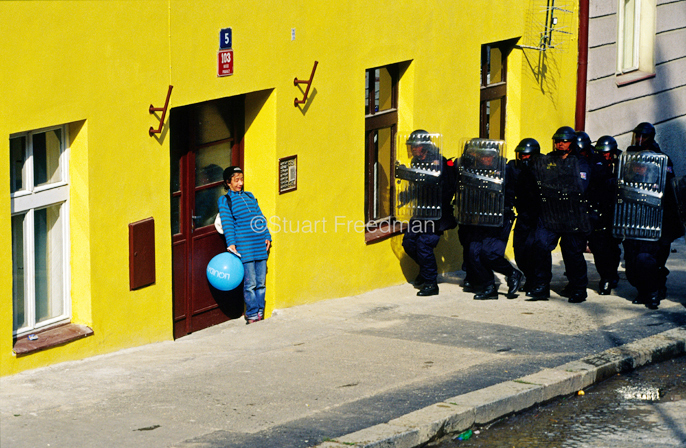
… was apparently yesterday. I didn’t know but supposedly it’s celebrated every year to mark the birthday of some well known painter called Cartier-Bresson… I also missed World Photography Day on August the 19th. Who knew? Far be it from me to suggest that there is a little too much photography in the world but I happened to be showing work to a new client yesterday and he found the image below hilarious so I thought I’d post it here. It’s a good enough reason. It’s taken on the street so I guess that it qualifies… True, it’s not exactly an homage to Winogrand and it was unusually for me, taken on a 80-200 but I was just pulling a gas mask off at the time and it is on tranny, so I think I’m excused… On assignment for Newsweek at the time covering the anti Capitalist protests in Prague. Just as I was taking it I remembered the Don McCullen shot from Derry (see here). Same but different.


Czech Republic - Prague - A drunken protester attempts to hide in a doorway as riot police charge demostrators during the protests surrounding the World Bank and International Monetary Fund meetings
Czech Republic – Prague – A drunken protester attempts to hide in a doorway as riot police charge demostrators during the protests surrounding the World Bank and International Monetary Fund meetings


David beats Goliath


I was delighted to read over the weekend in a piece by Dean Nelson and Simon de Trey-White in the Daily Telegraph of the decision by Vedanta Mining to respect the wishes of the Dongria Kondh tribe and cease mining their sacred mountain for bauxite.

Vedanta Resources, a UK-registered ftse -100 company wanted to mine the Niyamgiri Hills in Orissa which are sacred to  Dongria Kondh, a protected tribal group of ‘original’ Aboriginal peoples. The Orissa state government had agreed to the destruction of the Tribal peoples land in 2005 but the decision was eventually overturned by the Supreme Court after a tortuous appeals process. The final decision was made by the Dongria Kondh themselves at a gathering at the weekend.

I covered the story in 2007 and wrote about it for the Indian magazine Tehelka (see here).

In a blog post on this site in 2009 I wrote that,

“I am no romantic when it come to India. I don’t share a Raj view of the colonial apologists (despite inevitably by dint of being British having reaped the indirect rewards of the subjugation of that country). I don’t yearn for quaint, underdeveloped communities full of poverty and colour. I want to see India progress. But I know the stink of international corporate power when I smell it… India had no colonies from which to steal resources so it’s stealing them from its own weak and vulnerable. The profits of this mine will not be spread evenly to benefit the Indian economy – it will be hoarded in the off-shore bank accounts of those corrupt politicians and corporate executives who already think that India is theirs by right.

A new middle class India has been brought up to believe that a successful society means a consumerist society. Greed and nationalism go hand in hand: it is not the poor of India calling for war with their brothers and sisters in Pakistan.”

It is a deeply significant victory for the Dongria Kondh but as Nelson correctly points out the flow of modernity is inevitable.

As I also wrote in 2009,

“Traditionally, Indians have protested injustice in a dignified Ghandian way with hunger strikes and marches. While the Western media and much of India has been marvelling at ‘Shining India’ it has failed to notice that a good deal of India is now under (mostly Maoist) rebel control. In Kashmir, Manipur, Nagaland, Bihar, Andhra Pradesh, Chhattisgarh and Jharkhand the Indian state is fighting a battle it might not win.”

I’ve used before Arundhati Roy‘s metaphor of India ‘eating its own people’ to describe that country’s unfettered race to Market Capitalism’. I hope that the Dongria Kondh’s victory for their peaceful, traditional way of life in harmony with the land of their fathers will last for as long it can.


India - Orissa - Dabu Limajhi, a tribal woman in her home in Kankasarpa village, India – Orissa – Dabu Limajhi, a tribal woman in her home in Kankasarpa village,

Greece and another summer of hunger


Helena Smith in today’s Guardian reports from Greece on the “unravelling social fabric” of that country. The draconian austerity imposed by the European Union has made beggars of many Greeks and according to a UNICEF report earlier this year, nearly 600,000 children live under the poverty line – more than half that number lack basic daily nutritional needs.

I wrote last summer (here and here) about the crisis interviewing academics, NGO’s and those queuing for meagre hand-outs recently impoverished by the cuts. I focused on community action and how people were feeding each other from their gardens – survival strategies against the onslaught of NeoLiberal bankers set on profit and punishment. Here was the shock in action, the management and manipulation of crisis, the confiscatory deflation (see Chile, Argentina, Mexico etc, etc); the revenge of the elites; here was the project to destroy social cohesion (because there is no such thing as Society).

Here’s a picture of that idea failing.

Volunteers prepare and serve potato soup for the poor and homeless in a Municipal Soup kitchen in Athens, Greece


My last paragraph tried to sketch the scene outside the Municipal Soup kitchen in a way that photography couldn’t.

“In the afternoon, the municipal soup kitchen has a slightly carnival atmosphere. Africans, Kurds, Arabs and Bangladeshis all congregate in their little groups talking animatedly about their troubles. Who knows their tortuous routes to Europe, but they are being fed. There is a blur of grubby children running this way and that. Women in headscarves picnic on the grass with chunks of Greek bread. Men of all shades discuss politics and perhaps wonder about the families that they have left in yet more difficult, dusty places.
Natassa has returned with her husband to help carry more potatoes home in a shopping basket on wheels. He is tired and a little resigned, never imagining that his dotage would be like this. “We are good people” he says. The lowing sun casts long, sharp shadows that cut the ground into the jagged shapes of the railings around the building. Arm in arm. Two old people as if on promenade. Then she turns and her face lights with something that is between pride and humour.

“I may be a beggar” she says, “but I am still a lady”

She is, for that moment, all of Greece.

©Stuart Freedman 2012

How I learned to love Bollywood


There’s a really interesting piece in the Guardian today by Amit Chaudhuri (the British media’s new go-to man for South Asian comment) about Bollywood – the catch-all term for Indian mainstream film. Chaudhuri relates his own personal journey back to an Indian past whilst watching classic Hindi cinema at university in Cambridge in the ’80s. It was a medium that he’d ignored partly because of his middle-class upbringing and partly because he’d grown up on Hollywood movies. Interestingly, as he says, “just as Bollywood seemed to become all gloss and syrup, there was another development.” This came in the form of Independent Hindi cinema. Movies like Maqbool and Omkara. It’s a shame for the outsider who doesn’t speak Hindi because it’s really tricky to find subtitled versions beyond the big blockbusters. I’m still trying to hunt down a version of the Gangs of Wasseypur that I can understand. For me, I remember sitting open mouthed the first time I saw some of the beautiful Satyajit Ray offerings in black and white that are pretty easy to find… but then also loving more modern ironic offerings like Quick Gun Murugan. In any case it will be interesting to see where ‘new’ Indian cinema will go in the next few years in a rapidly changing India.

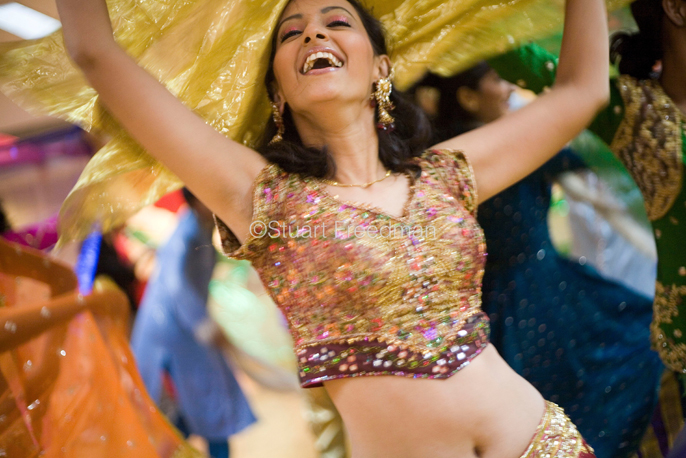
I’ve never worked on a Bollywood movie (although I did shoot movie moghul Ronnie Screwvalla for the Sunday Times Magazine a few years ago – see here) but did photograph the rehearsals for The Merchants of Bollywood (again for the Sunday Times Magazine) in Mumbai a while back. As my own homage to Bollywood, here’s one of my favourite frames from the job…


Indian - Mumbai - Dancer Ashwini Iyer, 23, practices her routine at a rehearsal of the production of The Merchants of Bollywood in a studio in Mumbai, India
Indian – Mumbai – Dancer Ashwini Iyer, 23, practices her routine at a rehearsal of the production of The Merchants of Bollywood in a studio in Mumbai, India


Music on a rainy afternoon


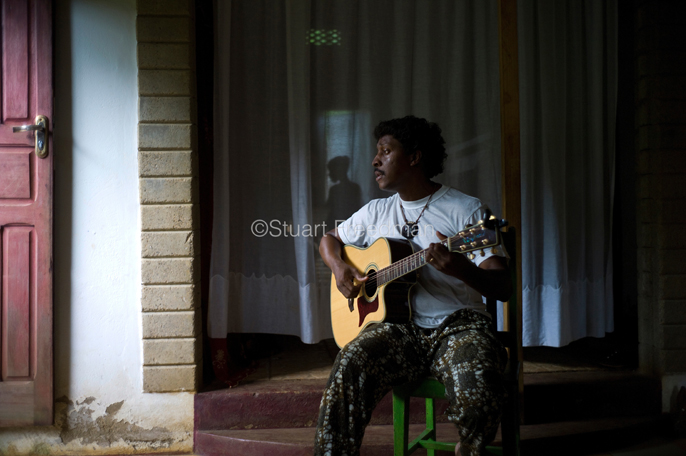
Here’s another image from a recent Conde Nast Traveller story in Sao Tome and Principe. It shows singer Guilherme de Caravlho playing at home in Sao Tome. Outside the heavens had just opened and a rain storm was passing overhead. Behind the curtain his daughter danced to the music.

I’ve written before about music from former Portuguese colonies: the melancholy, the saudade. Here was a perfect moment to illustrate it. I hope that I did his song justice…


Sao Tome and Principe - Sao Tome - Singer Guilherme de Caravalho plays guitar at home
Sao Tome and Principe – Sao Tome – Singer Guilherme de Caravalho plays guitar at home

You dancin’?


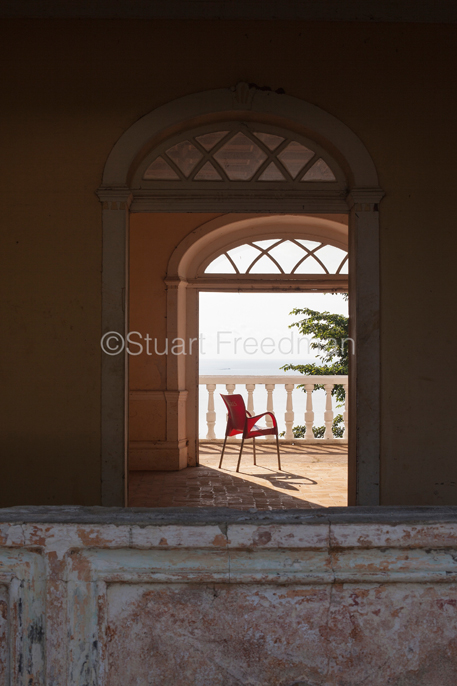
Here’s the first in an occasional series of unpublished images from a recent Conde Nast Traveller piece on Sao Tome and Principe.

I’d just finished a portrait down the road when I heard some music and drifted into a bar (as you do). I found a sound system and a few people swaying to the music between the tables. This elegant woman was dancing the afternoon away.

A thousand stories.


Sao Tome and Principe - Airport - Paula, a local woman dances at the White House bar near the airport, Sao Tome and Principe
Sao Tome and Principe – Airport – Paula, a local woman dances at the White House bar