It seems that Imran Khan, who I’ve photographed a couple of times on assignment (and previously written about) is finally making a breakthrough in the murky and dangerous world of Pakistani politics with a large rally on Christmas Day. I was delighted therefore to see that his new book, Pakistan, a personal history includes a couple of my images of him.
Here’s one they unfortunately missed…
Pakistan - Lahore - Imran Khan the former Pakistan International Cricket player at prayer in a mosque in Lahore, Pakistan
There’s a rather charming slideshow on the BBC here on the changing face of Delhi by one of its elderly residents. A shame that the city authorities haven’t made more of this to be honest. Delhi remains an enigmatic and petulant youth amongst other capitals: certainly for me infuriating and engaging at the same time.
Of course, as Kanika Singh, Convener of Delhi Heritage Walks told Tehelka magazine, not everyone shares that view, “Only last year, we evicted all street hawkers while preparing for the Commonwealth Games—and now we are celebrating their contributed (sic.) to our ‘heritage’. I don’t feel like celebrating this occasion. Whose Delhi are we celebrating?”.
The point is surely that cities only belong to their inhabitants when they feel they have some stake in them. I agree that most of Delhi is too busy trying to earn a crust to survive to be bothered about the anniversary but surely (and, if you’ve read this blog before you will know that I am the very last person to romanticise or excuse the Raj) the city is the sum of it’s parts: Hindu, Muslim and the British all have legacies that has made Delhi what it is and decrying any of those for some neo-nationalist point is surely counter-productive. Delhi is what it is and pretending that the city – or indeed much of India for that matter, doesn’t have some English blood is as pointless and saying it isn’t a melting pot of past empires. Selective cultural memory is a very dangerous thing for all societies (remember Ayodya?) and only by melding the various strains in a city (certainly one as large and anarchic as Delhi) can you hope to create a genuinely inclusive society…
Anyway, lecture over. Here’s one I made earlier…
India - Gurgaon - Bricklayers constructing a house in the shadow of an exclusive new development
I’ve just photographed and written another piece on Delhi street food and as I was walking through Chawri Bazaar yesterday I spotted a chai wallah plying his trade. On the wall next to the stall he’d hung some of his teacup frames. It looked so odd that I made a picture.
I wonder how many cups of tea these holders have held over the years?
India - Delhi - A chai wallahs tea glass holders pinned to a wall
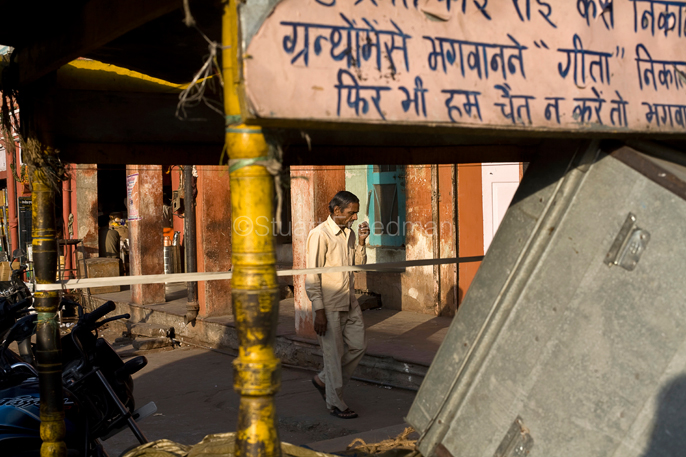
India - Jaipur - A man walks through the streets of the Old City at dusk
I have just finished a lovely four day travel assignment in one of India’s most tourist-heavy cities, Jaipur. Ironically I was tasked to write and photograph about the quiet spots, the quirky and the unusual and I’m pleased to say that there were many. I stayed an extra day and a half in order to edit and write the piece and on the last afternoon, took myself out to shoot on the streets. I always used to do this kind of work on Leica’s and tranny. That process was very freeing but I find it incredibly difficult these days to shoot this kind of work on DSLR’s. Perhaps it’s just me but one looks so much like a photographer that the process becomes a cliche: two big heavy cameras with two big heavy prime lenses. A long way from the classic rangefinder. It is more than that however – purely in terms of seeing, those little cameras allowed you to examine spatial relationships through the viewfinder. You could pre-focus and just walk into the picture. I feel very removed when I try to do these kind of things with my current kit. There’s a sort of rhythm that works on the street and it’s really difficult to do with such a big, noisy machine pressed to your face. I have, over the years in India gone back to my M6 rangefinders as it’s still relatively cheap and easy to process film here. However, then you have the laborious task of scanning – a process which, after spending the best part of two years feeding my archive (in the form of little plastic squares) through various machines, I’d rather die than attempt again. The irony is of course that I used to be sponsored by Leica (and Kodak for that matter) but who, apart from dentists (meaning rich hobbyists) as Simon Norfolk said a few years ago can afford a couple of M9’s? Or perhaps I’m just not working hard enough…
I’m sad to report that the Mehrauli Flower Market seems to have finally closed. There had been rumours that this and the one in central Delhi were to be moved to an industrial area in Okhla but I’m certain this hasn’t happened. A real shame – not least for those poor people that worked here. I’d photographed the Mehrauli market a little bit for my ongoing work Public Spaces, Private Lives and here are two of my favourite images from there from the set.
India - New Delhi - A bag of petals in a sack at the end of the day at the Mehrauli Flower Market
India - New Delhi - A phoolwallah on his tricycle collecting a delivery of flowers from the Mehrauli flower market
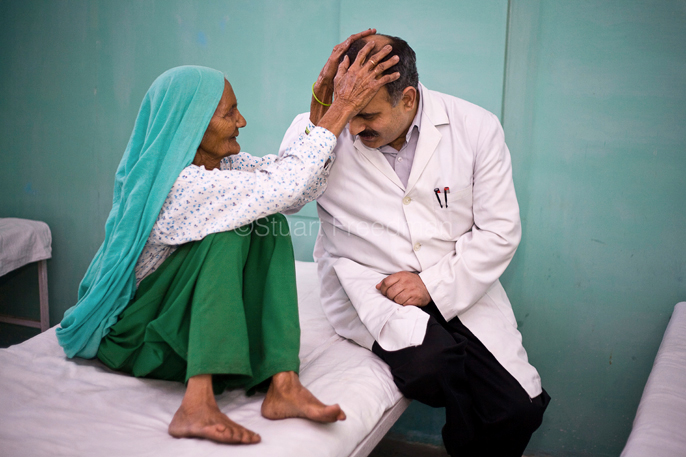
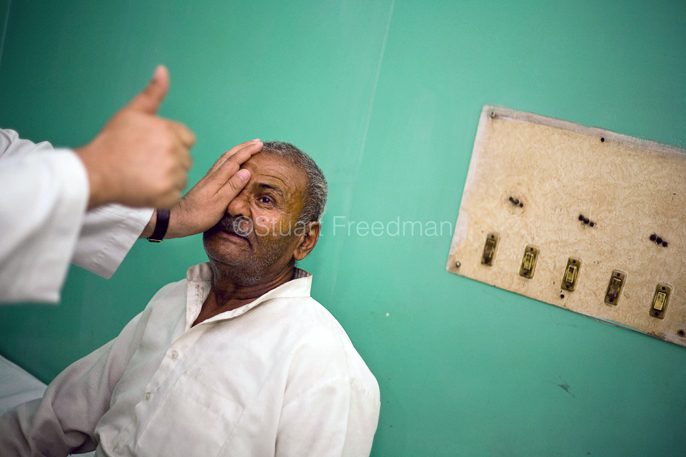
In honour of World Sight Day. I thought I’d publish a few of images to celebrate people having their sight restored. The surgeon, Doctor Rajendra Trishal is one of those unsung Indian doctors who work in very unglamorous surroundings but nevertheless change peoples lives by their work.
The last picture is not for the squeamish, so beware…
India - Ghaziabad - Doctor Rajendra Trishal is blessed by Palo Devi, whose cataracts the doctor removed the previous day.
India - Ghaziabad - Doctor Rajendra Trishal examines Rohatas Kale, 60, whose cataracts the doctor removed the previous day
India - Ghaziabad - Doctor Rajendra Trishal performs cataract surgery on a patient at the Ginni Modi Opthalmic Research Centre, Modinagar
This post is a little late as World Homeless Day was on Monday 10/10/11 and although several kind people (Laurence Watts, Justin Leighton, Panos and Duckrabbit) Tweeted some of my work but I was away and so missed the opportunity to write something.
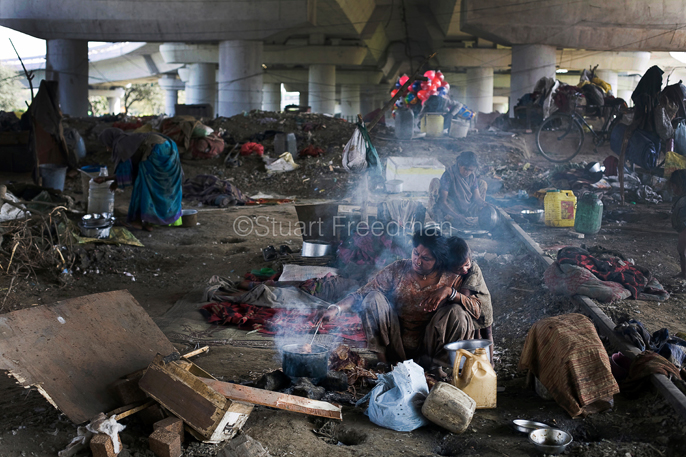
The work here is from an ongoing piece about Delhi and it’s people – where some 100000 people just happen to be homeless. I’m always cautious these days about doing another story about the homeless – you know the nameless victims staring up at the camera but the sheer scale of Delhi’s problem is so significant, so enormous it became inevitable. The work was an assignment from ActionAid (thanks to Laurence who believed in my proposal) and was made through the invaluable assistance of Aashray Adhikar Abhiyan from whom I must thank the wonderful Paramjeet Kaur and Prakash, my invaluable guide and I hope now, friend. I tried very hard to make work that showed people as individuals coping in very difficult circumstances but one that is surprisingly easy to fall into. Normal, ordinary people in difficult situations. These are just three of my current favourite images – you can see a larger set via my archive or the Panos site.
India - New Delhi - Patti Das and his child Khrisha on a piece of waste ground beneath a flyover near Okhla station. New Delhi, India.
India - New Delhi - A mother picks at her child's hair for fleas as a train passes behind them on a piece of waste ground where they live beneath a flyover near Okhla station. New Delhi, India
India - New Delhi - A homeless mother, hugged by her small child, cooks breakfast by the railway tracks where her family live. Okhla, New Delhi, India